Rwanda Flag
The proportions, colors, and history of Rwanda's flag - a banner that tells Rwanda's own story.
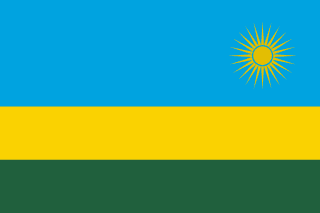
| Flag | Rwanda Flag |
|---|---|
| Country | Rwanda |
| Capital | Kigali |
| Continent | Africa |
| Official Languages | Kinyarwanda, English, French |
| Currency | Rwandan Franc (RWF) |
| Dialling Code | +250 |
Rwanda Flag Meaning
Flag Design
The Rwandan flag is rectangular with a 2:3 aspect ratio, composed of three horizontal bands: a blue band at the top covering half the flag’s width, and yellow and green bands below, each covering a quarter. In the upper right corner of the blue band is a golden sun with 24 rays. The current design has been in use since October 25, 2001.
The flag features a clean, simple layout with a dominant blue field and the sun positioned slightly off-center toward the upper right, giving it a calm and uplifting appearance. Official specifications define the precise colors of the bands and sun to distinguish it from the previous flag.
Meaning
Blue symbolizes peace and tranquility, reflecting the Rwandan people’s aspiration for harmony. Yellow stands for hope and a bright future, as well as economic progress. Green represents prosperity and the country’s natural resources, particularly its agriculture and land. The sun and its rays signify unity, enlightenment, and solidarity, embodying the light and renewal that followed the darkness of the 1994 genocide.
History and Legal Status
From 1961 to 2001, Rwanda used a flag with three vertical stripes in red, yellow, and green, featuring a black letter K (sometimes accompanied by the national emblem) in the center. Due to the association of the red color and design with violence in the country’s history, the government redesigned the flag after the genocide to represent reconciliation and a new national identity. The new flag, adopted in 2001, removed the red and introduced the blue, yellow, and green bands along with the sun motif as the new national symbols.
Today, the Rwandan flag is prominently displayed at government buildings, schools, public events, and sporting occasions, serving as a key emblem of national identity and unity. Respect for the flag is considered a civic duty, and visitors are encouraged to observe appropriate decorum when it is displayed.
Rwanda Overview
Country Details »About Rwanda
Rwanda (officially the Republic of Rwanda) is a landlocked country in east-central Africa, situated between the western branch of the East African Rift and the Great Lakes region. It borders Uganda to the north, Tanzania to the east, Burundi to the south, and the Democratic Republic of the Congo to the west across Lake Kivu. Covering an area of approximately 26,300 square kilometers, it is one of Africa’s smaller nations. Its capital, Kigali, is located on the central plateau and serves as the country’s political, economic, and transportation hub.
The country is divided into the City of Kigali and four provinces, with a population of around 14 million, making it one of the most densely populated countries in Africa. The official languages are Kinyarwanda, English, and French, while Swahili is also widely used in commerce. Rwanda is known for its mountainous terrain, consisting of rolling hills and highlands, which earned it the nickname "Land of a Thousand Hills."
Geography and Climate
Rwanda lies on the East African Plateau, with an average elevation of about 1,600 meters, sloping from west to east. The volcanic Virunga Mountains in the northwest form the highest region, with Mount Karisimbi (approximately 4,507 meters) being the country’s highest peak. This area is also home to the world’s last remaining habitat of mountain gorillas. The southwestern Nyungwe Forest preserves one of Africa’s oldest and largest montane rainforests, while the eastern Akagera National Park features savannahs and wetlands interspersed with lakes linked to those along the Tanzanian border.
The climate is classified as a highland tropical type, cooler than surrounding regions at similar latitudes due to the altitude, with temperatures typically ranging between 15–27°C. The year is divided into rainy and dry seasons: the long rainy season runs from March to May, the long dry season from June to September, the short rainy season from October to November, and the short dry season from December to February. The dry seasons feature clear skies and accessible roads, making them the best times for gorilla trekking and wildlife watching.
Historical Background
Early inhabitants of Rwanda included the Twa, Hutu, and Tutsi peoples. By the 16th century, a kingdom centered on the Tutsi monarchy had emerged. In the late 19th century, Rwanda became part of German East Africa, and after World War I, it was placed under Belgian mandate. Colonial policies, including the introduction of ethnic identity cards, exacerbated social divisions. Rwanda gained independence in 1962, but experienced prolonged political instability afterward.
In 1994, Rwanda suffered a devastating genocide targeting the Tutsi people, during which approximately 800,000 people were killed within about 100 days—one of the darkest chapters in modern history. After the genocide, the Rwandan Patriotic Front took power, and the country gradually embarked on a path of reconciliation and reconstruction. Efforts such as the establishment of community-based Gacaca courts helped foster social healing, alongside significant investments in economic development and public services, leading to visible improvements in urban and rural areas. The Kigali Genocide Memorial serves as a national site of remembrance and education, reflecting on this painful history.
Economy and Currency
Rwanda’s economy is driven primarily by agriculture, services, and tourism. Key exports include coffee, tea, horticultural products, and more recently, sectors such as information and communication technology, conferences and exhibitions, and financial services have seen rapid growth. The government aims to position Rwanda as a regional hub for information and finance. Known for efficient governance, a clean urban environment, and strong public safety, Rwanda is often referred to as "Africa’s Singapore." The official currency is the Rwandan Franc (RWF), issued by the National Bank of Rwanda.
Culture and Society
Rwandan society is united by the Kinyarwanda language and a strong emphasis on collectivism and reconciliation. Every last Saturday of the month, the country observes Umuganda, a national community workday held in the morning, where residents engage in activities such as cleaning, road repair, and tree planting. This practice is considered a symbol of governance and community cohesion. Since 2008, Rwanda has enforced a strict ban on plastic bags, restricting their import, sale, and use, contributing to the country’s notably clean appearance—tourists are advised not to bring single-use plastic bags into the country.
In traditional arts, Rwandan Intore dancers are known for their acrobatic jumps, warrior-style choreography, and distinctive grass headdresses, while drumming and choral singing play important roles in celebrations. The diet mainly consists of bananas, beans, cassava, maize, and potatoes, with staples like Ugali often served with stews.
Tourism Overview
Rwanda is a premier destination for high-end eco-tourism in East Africa, with its flagship attraction being gorilla trekking in Volcanoes National Park. The global population of mountain gorillas numbers only around 1,000, mostly found in the Virunga Mountains, and Rwanda issues a limited daily quota of permits, requiring bookings several months—or even longer—in advance. Other highlights include canopy walks and chimpanzee tracking in Nyungwe National Park, the “Big Five” wildlife experiences in Akagera National Park, and lakeside relaxation and coffee estate tours around Lake Kivu.
Rwanda enjoys overall good security and ranks high in Africa for hygiene standards. Kigali’s conference centers, art galleries, and craft markets reflect its modern side, while the Kigali Genocide Memorial offers an essential visit to understand the country’s past and renewal—visitors should maintain a respectful demeanor. Note that enforcement of anti-plastic and littering laws is strict, so compliance is expected.
Rwanda Travel Guide
All Guides »Rwanda Travel Quick Guide: Visas, Seasons, Budget & Etiquette
Gorilla permits, dry season timing, daily budget, and public etiquette—get these...
Rwanda Classic 7-Day Itinerary: Kigali — Volcanoes National Park — Nyungwe Forest — Lake Kivu — Akagera 7 days
From the capital to gorilla rainforests, alpine lakes, and eastern savannahs — e...
Rwanda 4-Day Short Trip: Kigali — Volcanoes National Park — Lake Kivu 4 days
Even with limited time, you can experience Rwanda’s highlights — gorillas, lakes...
Essential Attractions in Rwanda: From Kigali to the Rainforests of the Thousand Hills
A region-by-region guide to Rwanda’s top sights, including highlights and recomm...
Rwanda Food Guide: Ugali, Brochettes, and Lake Fish
From humble ugali and isombe to street-side brochettes and tiny fish from Lake K...
Rwanda Transportation Guide: Airport Transfers, Motorcycle Taxis, and Interregional Private Car Hire
How to get from the airport into town, how to get around the city, and how to co...