United Arab Emirates Flag
The proportions, colors, and history of United Arab Emirates's flag - a banner that tells United Arab Emirates's own story.
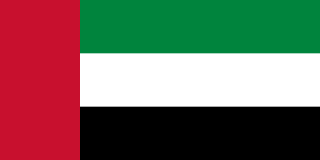
| Flag | United Arab Emirates Flag |
|---|---|
| Country | United Arab Emirates |
| Capital | Abu Dhabi |
| Continent | Asia |
| Official Languages | Arabic (English is widely spoken) |
| Currency | UAE Dirham (AED) |
| Dialling Code | +971 |
United Arab Emirates Flag Meaning
Flag Design
The flag of the UAE consists of a vertical red band on the hoist side and three horizontal bands of equal width in green, white, and black from top to bottom. The flag has a 1:2 aspect ratio, with the vertical red band occupying about one-quarter of the flag’s width and each horizontal band taking up one-third of the flag’s height.
Meaning
The four colors—red, green, white, and black—are pan-Arab colors symbolizing shared traditions of the Arab people. Green generally represents fertile land and hope, white stands for purity and peace, black symbolizes the historical Abbasid Caliphate and strength of will, and red signifies courage, power, and the spirit of sacrifice for the nation. Together, these colors reflect the unity of the Arab world and the Islamic faith.
History and Legal Status
The UAE flag was first raised on December 2, 1971, the day the federation was established, and was chosen by Sheikh Zayed bin Sultan Al Nahyan, then ruler of Abu Dhabi and founding president. Since then, the design has remained largely unchanged, with only minor refinements to specifications and usage guidelines.
In the UAE, the flag is protected by law and must not be disrespected, defaced, displayed upside down, or used for commercial advertising. There are strict protocols for flying the flag at half-mast. November 3 is observed as UAE Flag Day, when institutions and citizens nationwide display the flag. On National Day, at government buildings, schools, and sporting events, the red, white, black, and green flag is prominently displayed as a powerful symbol of national identity and unity.
United Arab Emirates Overview
Country Details »Overview of the UAE
The United Arab Emirates (UAE) is located in the southeastern part of the Arabian Peninsula, bordering the Persian Gulf to the north, Saudi Arabia to the west and south, and Oman to the east and northeast. Covering an area of about 83,600 square kilometers, the country is a federation of seven emirates: Abu Dhabi, Dubai, Sharjah, Ajman, Umm Al Quwain, Fujairah, and Ras Al Khaimah. Its capital is Abu Dhabi, and its largest city is Dubai.
The UAE is a federal constitutional monarchy. The Federal Supreme Council, composed of the rulers of the seven emirates, is the highest authority. The President and Vice President are hereditary positions held by the rulers of Abu Dhabi and Dubai, respectively. With a population of about 10.2 million, nearly 90% are expatriates from South Asia, the Arab world, Europe, and the Americas, forming a highly international society.
Geography and Climate
The UAE’s landscape is dominated by deserts and arid plains. The southwestern part extends into the Rub' al Khali (Empty Quarter), and the Hajar Mountains run along the eastern border, with Jebel Jais in Ras Al Khaimah being the highest peak. The country has a long coastline along the Persian Gulf, where major cities like Dubai and Abu Dhabi and numerous man-made islands are located. Most of the interior is desert, with oases and urban areas concentrated along the coasts and foothills.
The climate is tropical desert, characterized by year-round heat and dryness. From November to March is the cool season, with daytime temperatures around 20–30°C and cooler nights, making it the most comfortable time for outdoor activities and desert trips. From April to October is the hot season, with coastal humidity and temperatures often exceeding 40°C; indoor air-conditioned spaces and malls become primary activity areas. Rainfall is scarce throughout the year, but occasional heavy rains can cause urban flooding.
Historical Background
The region now known as the UAE has long been an important center for trade and pearling in the Persian Gulf. Cities like Dubai and Sharjah were historically renowned for pearl fishing and maritime commerce. Starting in the 19th century, the various emirates signed a series of agreements with the United Kingdom, becoming known as the “Trucial States,” with Britain handling their defense and foreign affairs.
In 1958, oil was discovered in Abu Dhabi, and in 1966, it was also found in Dubai. The immense oil revenues transformed the region dramatically. After the British withdrawal in 1971, the seven emirates formed the United Arab Emirates and declared independence. Founding President Sheikh Zayed bin Sultan Al Nahyan played a leading role in establishing the federation and initiating its modernization. Over the following decades, the UAE leveraged its oil wealth and open policies to rapidly develop into a global hub for finance, trade, aviation, and tourism in the Middle East.
Economy and Currency
The UAE is one of the most open economies in the Middle East. While oil and gas were the foundation of its early development, today sectors such as trade, finance, logistics, aviation, and tourism in Dubai have surpassed oil as key pillars of the economy. Dubai hosts the Jebel Ali Free Zone and the Dubai International Financial Centre, while Abu Dhabi holds the majority of the country’s oil and gas resources and sovereign wealth funds, creating a complementary economic structure between the two emirates.
The official currency is the UAE Dirham (AED, symbol د.إ), issued by the Central Bank of the UAE. The dirham has been pegged to the US dollar at a fixed rate of approximately 3.67 dirhams to 1 US dollar since 1997, ensuring a stable exchange rate that makes currency exchange and card payments convenient for travelers.
Culture and Society
The UAE is an Islamic country, predominantly Sunni, where Islamic law still influences social and family matters. During Ramadan, eating and drinking in public during daylight hours is discouraged, and Friday is the weekly holy day (Jumu'ah), affecting public institution schedules. Traditional attire includes the white robe (kandura) for men and the black abaya for women. When visiting malls and government buildings, modest and conservative clothing is recommended.
At the same time, the UAE is a highly international society where English is widely spoken. Dining, shopping, and entertainment options are extremely diverse, ranging from traditional Arabic markets and camel culture to world-class concert halls, museums, and theme parks. Coffee, dates, and Arabic grilled meats are staples of the local cuisine.
Tourism Overview
The UAE is one of the most popular tourist destinations in the Middle East. Iconic attractions include Dubai’s Burj Khalifa, Dubai Mall, Palm Jumeirah, and desert dune bashing; Abu Dhabi’s Sheikh Zayed Grand Mosque, Louvre Abu Dhabi, and Ferrari World; and Sharjah’s museums and cultural heritage. Visa-free entry, frequent flights, safety, and tax-free shopping make it a top choice for stopovers and short breaks.
Travelers should be aware of the hot climate and plan activities for indoor venues or early mornings and evenings. Public displays of affection should be avoided, alcohol is only served in licensed venues, and respecting local religious customs is essential for a pleasant trip.
United Arab Emirates Travel Guide
All Guides »UAE Travel Quick Guide: Visa-Free Entry, Best Seasons, Budget & Etiquette Taboos
How to use visa-free entry, when to visit to avoid the heat, daily spending esti...
Classic 6-Day UAE Itinerary: A Dual-City Journey Through Dubai and Abu Dhabi 6 days
Combine Dubai’s skyscrapers and desert dune bashing with Abu Dhabi’s culture and...
4-Day Short Trip to the UAE: A Complete Guide to Dubai’s Skyscrapers, Old Town, and Desert Experiences 4 Days
Even just sticking to Dubai can be incredibly rewarding: Explore modern landmark...
Essential Attractions in the UAE: A Complete Guide to Dubai and Abu Dhabi Landmarks
Explore the top attractions in the UAE by city, featuring landmarks such as the ...
UAE Food Guide: Top Arabian Kebabs, Shawarma, and Date Desserts
From street-side shawarma to premium Arabic kebabs at upscale restaurants, and f...
UAE Transportation Guide: Dubai Metro, Nol Card, and Intercity Buses Explained
How to ride the Dubai Metro, buy a Nol card, and travel from Dubai to Abu Dhabi ...