Algeria Flag
The proportions, colors, and history of Algeria's flag - a banner that tells Algeria's own story.
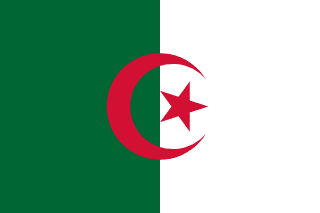
| Flag | Algeria Flag |
|---|---|
| Country | Algeria |
| Capital | Algiers |
| Continent | Africa |
| Official Languages | Arabic, Berber |
| Currency | Algerian Dinar (DZD) |
| Dialling Code | +213 |
Algeria Flag Meaning
Flag Design
The Algerian flag consists of two equal vertical bands of green and white, with green on the hoist side and white on the outer side. At the center, where the two colors meet, is a red crescent moon and a red five-pointed star, with the crescent’s open side facing upward and the star positioned inside it. The flag’s aspect ratio is 2:3. The combination of green, white, red, the crescent, and the star is simple, symmetrical, and striking, making it one of the most recognizable flags in North Africa and the Arab world.
Meaning
Green symbolizes Islam and also represents hope and the vitality of the land. White stands for purity and peace, and is also linked to the traditional white-and-green flag of resistance leader Abdelkader. Red signifies the blood of martyrs who died for independence and freedom, as well as the fervor of revolution and national liberation. The red crescent and star not only denote Islamic faith but also encapsulate symbols used by the National Liberation Front during the independence struggle, representing the unity of the nation in faith and revolutionary tradition.
History and Legal Status
This flag was widely used around the time of the National Liberation Front’s independence war against French colonial rule in 1954 and became a symbol of resistance. After Algeria’s formal independence in 1962, it was adopted as the national flag and has remained so ever since, recognized in the current constitution as one of the country’s official symbols. Algeria also established a complete national emblem system in 1962, incorporating the national anthem *Qassaman*, the red crescent, and the Hand of Fatima.
Today, the flag flies over government buildings, parliament, the military, airports, and embassies in Algiers and abroad. It is prominently displayed on key national holidays such as Independence Day (July 5) and Revolution Day (November 1). The flag embodies the multiple identities of the Berber, Arab, and Islamic peoples and is a central symbol of modern Algerian national identity.
Algeria Overview
Country Details »Overview of Algeria
Algeria (officially the People's Democratic Republic of Algeria) is located in North Africa, south of the Mediterranean Sea, and is the largest country on the continent, covering about 2.38 million square kilometers. It borders Tunisia and Libya to the east, Niger, Mali, and Mauritania to the south, Morocco and Western Sahara to the west, and the Mediterranean Sea to the north, with a coastline of about 1,200 kilometers. Around 80% of the country consists of the Sahara Desert, with most of the population and cities concentrated in the narrow coastal strip in the north. The capital, Algiers, is nestled between mountains and sea and is known as the White City (La Blanche) due to its many white buildings. It serves as the political, economic, and cultural center of the nation.
Algeria gained independence from French colonial rule in 1962 after an eight-year war, establishing a state economy heavily reliant on oil and natural gas. In the 1990s, political instability led to a decade-long civil conflict between the government and Islamist militants, known as the Black Decade. In 2019, mass peaceful protests (Hirak) against President Bouteflika’s bid for a fifth term led to a peaceful transition of power. Today, Algeria—with its abundant energy resources and rich historical heritage—is gradually revealing its lesser-known attractions to travelers.
Geography and Climate
Algeria’s terrain is distinctly layered from north to south: the northern coastal region features a Mediterranean climate with narrow plains and hills, home to major cities like Algiers, Oran, and Annaba. Further inland lie the Tell Atlas Mountains and fertile valleys. To the south are the Hauts Plateaux (high plateaus) and the Saharan Atlas Mountains, transitioning into the vast Sahara Desert. The desert is home to notable features such as the Hoggar volcanic mountain range, the Tassili Plateau, and expansive sand seas. The southern city of Tamanghasset serves as a gateway to the deep Sahara.
Climatically, the northern coast enjoys a Mediterranean climate with mild, rainy winters and hot, dry summers. The inland highlands have a semi-arid climate with cooler winters. The Sahara exhibits a typical tropical desert climate, with extremely hot summers, dramatic diurnal temperature shifts, and winter nights that can approach freezing. Dry winds and sandstorms are common in the desert, so travelers should monitor weather conditions and plan supplies accordingly. As a general rule, spring and autumn are ideal for the north, while winter is best for the desert.
Historical Background
The indigenous people of Algeria are the Berbers (known as Amazigh), with ancient kingdoms like Numidia having been predominantly Berber, ruled by figures such as Masinissa and Jugurtha who contended with Rome. During Roman rule, cities like Timgad and Djémila flourished as prosperous colonies, leaving behind remarkably well-preserved Roman ruins. Later, the region saw the influence of the Vandals and Byzantines. The 7th-century Arab conquest brought significant linguistic and religious changes. From the 16th century, Algiers became an Ottoman military and pirate stronghold in the Mediterranean, with the Kasbah Old Town taking shape during this period.
France invaded Algiers in 1830, gradually turning it into a colony and overseas department. Over a century of colonial rule profoundly altered Algeria’s economic and social structures. In 1954, the National Liberation Front (FLN) launched an armed uprising, culminating in Algeria’s independence in 1962 after eight years of war. Post-independence, the country adopted socialist policies and nationalized its oil and gas industry. The 1990s were marked by civil war, and the 2019 Hirak protests spurred further political change. This layered history has created a uniquely rich cultural and historical legacy.
Economy and Currency
Algeria is a key energy exporter in Africa, with oil and natural gas accounting for the majority of its foreign exchange earnings. Natural gas is a major export to Southern Europe. Beyond energy, agriculture focuses on citrus fruits, grapes, olives, grains along the Mediterranean coast, and dates in the Sahara oases. Key industries include steel, petrochemicals, and cement. The official currency is the Algerian Dinar (DZD), issued by the Bank of Algeria (Banque d’Algérie). Due to foreign exchange controls, the dinar has both an official and a parallel market exchange rate, with a significant gap between them. Travelers should exchange currency through official channels and declare foreign currency holdings truthfully.
Culture and Society
Algerian culture blends Berber traditions, Arab-Islamic influences, and a strong imprint of French colonialism. Arabic is the official language, and Berber was recognized as an official language in 2016. French is widely used in administration, business, and higher education. Berber regions like Kabylie maintain unique linguistic, musical, and artisanal traditions, with highlights including the Berber New Year, pottery, silver jewelry, and carpets.
Cuisine centers around couscous, typically served with steamed semolina, stews, and vegetables. Olive oil, harissa (spicy chili paste), lentils, and lamb stews are common, alongside French bread and coffee culture. Tea and strong coffee are standard hospitality offerings. Family and community ties are central to social life, and football is the most popular sport.
Tourism Overview
Algeria boasts seven UNESCO World Heritage Sites, offering rich cultural and historical experiences: the Casbah of Algiers is a preserved Ottoman-era medina and the setting of the film *The Battle of Algiers*; Timgad and Djémila feature extensive Roman ruins; Tipasa combines Roman sites with the Mediterranean coastline; the Tassili n’Ajjer rock art and the M’Zab Valley showcase desert civilizations. Other highlights include the gorges and hanging bridges of Constantine, the Rai music culture of Oran, and the dramatic landscapes of the Hoggar Mountains. However, note that visa requirements are strict, and safety risks exist in southern and border areas (especially near the Saharan borders). Travelers should avoid sensitive zones and follow local and official security advisories.
Algeria Travel Guide
All Guides »Algeria Travel Quick Guide: Visas, Seasons, Budget, and Etiquette Tips
Find out how to get a visa, the most comfortable travel seasons, daily costs, an...
Classic 7-Day Algeria Itinerary: Algiers – Constantine – Roman Ruins 7 days
From the White City of Algiers and the Kasbah old town, to the cliffside hanging...
4-Day Short Trip to Algeria: In-Depth Tour of Algiers and the Kasbah 4 days
With limited time, focus on Algiers: connect the Kasbah old town, museums, Tipas...
Essential Attractions in Algeria: From the Casbah to Sahara Rock Art
Explore Algeria’s UNESCO World Heritage Sites, Roman ruins, and Sahara landscape...
Algerian Food Guide: Couscous, Olive Oil, and Harissa
Algerian cuisine blends Berber, Arab, and French influences, built around cousco...
Algeria Transportation Guide: Getting from the Airport to the City, Metro, Trains, and Private Transfers
Algiers has a metro and commuter trains, while intercity travel mainly relies on...