Kazakhstan Flag
The proportions, colors, and history of Kazakhstan's flag - a banner that tells Kazakhstan's own story.
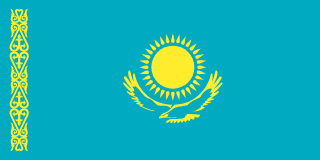
| Flag | Kazakhstan Flag |
|---|---|
| Country | Kazakhstan |
| Capital | Astana |
| Continent | Asia |
| Official Languages | Kazakh, Russian |
| Currency | Kazakhstani tenge (KZT) |
| Dialling Code | +7 |
Kazakhstan Flag Meaning
Flag Design
The flag of Kazakhstan is a rectangular banner in light blue (sky blue), with a 1:2 aspect ratio. At the centre is a golden sun with 32 rays radiating outward; beneath the sun is a soaring golden steppe eagle. Along the hoist side, there is a vertical gold stripe adorned with traditional Kazakh ornamental patterns known as “koshkar-muiz,” meaning ram’s horns.
Meaning
Light blue is a colour traditionally revered by the Kazakh people, symbolizing the sky, peace, tranquillity, and infinity, as well as hopes for peace and prosperity. The golden sun represents life, light, wealth, and warmth, with the 32 rays reflecting the nomadic understanding of nature and time. The eagle beneath the sun symbolizes freedom, strength, vision, and the pride of the steppe peoples, and is also a sacred symbol in Kazakh falconry tradition. The decorative stripe near the hoist represents Kazakh ornamental art and enduring national heritage, blending modern national symbols with ancient cultural motifs.
History and Legal Status
After independence, Kazakhstan set out to design a new flag. The current design was created by designer Shaken Niyazbekov and officially adopted by the Supreme Soviet on June 4, 1992. Kazakhstan subsequently designated June 4 as Flag Day. The design, colour proportions, and details of the sun and eagle are regulated by specific legal documents, with standardised illustrations for these elements.
Today, the light blue sky, golden sun, and soaring steppe eagle have become Kazakhstan’s most recognisable national symbols, appearing on government buildings, schools, sports events, overseas embassies and consulates, as well as on tenge banknotes and passports. They are a key representation of national identity and pride.
Kazakhstan Overview
Country Details »Kazakhstan Overview
Kazakhstan (Kazakh: Қазақстан) is located in Central Asia, at the heart of the Eurasian continent. With a land area of about 2.7249 million square kilometres, it is the world’s largest landlocked country and ranks ninth in total area. It borders Russia to the north, Uzbekistan, Turkmenistan, and Kyrgyzstan to the south, China to the east, and the Caspian Sea to the west. The Ural River runs from north to south through the western part, placing Kazakhstan both in Asia and Europe geographically. Its capital is Astana, and its largest city is Almaty, located in the southeast.
Kazakhstan is a presidential republic, divided into several provinces and municipalities. It has a population of approximately 20 million, comprising over 130 ethnic groups, with Kazakhs making up about 70% and Russians around 15%. As a key stop on the ancient Silk Road and the birthplace of the modern Belt and Road Initiative, Kazakhstan holds significant geopolitical and economic influence in Central Asia.
Geography and Climate
Kazakhstan’s terrain is diverse: the Tien Shan and Altai mountain ranges rise in the southeast, with snow-capped peaks and glaciers. Khan Tengri Peak on the China-Kazakhstan border stands at about 6,995 metres, one of the country’s highest. The central region features vast Kazakh hills and grasslands; the west consists of the Caspian coastal lowlands and the Turan Plain. The country has many lakes, including the Caspian Sea, the Aral Sea, and Lake Balkhash, forming a unique inland water system. The Aral Sea has shrunk dramatically due to water diversion, becoming a globally recognized environmental issue.
The climate is typically continental, with long, harsh winters and short, dry, hot summers. Day and night, as well as seasonal, temperature variations are significant. Southern Almaty has relatively distinct seasons with pleasant springs and autumns. In the north and the capital Astana, winter temperatures often drop to minus 20 to minus 30 degrees Celsius, making it one of the coldest capitals in the world. Precipitation is concentrated in the north and mountainous areas, while the south and west are quite dry—stay hydrated and protect yourself from the sun when travelling.
Historical Background
The Kazakh steppes have long been home to nomadic peoples, including the Saka, Wusun, and Xiongnu. Later, the Turkic Khaganate, the Kara-Khanid Khanate, and the Golden Horde ruled the region. In the mid-15th century, the Kazakh Khanate was formally established, and the ethnonym “Kazakh” gradually became fixed. From the 18th to 19th centuries, Tsarist Russia expanded southward and annexed the Kazakh steppes, incorporating the area into the Russian Empire.
In 1920, a Soviet autonomous republic was established here, which became a Soviet Socialist Republic in 1936. On December 16, 1991, Kazakhstan declared independence, becoming a sovereign nation after the dissolution of the USSR. In 1997, the capital was moved from southern Almaty to northern Akmola, which was then renamed Astana. Between 2019 and 2022, it was briefly renamed Nur-Sultan before reverting to Astana in 2022.
Economy and Currency
Kazakhstan has the largest economy in Central Asia, rich in oil, natural gas, and mineral resources. It has substantial proven oil reserves, has long ranked first in the world in uranium production, and also exports significant amounts of chromium, copper, coal, and iron. In recent years, the government has worked to diversify the economy, developing agricultural processing, logistics, information technology, and tourism. It also strengthens its role as a regional hub through transit transport and energy pipelines.
The national currency is the Kazakhstani tenge (KZT), issued by the National Bank of Kazakhstan. Since its introduction in 1993, it has undergone several redesigns and exchange rate adjustments. Almaty and Astana have relatively developed financial and service sectors, with widespread use of mobile payments and bank cards, though cash is still dominant in rural areas and markets.
Culture and Society
Kazakh culture is deeply rooted in nomadic traditions: the sounds of the dombra (a two-stringed instrument), akyn (improvised folk singing), falconry, and kokpar (horseback polo) are important aspects of national identity. Sunni Islam is the main religion, while many ethnic Russians are Eastern Orthodox, with the two traditions coexisting. Nauryz, celebrated in March, is a major spring festival where families prepare traditional foods, visit relatives, and celebrate warmly.
The cuisine focuses on meat and dairy. Dishes like beshbarmak (hand-pulled meat with noodles), horse sausage, kumys (fermented mare’s milk), and shubat (camel milk) are staples for entertaining guests. Kazakh is the state language, while Russian is widely used in government and daily life. English proficiency is generally low in cities, so having a translation app handy is useful.
Tourism Overview
Kazakhstan’s tourism appeal lies in its contrasts: from the green, mountain-framed city of Almaty to breathtaking natural wonders like Charyn Canyon, Kaindy Lake, and Kolsay Lake, and the futuristic architecture of Astana. Almaty is conveniently located for day trips to Medeu Ski Resort, Big Almaty Lake, and the Zenkov Cathedral, making it an ideal first stop.
Other highlights include the Khoja Ahmed Yasawi Mausoleum in Turkistan, a significant Islamic architectural heritage site; the Baikonur Cosmodrome, a landmark of space exploration history; and the desert landscapes and underground mosques of Mangystau, ideal for adventurous explorers. Overall, Kazakhstan’s vast size and distances between attractions mean it’s best to plan your trip around Almaty and Astana as hubs, using private cars or domestic flights to connect destinations.
Kazakhstan Travel Guide
All Guides »Kazakhstan Travel Snapshot: Visa-Free Entry, Best Seasons, Budget & Etiquette
Get all the essentials before you go: visa-free policy, ideal travel seasons, da...
Classic 7-Day Kazakhstan Itinerary: Almaty — Charyn Canyon — Astana 7 days
Explore snow-capped mountains and canyons in the south, and a futuristic capital...
Kazakhstan 4-Day Short Trip: In-Depth Tour of Almaty 4 days
Using Almaty as your base, explore the city, snow-capped mountains, canyons, and...
Essential Attractions in Kazakhstan: From Snowy Mountains and Lakes to a Futuristic Capital
A categorized guide to Kazakhstan’s top attractions by city and nature, includin...
Kazakhstan Food Guide: Kazakh Bozbash, Kumys, and Steppe Flavors
Nomadic diets center around meat and dairy—from beshbarmak to baursak, get to kn...
Kazakhstan Transportation Guide: Airports, Metro, Taxis, and Inter-city Flights
Key travel information for Almaty and Astana, including airport transfers, ride-...