Venezuela Flag
The proportions, colors, and history of Venezuela's flag - a banner that tells Venezuela's own story.
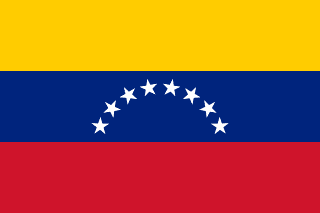
| Flag | Venezuela Flag |
|---|---|
| Country | Venezuela |
| Capital | Caracas |
| Continent | South America |
| Official Languages | Spanish |
| Currency | Venezuelan Bolívar (VES) |
| Dialling Code | +58 |
Venezuela Flag Meaning
Flag Design
The Venezuelan flag consists of three equal horizontal stripes of yellow, blue, and red, in a 3:2 ratio. Unlike the similar flags of Colombia and Ecuador, the blue stripe on the Venezuelan flag features a semicircular arc of white five-pointed stars along the hoist side—currently eight stars. Government flags include the national coat of arms in the upper left corner, while civilian flags display only the star arc. The equal-width yellow, blue, and red stripes differ markedly in layout from the Colombian flag, which divides the field into quarters of yellow, blue, and red.
Meaning
The tricolor flag was designed by independence pioneer Francisco de Miranda in 1806. The traditional interpretation is that yellow represents Venezuela’s fertile land and wealth in gold, blue symbolizes the Caribbean Sea and Atlantic Ocean separating the Americas from the Old World, and red stands for the blood of those who died for independence. The eight stars correspond to the seven provinces that declared independence in 1811, plus the province of Guayana, which was reclaimed in 1817. The arc of stars is also romantically interpreted as representing a southern sky constellation.
History and Legal Status
Miranda first raised the tricolor flag at the mouth of the Orinoco River in 1806, and it became the model for the national flag after independence in 1811. It underwent several adjustments during the period of Gran Colombia and in subsequent republics, with the number of stars varying between seven and eight. In March 2006, the National Assembly passed a law restoring the flag to eight stars and adding elements such as a horse and bow-and-arrow to the coat of arms, creating the current design, which was officially adopted on August 3, 2006. The use of the flag is regulated by the Law on the Flag, Coat of Arms, and National Anthem. On Independence Day (July 5), the flag must be displayed nationwide, and the Bolívar banner is often flown alongside it as part of the national symbolic ensemble.
Venezuela Overview
Country Details »Overview of Venezuela
Venezuela (officially the Bolivarian Republic of Venezuela) is located in the northern part of South America, bordering the Caribbean Sea and Atlantic Ocean to the north, Colombia to the west, Brazil to the south, and Guyana to the east. It covers an area of approximately 916,000 square kilometers and has a population of around 28.3 million. Its capital, Caracas, is situated in the valley of the Caribbean coastal mountains on the northern side of the Caribbean coast and serves as the country’s political, economic, and cultural hub. The second-largest city, Maracaibo, is known as the “City of Lakes” and for the “Catatumbo lightning,” a phenomenon of near-constant thunderstorms.
Geography and Climate
Venezuela features extremely diverse terrain: the northwestern region includes the northern Andes and the lowlands around Lake Maracaibo, where the Sierra Nevada de Mérida mountain range is home to the country’s highest peak, Pico Bolívar (approximately 4,978 meters). The central region is traversed by the vast grassy plains of the Orinoco River basin. In the southeastern Guiana Highlands, dozens of flat-topped table mountains called tepuis are scattered, including within Canaima National Park, where Angel Falls—a 979-meter-high waterfall that plunges from a tepui—is the world’s highest uninterrupted waterfall and served as inspiration for the “Paradise Falls” in the animated film Up. The northern coast and nearby waters feature coral islands such as Los Roques. Most of the country has a tropical climate, with year-round heat in the lowlands and distinct dry (November–April) and rainy (May–October) seasons. Higher-altitude cities like Caracas and Mérida enjoy a milder climate.
Historical Background
In the pre-Columbian era, Venezuela’s coastal and highland regions were inhabited by Caribbean and Arawak peoples. In 1498, Christopher Columbus reached the area during his third voyage, and from the 16th century it became a Spanish colony, nicknamed “Little Venice” due to the stilt houses around Lake Maracaibo. In 1806, Francisco de Miranda first raised the tricolor flag in an attempt to liberate the territory, and on July 5, 1811, Venezuela declared independence, becoming one of the first regions in Spanish America to do so. Subsequently, under the leadership of “El Libertador” Simón Bolívar, the country fought hard to break free from colonial rule and at one point formed part of the short-lived Gran Colombia along with Colombia and Ecuador. In the 20th century, Venezuela rapidly grew wealthy due to its oil wealth and was a founding member of OPEC. During the 1970s, it had the highest per capita income in Latin America. However, since 2014, falling oil prices and poor economic policies led to a severe economic crisis and hyperinflation, prompting millions to emigrate abroad, with profound social and humanitarian impacts.
Economy and Currency
Venezuela holds the world’s largest proven oil reserves, along with abundant natural gas, iron ore, gold, and bauxite resources. Its economy has long been heavily dependent on oil exports. After 2014, the economy contracted drastically, with a persistent and significant gap between the official and black-market exchange rates, and hyperinflation at one point. The government has issued three new currencies and repeatedly adjusted the exchange rate system. The Strong Bolívar introduced in 2016 and the revised “Digital Bolívar” launched in 2021 are both currently legal tender, but in practice, U.S. dollar cash and digital dollar payments are widely circulated in major cities, creating a de facto dual-currency system.
Culture and Society
Venezuela’s population is predominantly mestizo, a mix of European immigrants, Indigenous peoples, and Afro-descendants, resulting in a culture that blends Spanish, Caribbean, and Indigenous traditions. Arepas (cornmeal cakes) are a staple breakfast food, while the national dish Pabellón Criollo—a combination of black beans, shredded beef, and plantains—reflects the country’s tripartite heritage. Baseball is more popular than football, and Venezuelan players have achieved notable success in Major League Baseball in the United States. Traditional music styles such as joropo, salsa, and Caribbean carnival are also deeply rooted. Beauty pageants are highly popular, with Caracas having produced numerous Miss Universe winners. In literature, writer Arturo Uslar Pietri depicted the tropical plains with magical realism and is considered a precursor to the Latin American magical realism movement.
Tourism Overview
Venezuela boasts some of the world’s top-tier natural tourism resources: small sightseeing planes from Ciudad Bolívar or Canaima can take visitors directly to Angel Falls, which is at its most powerful during the rainy season (June–November). The tepuis and waterfall-laced lagoons in Canaima National Park are ideal for hiking and photography, and the hike up Mount Roraima is a dream destination for seasoned adventurers. Los Roques Archipelago is one of the best-preserved coral reef national parks in the Caribbean, offering excellent snorkeling and sailing experiences. Mérida’s cable car was once among the world’s highest aerial tramways, connecting snow-capped mountains with Andean towns. However, it must be noted that the country’s security situation is complex. Most foreign visitors are advised to avoid travel. Major cities experience frequent crime, and infrastructure and aviation services are unstable, which significantly affects access to these attractions. Travelers who must go should closely monitor the latest advisories, purchase insurance with emergency evacuation coverage, and arrange itineraries through trusted local operators.
Venezuela Travel Guide
All Guides »Venezuela Travel Snapshot: Safety Alerts, Visa, Seasons & Budget (Read Before Deciding)
The Venezuelan government and various international bodies have issued safety ad...
7-Day Venezuela Itinerary: Caracas – Los Roques – Canaima and Angel Falls (Prioritizing Feasibility) 7 days
A classic route centered on natural wonders: experience Caribbean island-hopping...
Venezuela 4-Day Short Trip: Caracas, Avila Mountain, and Margarita Island 4 days
A Safe Bet When Time Is Limited: One to Two Days of Capital Culture Plus Island ...
Top Attractions in Venezuela: Angel Falls, Table Mountains, and the Caribbean Coral Sea
The world’s tallest waterfall, alien-like tabletop mountains, and top-tier Carib...
Venezuela Food Guide: Arepas, Black Bean Stew, and Rum
Experience Venezuela’s flavors during times of scarcity: national breakfast arep...
Complete Guide to Transportation in Venezuela: Airports, Domestic Small Planes, and Dollar Taxis
Few international flights, domestic travel relying on small planes and negotiate...