Estonia Flag
The proportions, colors, and history of Estonia's flag - a banner that tells Estonia's own story.
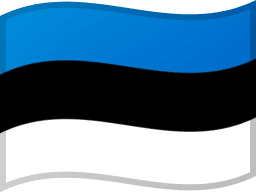
| Flag | Estonia Flag |
|---|---|
| Country | Estonia |
| Capital | Tallinn |
| Continent | Europe |
| Official Languages | Estonian |
| Currency | Euro (EUR) |
| Dialling Code | +372 |
Estonia Flag Meaning
Flag Design
The flag of Estonia consists of three equal horizontal bands of blue, black, and white. The official proportions are 7:11. The design is simple and striking: blue on top, black in the middle, and white at the bottom. It is one of the earliest tricolour national flags and is highly recognizable in the Baltic region.
Meaning
The traditional interpretation of the colours is: blue represents the sky, lakes, and the Baltic Sea, as well as loyalty to the nation; black symbolizes the fertile black soil and the hardships of foreign rule and exile in Estonian history, as well as the colour of traditional farmers’ clothing; white stands for snowfields, the white nights of summer, and the people’s pursuit of light and freedom. Together, the colours are often described by Estonians as “blue sky above, black earth below, and a pure white heart within,” summarizing loyalty, destiny, and hope.
History and Legal Status
The blue, black, and white colours were first adopted as a national flag by Estonian student groups and the “Estonian Students’ Society” in the 1880s, quickly spreading during the period of national awakening under Russian imperial rule. After Estonia declared independence in 1918, the tricolour became the national flag. It was banned along with the national coat of arms and anthem after the Soviet annexation in 1940 and could only be preserved secretly by the public, while the Estonian diaspora continued to use it. During the “Singing Revolution” of the late 1980s, the flag re-emerged publicly and was officially reinstated in 1990. The current Flag Act of Estonia came into effect in 2005, specifying strict regulations on proportions, display dates (such as Independence Day on February 24 and Victory Day on June 23), and flag-raising etiquette. The blue, black, and white colours are now the most prominent symbols of Estonian national identity.
Estonia Overview
Country Details »Estonia at a Glance
Estonia (officially the Republic of Estonia) is located on the eastern coast of the Baltic Sea in northeastern Europe. It faces Finland across the Gulf of Finland to the north, borders the Baltic Sea to the west, Latvia to the south, and Russia to the east. With a land area of about 45,300 square kilometres, it is the smallest and northernmost of the three Baltic states. The capital, Tallinn, is just 80 kilometres across the Gulf of Finland from Helsinki and can be reached by ferry in two hours. It serves as the country’s political, economic, and tourism hub. Estonia has a population of around 1.37 million, making it one of the least populous countries in the EU. It adopted the euro in 2011, becoming the first of the Baltic states to use the currency.
Geography and Climate
Estonia has a flat terrain, with an average elevation of only about 50 metres. Its highest point, Suur Munamägi, reaches just 318 metres. The coastline stretches over 3,700 kilometres, dotted with more than 2,000 islands, the largest of which are Saaremaa and Hiiumaa. About half of the country is covered by forests, interspersed with marshes and lakes, as seen in Lahemaa National Park, which combines coastal, forest, and manor landscapes. The climate is a humid temperate transitional type: summers are cool, with July averages around 17°C and extremely long daylight hours, while the north enjoys the “midnight sun” in June. Winters are moderated by the Baltic Sea, with January averages around -4 to -6°C in Tallinn and frequent sea ice.
Historical Background
Estonians belong to the Finno-Ugric language group and have lived in the region for thousands of years. In the 13th century, the area was ruled successively by Denmark and the Livonian Brothers of the Sword. Tallinn’s Old Town took shape during the Hanseatic League’s trading boom. Later, the region came under the control of Poland, Sweden, and the Russian Empire. Estonia declared independence in 1918 and gained international recognition after the War of Independence. It was annexed by the Soviet Union in 1940, occupied by Germany from 1941 to 1944, and re-incorporated into the USSR afterward, with large-scale deportations of residents. In 1989, two million people from the three Baltic states joined hands to form the “Baltic Way” human chain. Estonia regained independence in 1991 and joined the EU and NATO in 2004, embarking on a path of highly digitalized development.
Economy and Currency
Estonia is known globally as a “digital nation”: it was the first to implement nationwide online voting in 2005 and declared internet access a basic human right in 2007. The core technology of Skype was developed in Tallinn. E-governance covers almost all services including tax filing, healthcare, and education. The “e-Residency” program launched in 2014 allows anyone worldwide to apply online for a digital Estonian identity and register a company remotely, attracting entrepreneurs from around the globe. Estonia officially adopted the euro on January 1, 2011, becoming the first former Soviet republic to join the eurozone. Its economy is driven by IT services, timber processing, machinery, and shipping logistics.
Culture and Society
The Estonian language, part of the Finno-Ugric family, is distinct from the Indo-European languages spoken in neighbouring countries, and national identity is deeply rooted in language and folk songs. The Estonian Song Festival (Laulupidu), held every five years, features tens of thousands singing together and is listed as a UNESCO Intangible Cultural Heritage. The “Singing Revolution” played a direct role in the independence movement. Sauna culture and rye bread are two key elements of daily life: the country has more saunas than churches, and dense, dark rye bread is considered the “national taste.” Society is generally quiet, rule-oriented, and highly digital, yet retains a slow, Nordic-paced rhythm in daily life.
Tourism Overview
Tallinn’s medieval Old Town was inscribed as a UNESCO World Heritage Site in 1997. The Town Hall Square, Toompea Castle, and winding cobblestone streets make up one of Europe’s best-preserved medieval cityscapes. The Seaplane Harbour Maritime Museum and the KGB Museum at Hotel Viru showcase maritime heritage and Cold War history. Outside the city, Lahemaa National Park is ideal for forest hikes and manor stays. The university town of Tartu is rich in academic atmosphere, while Saaremaa Island is known for its windmills, massive meteorite craters, and tranquil coastline. Estonia boasts well-developed tourism infrastructure and high English proficiency. Together with Helsinki and Stockholm, it forms a classic Baltic route and is a key stop on North Europe–Baltic itineraries.
Estonia Travel Guide
All Guides »Estonia Travel Snapshot: Schengen Visa, Seasons, Euro Budget & Nordic Etiquette
Tallinn is just the beginning—before you go, understand visas, daylight hours, a...
Classic 6-Day Estonia Itinerary: Tallinn — Lahemaa National Park — Tartu — Saaremaa Island 6 days
From medieval old towns to swamp boardwalks and island windmills, this route sho...
Estonia 4-Day Short Trip: In-Depth Exploration of Tallinn Old Town and Nearby Attractions 4 days
A relaxed 4-day slow travel itinerary based in Tallinn: explore the old town, vi...
Must-visit attractions in Estonia: medieval old towns, bogs, and islands
From the red spire of Tallinn’s Old Town Hall to the Lahemaa bog boardwalks and ...
Estonian Food Guide: Rye Bread, Pickled Herring, and Nordic Modern Cuisine
Estonian cuisine is built on rye and Baltic Sea flavors, with both traditional f...
Complete Guide to Transportation in Estonia: Airports, Ferries, Buses & City Tickets
Just 15 minutes from Tallinn Airport to the Old Town, ferries connect to Scandin...