Croatia Flag
The proportions, colors, and history of Croatia's flag - a banner that tells Croatia's own story.
| Flag | Croatia Flag |
|---|---|
| Country | Croatia |
| Capital | Zagreb |
| Continent | Europe |
| Official Languages | Croatian |
| Currency | Euro (EUR) |
| Dialling Code | +385 |
Croatia Flag Meaning
Flag Design
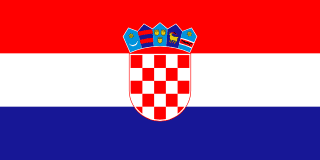
The Croatian flag consists of three equal horizontal bands of red, white, and blue, in that order from top to bottom, with a width-to-length ratio of 1:2. Positioned slightly left of center is the Croatian coat of arms: a shield with a red-and-white checkerboard pattern (šahovnica), topped with a crown bearing five smaller shields representing Croatia’s five historical regions.
Meaning
The red, white, and blue colors are pan-Slavic, reflecting Croatia’s Slavic heritage. The red-and-white checkerboard is Croatia’s oldest national symbol, dating back to the 11th–12th century royal insignia. It remains a powerful emblem on national sports kits, urban décor, and cultural identity, with the Croatian national football team nicknamed “The Vatreni” (The Blazers) due to their checkerboard jerseys. The five smaller shields above the main shield represent the five historical territories that form modern Croatia, symbolizing unity and heritage.
History and Legal Status
The red-white-blue tricolor has been a Croatian national symbol since the 1848 Spring of Nations movement. It was retained through the Kingdom of Yugoslavia and Yugoslav era. In December 1990, shortly before independence, Croatia added and standardized the crown of five shields above the shield. After declaring independence in 1991, the design has remained in use and is protected under the “Law on the Coat of Arms, the Flag, and the National Anthem.” The flag is flown at government buildings, border crossings, schools, and embassies. During major football events like the World Cup, the red-and-white checkerboard flag is one of the most visible in Europe. The flag flying over Dubrovnik’s walls alongside historical flags of the Republic of Ragusa is a classic sight for visitors.
Croatia Overview
Country Details »Croatia Overview
Croatia (officially the Republic of Croatia) is located in southeastern Europe on the eastern coast of the Adriatic Sea. It borders Slovenia to the northwest, Hungary and Serbia to the northeast, Bosnia and Herzegovina and Montenegro to the south, and faces Italy across the sea. The country consists of inland regions, a coastline stretching 1,777 kilometers, and over a thousand islands, covering an area of approximately 56,594 square kilometers with a population of around 3.85 million. The capital, Zagreb, situated in the northern inland part, is the political, economic, and cultural center. However, the Dalmatian coastal cities—such as Dubrovnik, Split, and Zadar—are where the majority of international visitors gather.
Croatia declared independence from Yugoslavia in 1991, joined the European Union in 2013, and became part of both the eurozone and the Schengen Area on January 1, 2023. It has achieved full integration in terms of currency, borders, and EU core systems, making it one of the Balkan countries with the most significant improvements in travel accessibility in recent years.
Geography and Climate
Croatia is crescent-shaped, with inland areas dominated by the Sava River Plain and the Dinaric Alps. Its highest peak is Dinara Mountain (1,913 meters), located behind the Dalmatian region. The coastal zone features numerous islands, with about 50 permanently inhabited ones, including Krk, Cres, Brač, and Hvar as the largest. The Adriatic Sea boasts crystal-clear waters, and the country consistently ranks among the top in Europe for the number of Blue Flag beaches. Karst landscapes are prominent, with the iconic cascading lakes and waterfalls of Plitvice Lakes National Park (commonly known as the Plitvice Lakes) formed through karst hydrological processes.
The climate falls into two main types: inland areas experience a temperate continental climate with cold winters and hot summers, while the coastal and island regions have a Mediterranean climate—hot, dry summers and mild, rainy winters—offering up to five months of swimming weather. Generally, May–June and September–October offer pleasant weather and fewer crowds, whereas July–August is the peak beach season with the highest prices for accommodations and services.
Historical Background
Croats settled along the eastern Adriatic coast in the 7th century. In 925, Tomislav established the first unified Croatian Kingdom. From 1102, Croatia entered a personal union with Hungary and, for centuries afterward, was influenced alternately by the Habsburg Monarchy and the Republic of Venice. While the inland regions were part of the Viennese system, coastal cities were strongly shaped by Venetian culture. Dubrovnik, in particular, maintained centuries of independence as the Republic of Ragusa, developing advanced maritime, diplomatic, and trade traditions. In 1918, it joined the Kingdom of Serbs, Croats, and Slovenes, and after World War II, became a constituent republic of Yugoslavia.
Croatia declared independence in June 1991, followed by several years of conflict, and began rebuilding and development after 1995. The word “cravat” (necktie) originates from the linen neckwear worn by Croatian mercenaries, which became popular in the French court and eventually spread worldwide, seen as Croatia’s gift to men’s fashion. In 2013, Croatia joined the EU, and on January 1, 2023, it replaced the kuna (HRK) with the euro and joined the Schengen Area simultaneously.
Economy and Currency
Croatia is a moderately developed economy, with tourism as its pillar industry, accounting for about 20% of GDP. In summer, the number of tourists can reach several times the country’s population. Other key sectors include shipbuilding, petrochemicals, food processing, and agriculture (such as olive oil, lavender, and wine). The official currency is the euro (EUR). On January 1, 2023, Croatia officially adopted the euro at a fixed exchange rate of 1 euro = 7.53450 kuna, replacing the former currency and becoming the 20th member of the eurozone. The reverse side of Croatian euro coins features national elements such as the marten (the namesake of the former currency), the Glagolitic script, the checkerboard national coat of arms, and a portrait of inventor Nikola Tesla. Credit cards are widely accepted in tourist areas, but cash is still needed at small island guesthouses, markets, and family-run restaurants.
Culture and Society
The official language is Croatian, which is mutually intelligible with Serbian and Bosnian. Most tourism professionals speak English, and German and Italian are also common along the coast. The predominant religion is Catholicism, with major holidays including Assumption Day and Christmas. The red-and-white checkerboard pattern (šahovnica) is widely seen on sports fields, streets, and souvenirs, symbolizing national identity. Football is the most popular sport, and stadiums like Stadion Maksimir and the club GNK Dinamo Zagreb hold a special place in the nation’s sporting memory. Croatia’s runner-up finish in the 2018 FIFA World Cup brought global fame to the national team, nicknamed the “Vatreni” (The Blazers). The cuisine combines Central European and Mediterranean influences: inland areas feature grilled meat (pečenje), stews, and dough-based dishes, while the coast is known for olive oil, seafood, black risotto (crni rižot), and Plavac Mali wine. Istria, in particular, is one of Europe’s prime truffle-producing regions.
Tourism Overview
Croatia is one of the Mediterranean’s most well-established tourist destinations. Dubrovnik’s medieval walls—made globally famous as the filming location for King’s Landing in Game of Thrones—are among the finest experiences of any European old town, alongside its marble streets and rampart walks. Split’s Diocletian’s Palace uniquely blends a Roman imperial structure with a living city. Plitvice Lakes National Park, with its emerald lakes and cascading waterfalls, tops the list of Croatia’s national parks. Zadar offers unique public art installations like the Sea Organ and Greetings to the Sun. Zagreb showcases Central European charm through its Upper Town, Cathedral of the Assumption, and renowned Advent Christmas markets. With options for island-hopping, beach holidays, and gourmet wine routes, Croatia suits trips ranging from three-day urban tours to ten-day road trips.
Croatia Travel Guide
All Guides »Croatia Travel Quick Guide: Schengen Rules, Best Seasons, Budget, and Etiquette
Since 2023, Croatia has been a member of both the eurozone and the Schengen Area...
Classic 7-Day Croatia Itinerary: Zagreb — Plitvice Lakes — Zadar — Split — Dubrovnik 7 days
Travel south from the inland capital along the Dalmatian Coast: lakes, sea organ...
Croatia 4-Day Short Trip: Essence of the Dalmatian Coast (Split + Dubrovnik) 4 days
Only a few days off? Fly straight to the coast: Explore Split’s ancient city and...
Must-visit attractions in Croatia: city walls, palaces, and the Plitvice Lakes
From King’s Landing to Europe’s Jiuzhaigou, here’s a city-by-city guide to Croat...
Croatia Food Guide: Black Risotto, Peka Oven Dishes, and Coastal Wineries
Two culinary traditions in one: inland Central European flavors meet coastal Med...
Croatia Transport Guide: Getting from Airports to Cities, Intercity Buses, Ferries, and Driving
A coastal country connected by buses and ferries: how to get from the two main a...