Kuwait Flag
The proportions, colors, and history of Kuwait's flag - a banner that tells Kuwait's own story.
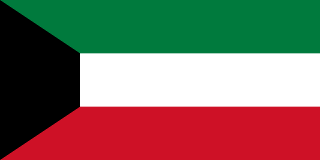
| Flag | Kuwait Flag |
|---|---|
| Country | Kuwait |
| Capital | Kuwait City |
| Continent | Asia |
| Official Languages | Arabic |
| Currency | Kuwaiti Dinar (KWD) |
| Dialling Code | +965 |
Kuwait Flag Meaning
Flag Design
The flag of Kuwait consists of three horizontal stripes of equal width: green on top, white in the middle, and red at the bottom, with a black trapezoid extending from the hoist side across the three stripes. The flag has a 1:2 aspect ratio, with the black trapezoid’s longer base along the hoist and its narrow edge facing inward, creating a distinctive visual balance. Each color band occupies one-third of the flag’s height, and the black trapezoid spans the full height, with its inner slanting edge roughly one-third the flag’s width—features that distinguish it from other Pan-Arab tricolor flags. The colors red, green, white, and black are known as the Pan-Arab colors.
Meaning
Green symbolizes fertile land and the Islamic faith, as well as vitality and hope; white stands for purity and peace, reflecting the nation’s integrity; red represents courage and the spirit of sacrifice for the country, as well as historical swords and battles; black signifies past hardships and defeated enemies, symbolizing rising from darkness. The combination of these four colors originates from Pan-Arab ideology, expressing unity among Arab nations. A famous verse by medieval Arab poet Safi al-Din al-Hilli describes the colors of Arab flags as representing the battlefield (green), achievements (white), swords (red), and war (black)—a cultural source widely regarded as the inspiration for the Pan-Arab color scheme, and a historical reference for Kuwait’s flag design.
History and Legal Status
Before adopting the current design, Kuwait used a red flag, which was later modified in 1899 with white text to differentiate it from neighboring flags, and further variations such as a white stripe were introduced around 1914. After gaining independence in June 1961, Kuwait officially adopted the current green, white, red, and black tricolor with the black trapezoid, first raised on September 7 of the same year. The specifications, colors, and protocol for hoisting the flag are legally regulated. Government buildings, schools, and public institutions are required to raise the flag daily, and its commercial use or any form of desecration is prohibited. On February 25 (National Day) and February 26 (Liberation Day), the flag is widely displayed nationwide, and landmarks such as the Kuwait Towers are often illuminated in its colors. The national emblem, like the flag, is legally protected and must be treated with respect; improper use or desecration may lead to legal consequences.
Kuwait Overview
Country Details »Overview of Kuwait
Kuwait (officially the State of Kuwait) is located on the northwestern shore of the Persian Gulf in Western Asia. It borders Iraq to the north and northwest, Saudi Arabia to the south and southwest, and faces the Persian Gulf to the east, with a coastline of about 500 kilometers. The country covers an area of approximately 17,800 square kilometers. Its capital, Kuwait City, is situated on the southern shore of Kuwait Bay and serves as the political, economic, and financial center of the nation. Kuwait is a hereditary constitutional monarchy, with the Emir as the head of state from the ruling Al Sabah family. It also has an elected National Assembly, making it one of the earlier Gulf states to adopt parliamentary politics. The official language is Arabic, while English is widely spoken in business, hospitality, and tourism sectors.
Kuwait has a population of around 4.8 million, about 70% of whom are expatriates from countries such as India, Egypt, Bangladesh, and the Philippines, contributing to the diverse social fabric of this desert nation. Oil and natural gas dominate the economy, placing Kuwait consistently among the countries with the highest per capita incomes globally. The national emblem features a golden falcon with outstretched wings, a shield with the flag design on its chest, and decorative waves and a sailboat at the base, symbolizing maritime heritage and national protection.
Geography and Climate
Kuwait is predominantly flat, covered by desert and gravel plains, with only a few low hills in the southwest. The highest point, Mutla Ridge, rises to just 306 meters. There are no permanent rivers or lakes, and the country relies almost entirely on desalinated seawater. Kuwait Bay, a natural harbor within the Persian Gulf, includes islands such as Bubiyan, Warbah, and Failaka. Failaka features remnants of Hellenistic settlements and traces of more recent conflicts.
The climate is typical of a hot desert: summers (May to September) are long, extremely hot, often exceeding 40°C and sometimes approaching 50°C, accompanied by dry northwest winds and dust storms. Winters (November to March) are cool and pleasant, with daytime temperatures around 15–25°C and cooler nights. Rainfall is scarce and mostly occurs in winter and early spring. Winter is the most comfortable time to visit.
Historical Background
Kuwait was established as a settlement in the early 18th century. Around 1716, the Utub tribe from the Arabian Peninsula migrated here and gradually developed a port community based on seafaring, trade, pearl diving, and shipbuilding. In 1752, the Al Sabah family was chosen to rule, a line that continues to this day. During the 18th and 19th centuries, Kuwait prospered as a key trading hub connecting India, the Arabian Peninsula, and East Africa, becoming an important port and shipbuilding center in the Persian Gulf.
In 1899, Kuwait signed an agreement with Britain to become a protectorate in exchange for British protection against external threats. The discovery of the Burgan oil field in 1938— one of the world’s largest— transformed the nation’s destiny. After the first export of crude oil in 1946, Kuwait rapidly modernized. It gained full independence on June 19, 1961; was invaded by Iraq in August 1990; and was liberated after the 1991 Gulf War. Since then, it has rebuilt from the ruins and burning oil fields, continuing to develop its sovereign wealth funds and diversify its economy.
Economy and Currency
Kuwait is a major global oil producer and a member of the Organization of the Petroleum Exporting Countries (OPEC). Oil revenues constitute the vast majority of government income and exports. To reduce dependency on oil prices, Kuwait has long managed its sovereign wealth fund through the Kuwait Investment Authority, one of the oldest such funds in the world. In recent years, the government has promoted a Vision 2035 plan to grow non-oil sectors such as finance, logistics, exhibitions, and tourism.
The national currency is the Kuwaiti Dinar (KWD), issued by the Central Bank of Kuwait and pegged to a basket of currencies. The dinar is one of the highest-valued currencies in the world, with 1 KWD worth approximately 3.2 to 3.3 USD. Travelers should pay close attention when budgeting.
Culture and Society
Kuwait is an Islamic country with generally conservative social norms, though its large expatriate population gives it an international flavor. Traditional dress includes the white robe (dishdasha) and headscarf for men, and the black abaya for women. The diwaniya is a unique social tradition where men gather in homes or dedicated halls to discuss current affairs and business—a key window into Kuwaiti society.
The cuisine centers on rice, lamb, chicken, and seafood. Popular dishes include machboos (spiced rice), haris (lamb porridge), and gurs (date desserts). Kuwaitis are hospitable, often serving Arabic coffee with dates to guests. Public alcohol consumption is prohibited, and eating or drinking in public during Ramadan daylight hours is discouraged; visitors should respect these customs.
Tourism Overview
Although not a traditional tourism hotspot, Kuwait attracts curious travelers with its “small but wealthy” character: futuristic Kuwait Towers, the 200-year-old Souq Mubarakiah, the grand Grand Mosque, the Tareq Rajab Museum of Islamic Art, and winter desert experiences like camel races and Bedouin camps. Historical remains on Failaka Island add further depth to its layered past.
Kuwait enjoys overall good public safety and modern urban infrastructure, but the summer heat poses serious challenges for outdoor activities. Winter is the recommended travel period, and visitors should respect local religious and dress customs.
Kuwait Travel Guide
All Guides »Kuwait Travel Snapshot: Visa Requirements, Best Time to Visit, Daily Budget, and Cultural Etiquette
Before you go, understand how to apply for an e-visa, why winter is the only ide...
Classic 5-Day Kuwait Itinerary: City Landmarks, Traditional Markets, and Desert Island Escapes 5 days
Based in Kuwait City, this 5-day trip connects landmarks like the Kuwait Towers,...
Kuwait 3-Day Itinerary: Landmarks, Century-Old Markets, and Gulf Views 3 days
See the best of Kuwait even with limited time: this 3-day itinerary organizes ke...
A must-visit attractions list for Kuwait: Kuwait Towers, the Grand Mosque, and centuries-old markets
Explore Kuwait’s top attractions by category — from futuristic national water to...
Kuwait Food Guide: Arabic Biryani, Kebabs, and Old Market Snacks
From the richly aromatic national dish machboos to freshly baked bread in old ma...
Complete Guide to Transportation in Kuwait: Airport Transfers, Ride-Hailing Apps, and Driving Essentials
Kuwait has almost no reliable public transport. To travel smoothly and save mone...