Luxembourg Flag
The proportions, colors, and history of Luxembourg's flag - a banner that tells Luxembourg's own story.
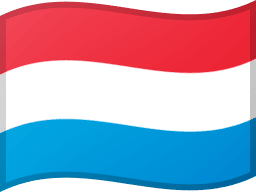
| Flag | Luxembourg Flag |
|---|---|
| Country | Luxembourg |
| Capital | Luxembourg City |
| Continent | Europe |
| Official Languages | Luxembourgish, French, German |
| Currency | Euro (EUR) |
| Dialling Code | +352 |
Luxembourg Flag Meaning
Flag Design
Luxembourg’s flag consists of three horizontal stripes of equal width: blue (top), white (middle), and red (bottom), in a 3:5 ratio. Officially, the blue is a light sky-blue (not navy), and the red is a vivid crimson. The design is simple yet striking, standing out vividly against the country’s cliffside fortresses and castle backdrops. The colors also echo the red lion emblem on Luxembourg’s coat of arms.
Meaning
The blue symbolizes the sky and rivers, representing the Luxembourgish spirit of freedom and openness. White stands for purity and peace, while red signifies the blood shed for independence and national fervor. These colors originate from the national coat of arms—a red lion wearing a crown, set against a blue-and-white striped background. The flag’s tri-color scheme was derived directly from this historic emblem.
History and Legal Status
The tricolor flag emerged during Luxembourg’s 19th-century independence movement and was officially adopted around 1845. Initially matching the Dutch flag in red-white-blue horizontal stripes (though with a lighter blue), the flag’s shade was standardized in June 1972 when legislation defined its precise colors and proportions to distinguish it from the Netherlands. In 2007, further laws confirmed sky-blue as the official shade.
Today, the tricolor flag shares symbolic status with the red lion crest (on a blue-and-white striped field) and is displayed at government buildings, schools, embassies, and during the annual June 23 National Day celebrations. It also flies prominently at Luxembourg’s EU institutions in Kirchberg, often alongside the European Union flag. Travelers may spot it during guard-changing ceremonies, National Day parades, or at the Schengen memorial site along the Moselle River.
Luxembourg Overview
Country Details »About Luxembourg
Luxembourg (officially the Grand Duchy of Luxembourg) is a small inland country in northwestern Europe, covering just 2,586 square kilometers. It borders Belgium to the north, Germany to the east (across tributaries of the Rhine), and France to the south. As the world’s only remaining grand duchy and one of the EU’s founding members, its capital, Luxembourg City, sits on the banks of the deep Pétrusse River Gorge and is home to around 130,000 people. The city hosts several key EU institutions and ranks among Europe’s most important financial centers.
Despite its small size, Luxembourg has one of the highest per capita GDPs in the world. Its three official languages—Luxembourgish, French, and German—are all widely spoken, with residents often mastering four or five languages in total, making it one of Europe’s most integrated nations. With over a hundred medieval castles and fortress ruins preserved across the country, Luxembourg is also known as the “Country of a Thousand Castles.”
Geography and Climate
Luxembourg’s terrain slopes from north to south. The northern Ardennes region features dense forests and the Oesling highlands, with the country’s highest point, Buurgplaatz (560 meters), located here. The central Gutland area consists of rolling hills and river valleys, while the southern Minette region was historically known for its iron and steel industry. The Moselle River flows along the southeastern border, forming a natural boundary with Germany, and its valley is lined with renowned Riesling vineyards.
The climate is a transitional mix of oceanic and continental types, strongly influenced by the Atlantic. Winters are cool and damp, with average January temperatures around 0°C and occasional snowfall. Summers are mild and pleasant, with July averages near 18°C, and extreme heat is rare. Rainfall is fairly evenly distributed year-round, with frequent fog in autumn and winter—travelers should pack a waterproof jacket.
Historical Background
Luxembourg’s history began in 963 AD when Count Siegfried of the Ardennes acquired the rocky outcrop of “Lucilinburhuc” (modern-day Luxembourg City) from a monastery. Over the centuries, the House of Luxembourg briefly held the Holy Roman Imperial throne, and the fortress—dubbed the “Gibraltar of the North”—was successively occupied by Burgundy, Spain, France, Austria, and Prussia. Its extensive underground fortifications stand as a testament to this turbulent past.
Luxembourg’s independence was recognized by the 1839 Treaty of London, and its permanent neutrality was declared at the 1867 London Conference, leading to the dismantling of its fortifications. It became a fully sovereign grand duchy in 1890. During both World Wars of the 20th century, Luxembourg was invaded by Germany but later abandoned neutrality to actively participate in European integration: it was a founding member of the European Coal and Steel Community in 1951, signed the Treaty of Rome in 1957, and hosted the 1985 signing of the Schengen Agreement in the town of Schengen, symbolizing freedom of movement in Europe. The euro was introduced in 1999, with Luxembourg among the first eurozone members.
Economy and Currency
Luxembourg boasts one of the world’s highest per capita incomes. Having transitioned from heavy industry (particularly steel) to financial services in the late 20th century, it is now one of the eurozone’s premier financial hubs. Key EU institutions, including the European Investment Bank, the European Court of Justice, the European Court of Auditors, and several directorates-general of the European Commission, are headquartered in the Kirchberg Plateau district of Luxembourg City. The country is also the world’s second-largest investment fund management center after the United States.
The official currency is the euro (EUR), with banknotes identical across all eurozone nations. Only the coin reverses feature national designs. Like most European countries, Luxembourg widely accepts debit/credit cards, mobile payments, and cash, making travel expenses highly convenient.
Culture and Society
Luxembourg’s culture blends Latin and Germanic traditions. Luxembourgish—a Germanic dialect with heavy French influence—was designated the national language in 1984. Street signs and official notices are typically in French, while education uses both German and French. Despite its small size, the country offers a densely concentrated taste of Europe: travelers can journey from ancient Ardennes castles through river valley farmlands to Moselle Valley wineries in a single day.
The cuisine combines hearty German fare with refined French touches. National dishes include smoked pork neck with broad beans, while street foods like potato fritters, caramelized waffles, and Moselle sparkling wine are popular. Luxembourg ranks among Europe’s safest countries, with orderly public life and free public transport—a global rarity.
Tourism Overview
Luxembourg’s tourism highlight is its capital’s UNESCO-listed Old Town: the Bock Casemates (fortress tunnels), the Chemin de la Corniche (dubbed Europe’s most beautiful balcony), the Grand Ducal Palace, and the Adolphe Bridge spanning the gorge create a compact yet rich urban experience. Nearby highlights include the medieval Vianden Castle (once home to Victor Hugo), the Mullerthal Region (known as “Little Switzerland” for its sandstone cliffs), and the Moselle Valley’s Schengen—a pilgrimage site for European travelers as the birthplace of the Schengen Agreement. Thanks to its compact size and free public transport, Luxembourg makes an excellent add-on to a broader Western European itinerary, perfect for a one- or two-day visit.
Luxembourg Travel Guide
All Guides »Luxembourg Travel Quick Guide: Schengen Visa, Seasons, Budget & Etiquette
Before you go, understand the Schengen visa, free public transport, budgeting fo...
Classic 6-day Luxembourg itinerary: Capital Old Town – Vianden – Mullerthal – Moselle Valley 6 days
The complete way to experience the "Land of a Thousand Castles": canyon fortress...
Luxembourg 3-Day Itinerary: In-Depth Exploration of the Capital’s Old Town 3 days
Even with just a weekend, you can uncover Luxembourg City: explore the Old Town,...
Essential Attractions in Luxembourg: Fortresses, Castles, and European Institutions
From the Bock Casemates to Vianden Castle and the Schengen Monument, here are th...
Luxembourg Food Guide: From the National Dish Judd mat Gaardebounen to Moselle Sparkling Wine
Luxembourg cuisine is a blend of German and French traditions: hearty pork and b...
Complete Guide to Transportation in Luxembourg: Free Public Transit Nationwide and Nearby Travel Connections
How to Explore the World’s First Country with Totally Free Public Transport: Air...