Somalia Flag
The proportions, colors, and history of Somalia's flag - a banner that tells Somalia's own story.
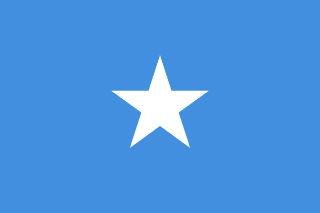
| Flag | Somalia Flag |
|---|---|
| Country | Somalia |
| Capital | Mogadishu |
| Continent | Africa |
| Official Languages | Somali, Arabic |
| Currency | Somali shilling (SOS) |
| Dialling Code | +252 |
Somalia Flag Meaning
Flag Design
The flag of Somalia is a light blue rectangle with a white five-pointed star in the center. The flag’s aspect ratio is 2:3. The light blue color closely resembles that of the United Nations flag, and the central star creates a simple yet striking design. This flag was designed by Somali scholar Mohammed Awale Liban and officially adopted on October 12, 1954. It is one of the earliest flags in the Horn of Africa to carry modern national symbolism.
Meaning
The white five-pointed star represents the five regions historically inhabited by Somalis: British Somaliland, Italian Somaliland, French Somaliland (now Djibouti), the Ogaden region in Ethiopia, and the Northern Frontier District of Kenya. It embodies the vision of pan-Somali nationalism. The light blue background pays tribute to the United Nations, which played a crucial supervisory and supportive role during the end of Italian trusteeship and the path to independence. The color also symbolizes the sky and seas of the Indian Ocean and Gulf of Aden. The combination of white and blue conveys a message of peace and openness.
History and Legal Status
After Somalia gained independence in 1960, this flag naturally became its national flag and has remained in use ever since. All subsequent governments, including the federal government established after 2012, have recognized its legal status. The current constitution provides unified regulations for the flag, emblem, and national anthem. The self-declared Republic of Somaliland in 1991 adopted its own green-white-red tricolor flag, but it remains unrecognized internationally. The flag representing Somalia in all official contexts remains the light blue flag with the white star. Today, it is flown at government buildings, within Mogadishu’s airport zone, at Somali embassies and consulates abroad, and appears in cooperative settings involving the African Union Mission in Somalia.
Somalia Overview
Country Details »Overview of Somalia
Somalia (officially the Federal Republic of Somalia) is located at the Horn of Africa, the easternmost point of the African continent. It borders the Gulf of Aden to the north, overlooking Yemen; the Indian Ocean to the east; Ethiopia to the west; Kenya to the southwest; and Djibouti to the northwest. With a land area of about 638,000 square kilometers and a coastline exceeding 3,300 kilometers, it has the longest coastline on the African continent. Its capital, Mogadishu, lies along the Indian Ocean and was historically a key port city in Indian Ocean trade networks, earning the nickname "Pearl of the Indian Ocean."
Somalia gained independence in 1960 through the union of British Somaliland and Italian Somaliland. After the collapse of the central government in 1991, it endured prolonged civil war and warlordism. Though the federal government was re-established in 2012, national governance remains in a gradual recovery phase. Notably, the former British Somaliland declared independence in 1991 as the self-declared Republic of Somaliland. While it has relatively stable governance, it lacks broad international recognition and is still considered part of Somalia internationally.
Geography and Climate
Somalia holds significant strategic value geographically: it controls key shipping routes through the Red Sea and Gulf of Aden to the Indian Ocean. A substantial proportion of global maritime trade between Asia and Europe via the Suez Canal passes through its northern waters, which also explains the historical prevalence of piracy in the region. The terrain is dominated by plateaus and plains, with higher mountainous areas (such as the Cal Madow range reaching over 2,400 meters) in the north. The central and southern regions consist of vast grasslands and semi-arid plains, with the Jubba and Shabeelle rivers flowing from the Ethiopian Highlands, serving as lifelines for agriculture in the south.
The country generally experiences a tropical desert and semi-arid climate, characterized by year-round heat. Coastal areas are influenced by the Indian Ocean monsoon, resulting in four distinct seasons alternating between precipitation and dry periods, with the period from December to February being relatively cooler. Rainfall is scarce and irregular, leading to frequent droughts. Pastoralists traditionally migrate with their livestock in search of water and grazing land, shaping Somalia’s camel- and goat-based nomadic economy.
Historical Background
Somalia’s coastal trade history dates back over two millennia. The ancient Egyptian records of the "Land of Punt" are widely believed to refer to the region of present-day Somalia or its neighboring areas. The "Periplus of the Erythraean Sea" from the age of Alexander the Great documented spice and incense trading ports along the coast. Frankincense and myrrh, produced in the Berbera area of the north, were historically transported by land and sea to Egypt, Rome, and the Middle East. Berbera became known as the "Port of Frankincense" during the Middle Ages, marking one of Somalia’s most significant contributions to world trade history.
In modern times, Somalia was divided into British Somaliland, Italian Somaliland, French Somaliland, and the Ogaden region controlled by Ethiopia. British and Italian Somaliland merged to form an independent nation in 1960. Following a coup led by Siad Barre in 1969, the country declined after the failed Ogaden War (1977–1978) and collapsed in 1991, descending into prolonged civil war. United Nations and African Union peacekeeping forces were deployed in subsequent years, and federal governance began rebuilding from 2012. However, threats from armed groups such as Al-Shabaab persist to this day.
Economy and Currency
Somalia’s economy is heavily reliant on livestock, with the country having one of the world’s largest camel populations, earning it the nickname "Nation of Camels." Camels serve as symbols of wealth and dowry, as well as sources of meat, milk, and exports. Other key economic components include livestock exports (primarily to Gulf countries), bananas, sesame, fisheries, and substantial remittances, which account for about 30% of GDP—making Somalia one of the most remittance-dependent nations globally. The official currency is the Somali shilling (SOS). Due to years of conflict and hyperinflation, the currency’s credibility has been undermined, with the U.S. dollar and mobile money dominating transactions.
Culture and Society
Somalia is a predominantly single-ethnicity nation, with the Somali people being a cross-border nomadic group sharing language, poetry, and clan traditions. Oral poetry holds a revered place in Somali culture, earning the people the title "Nation of Poets." During the 1980s, widespread conflict led to large-scale Somali diaspora communities in Europe and North America, many of which maintain strong economic and cultural ties with their homeland. The vast majority of the population practices Sunni Islam, which deeply influences social life, dress, and legal traditions.
Nomadic culture permeates daily life: wealth is measured in camels, hospitality is shown through milk and meat, and clan elders (through the traditional "shir" assembly system) continue to play a vital role in conflict resolution. In recent years, urban music, film, and sports have seen gradual revivals, and Mogadishu’s beaches have begun attracting visitors again during relatively calm periods.
Tourism Overview
Objectively speaking, Somalia is not currently a viable destination for normal travel: multiple safety alerts have been issued, advising against travel. The risks of terrorist attacks, kidnappings, and general insecurity are high. Most areas outside Mogadishu’s airport zone are not under effective government control, and medical and evacuation services are extremely limited. From a cultural geography perspective, historic sites such as Mogadishu’s old town and beaches, the Frankincense Route in Berbera, the rock art of Laas Geel in Somaliland (among Africa’s most significant prehistoric sites), and the coral reefs and diving potential along the Red Sea coast offer reasons for interest—but these are presented purely for informational purposes. Travel of any kind is strongly discouraged at this time.
Somalia Travel Guide
All Guides »Somalia Travel Snapshot: Safety Situation, Visa, Seasons & Budget Guide
Understand the safety situation first, then check visa, seasonal factors, and co...
7-Day Cultural & Geographic Tour of Somalia: The Horn of Africa & the Frankincense Coast (Currently Not Advisable to Visit) 7 Days
This itinerary connects key sites in Mogadishu, Berbera, and along the Red Sea c...
Somalia 4-Day Short Trip: Mogadishu and Surroundings Knowledge Tour (Currently Not Advisable to Visit) 4 days
A conceptual 4-day itinerary centered on the capital and Somaliland, designed to...
List of cultural and geographical sites to explore in Somalia: from Mogadishu to Las Geel
A regional breakdown of Somalia’s most historically and culturally significant s...
Somali Cuisine Guide: Camel Milk, Spiced Stews, and Indian Ocean Flavors
Shaped by nomadic traditions and Indian Ocean trade, Somali cuisine features sta...
Travel Guide for Transportation and Safety in Somalia: Flights, Land Travel, and Escort Arrangements
Transportation in Somalia primarily relies on international connecting flights a...