Kyrgyzstan Flag
The proportions, colors, and history of Kyrgyzstan's flag - a banner that tells Kyrgyzstan's own story.
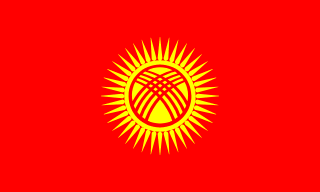
| Flag | Kyrgyzstan Flag |
|---|---|
| Country | Kyrgyzstan |
| Capital | Bishkek |
| Continent | Asia |
| Official Languages | Kyrgyz, Russian |
| Currency | Kyrgyzstani som (KGS) |
| Dialling Code | +996 |
Kyrgyzstan Flag Meaning
Flag Design
The flag of Kyrgyzstan is a red rectangle with a ratio of 3:5. At its center is a golden sun with 40 rays radiating outward. Inside the sun are two sets of curved lines crossing each other, forming the pattern of a traditional yurt’s roof window known as a tunduk. The sun has a diameter of about three-fifths the width of the flag, with the design centrally placed. In December 2023, Kyrgyzstan passed legislation altering the shape of the sun’s rays from slightly wavy to straight lines, making the design more symmetrical and prominent.
Meaning
Red symbolizes bravery and victory, as well as the banner tradition of the national hero Manas. The golden sun represents light, warmth, and life, while the 40 rays stand for the 40 clans or tribes that form the Kyrgyz people. The central tunduk is the wooden crown of a yurt, serving as the heart and source of light in a home, and symbolizing national unity, family, and cosmic order. Together, these elements convey deep meaning rooted in nomadic heritage and collective identity.
History and Legal Status
Kyrgyzstan adopted the red flag with the golden sun after gaining independence in 1991, and it was officially designated as the national flag in 1992, where it has remained ever since. The 2023 legislative change modified the sun’s rays from wavy to straight, with official reasoning aimed at avoiding misinterpretation and improving recognition. This alteration sparked public discussion. Today, the flag is prominently displayed at government buildings, national celebrations, Independence Day (August 31), and events like the World Nomad Games — serving as a core symbol of Kyrgyz national identity.
Kyrgyzstan Overview
Country Details »About Kyrgyzstan
Kyrgyzstan (officially the Kyrgyz Republic) is a landlocked country in northeastern Central Asia, covering approximately 199,900 square kilometers. It borders Kazakhstan to the north, Uzbekistan to the west, Tajikistan to the south, and China to the east. The capital, Bishkek, located in the northern Chüy Valley, is the country’s political, economic, and cultural center. The country is divided into seven provinces and two cities of national significance. Kyrgyz is the state language, and Russian is also an official language, both widely spoken in urban and rural areas.
Situated between the Tianshan and Pamir mountain ranges, Kyrgyzstan is a quintessential mountainous nation and a key section of the ancient Silk Road. Its diverse ethnic groups and historic trade routes have shaped an open yet down-to-earth social character.
Geography and Climate
About 90% of the country lies at elevations above 1,500 meters. The Tianshan Mountains run across the country, with its highest peak, Jengish Chokusu (Victory Peak), reaching 7,439 meters and shared with China. Lake Issyk-Kul, the world’s second-largest alpine lake, sits at around 1,600 meters above sea level. Its slightly saline waters remain unfrozen in winter, earning it the nickname “Hot Lake.” It is the country’s pride and a central tourism destination. The climate is continental, with distinct vertical zonation in mountainous areas: valleys are warm in summer, mountains are cool, and winters are cold and snowy. The best travel period is May to September, when alpine meadows (jailoo) turn green and herders bring their livestock to graze in the hills, dotted with white yurts.
Historical Background
The history of the Kyrgyz people dates back to ancient nomadic tribes. From the 6th to 8th centuries, the Kyrgyz Khanate was established and at one point powerful. This region was a vital part of the Silk Road, and the ancient city of Suyab (near present-day Tokmok) is believed by some to be the birthplace of the great Tang Dynasty poet Li Bai. From the mid-19th century, the Kyrgyz lands were incorporated into the Russian Empire; in 1924, the Kara-Kyrgyz Autonomous Oblast was formed, and in 1936, it became a Soviet republic. On August 31, 1991, Kyrgyzstan declared independence, becoming the Kyrgyz Republic. Since then, the country has undergone several political changes and gradually established a parliamentary republic system.
Economy and Currency
The economy relies on agriculture, animal husbandry, mining, and remittances from abroad. The country is rich in gold and hydropower resources, with the Kumtor Gold Mine long being a major source of foreign income. The national currency is the Kyrgyzstani som (KGS), issued by the National Bank of the Kyrgyz Republic, with 1 som = 100 tyiyn. The som is a floating currency, and its exchange rate is influenced by regional economics and external factors. Travelers should monitor daily rates and exchange money through official local channels.
Culture and Society
The Kyrgyz are the predominant ethnic group, traditionally nomadic. Yurts (portable tents), the epic poem “Manas,” equestrian games (such as kok-boru), and falconry are central to national identity. The “Manas” epic spans hundreds of thousands of lines, making it one of the longest epics in the world. The main religion is Sunni Islam, but nomadic traditions and nature worship still deeply influence daily life. The diet features lamb, horse meat, dairy products, and noodles. Hospitality is a cornerstone, with tea and flatbread commonly served to guests.
Tourism Overview
Nicknamed the “Switzerland of Central Asia,” Kyrgyzstan’s tourism centers on natural scenery and nomadic culture. Resorts like Cholpon-Ata and Karakol near Lake Issyk-Kul serve as hubs for trekking and leisure, while Ala-Archa National Park is just about 40 minutes from Bishkek and ideal for day hikes. Song Kol and the highland pastures of Naryn offer opportunities to stay in yurts and go horseback riding. Osh is a southern ancient city and pilgrimage site. Historic sites like the Burana Tower, Arslanbob walnut forests, and the Tash Rabat caravan serai reflect the Silk Road legacy. Transportation is mainly by road, with some mountain routes in poor condition — plan extra travel time accordingly.
Kyrgyzstan Travel Guide
All Guides »Kyrgyzstan Travel Snapshot: e-Visa, Best Seasons, Budget, and Nomadic Etiquette
How to apply for an e-visa, when is the best time to visit, estimated trip costs...
Kyrgyzstan 7-day itinerary: Bishkek — Issyk-Kul Lake — Song-Kul Lake — Osh 7 days
From the capital to alpine lakes and ancient southern cities, experience the bes...
Kyrgyzstan 4-Day Short Trip: Bishkek – Ala-Archa – Issyk-Kul 4 days
Even with limited holiday time, you can enjoy snow-capped mountains, lakes, and ...
Essential Attractions in Kyrgyzstan: Lakes, Snow Mountains, and Silk Road Ancient Cities
A guide to the most worthwhile attractions in Kyrgyzstan, organized by natural l...
Kyrgyzstan Food Guide: Plov, Horse Meat, and Dairy Delights
The nomadic table centers on meat and dairy—these dishes will help you quickly u...
Kyrgyzstan Transport Guide: Airports, Minibuses, and Mountain Transfers
A complete guide to getting to and from Bishkek’s airport, the minibus network, ...