Jordan Flag
The proportions, colors, and history of Jordan's flag - a banner that tells Jordan's own story.
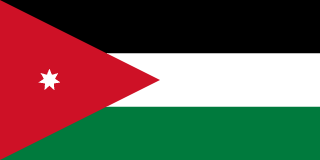
| Flag | Jordan Flag |
|---|---|
| Country | Jordan |
| Capital | Amman |
| Continent | Asia |
| Official Languages | Arabic (English widely spoken) |
| Currency | Jordanian Dinar (JOD) |
| Dialling Code | +962 |
Jordan Flag Meaning
Flag Design
The Jordanian flag consists of three equal horizontal bands of black, white, and green from top to bottom, with a red isosceles triangle on the hoist side. The base of the triangle spans the full width of the flag, and its apex points toward the center. Inside the triangle is a white seven-pointed star. The flag has a 1:2 aspect ratio. The combination of the black, white, green, and red bands along with the red triangle originates from the flag used during the Arab Revolt of 1916. The design is symmetrical and layered, making it one of the most recognizable flags in the Arab world.
Meaning
The colors black, white, green, and red are known as the Pan-Arab colors, each representing a historical dynasty: black for the Abbasid Caliphate, white for the Umayyad Caliphate, green for the Fatimid Caliphate, and red for the Hashemite dynasty and the Arab Revolt. The red triangle symbolizes the strength of the revolt and the central role of the Hashemite family in nation-building. The white seven-pointed star represents the seven verses of the first chapter of the Quran, Al-Fatiha, and also signifies faith, unity, and guidance. The overall design reflects both the ideal of Arab unity and the heritage of the Hashemite legacy. Notably, Jordan’s flag, along with those of Palestine and historical Arab Revolt flags, shares the same four-color scheme, but Jordan’s inclusion of the white seven-pointed star inside the red triangle is a unique distinguishing feature and often seen as the emblem of the Jordanian flag.
History and Legal Status
The Jordanian flag is directly derived from the flag of the Arab Revolt of 1916. After the establishment of the Emirate of Transjordan in 1921, a similar design was adopted. The official version featuring the white seven-pointed star was adopted in 1928, continued after independence in 1946, and was retained when the country was renamed the Hashemite Kingdom of Jordan in 1949, remaining the national flag to this day.
The proportions, colors, and display regulations of the Jordanian flag are defined by Jordanian law and royal decrees. During national holidays, royal events, and military ceremonies, strict adherence to these regulations is required. Even ordinary citizens and businesses must ensure the flag is displayed cleanly and respectfully. For many Jordanians, the flag represents not just the nation, but also the memory of independence and statehood.
Jordan Overview
Country Details »About Jordan
The Hashemite Kingdom of Jordan (Arabic: الأردن) is located in West Asia, in the northwest of the Arabian Peninsula. It borders Syria to the north, Iraq to the northeast, Saudi Arabia to the east and south, and Israel and Palestine to the west. To the southwest, it has a short coastline of about 26 kilometers along the Gulf of Aqaba, which connects to the Red Sea. The country covers an area of approximately 89,000 square kilometers, with a population of around 11.5 million. Its capital, Amman, is the political, economic, and cultural center of the nation.
Jordan is a constitutional monarchy, with the king serving as the head of state and holding significant executive powers. The parliament is bicameral, consisting of the Senate and the House of Representatives. The Jordanian royal family belongs to the Hashemite dynasty, considered descendants of the Prophet Muhammad. This lineage grants the monarchy a unique religious and historical status, positioning Jordan as a long-standing mediator and stabilizing force in regional affairs. The country is divided into 12 governorates. Islam is the state religion, while a sizable and protected Christian community also exists.
Geography and Climate
Jordan’s terrain can be divided into three main zones from west to east. The western region includes the Jordan Valley and the Dead Sea rift, where the Dead Sea lies about 430 meters below sea level—the lowest point on Earth’s land surface—with extremely high salinity that allows people to float effortlessly. East of this is the Eastern Highlands, ranging from 700 to 1,200 meters in elevation, where cities such as Amman, Madaba, and Karak are located. Further east and southeast lie the vast Badia Desert and the sandstone mountains of Wadi Rum, characterized by dramatic red dunes and rock formations.
The western highlands have a Mediterranean climate with mild, rainy winters and dry, hot summers. The eastern desert experiences large temperature variations between day and night and very little rainfall. Jordan is one of the most water-scarce countries in the world, making water resource management and agricultural water conservation key national policies. The best times to visit are spring and autumn. Summers in the desert are extremely hot during the day, while Aqaba and the Dead Sea remain swim-friendly in winter with abundant sunshine.
Historical Background
The region now known as Jordan has long been a crossroads of civilizations. In biblical times, ancient kingdoms such as Edom, Moab, and Ammon thrived here. Around the 4th century BCE, the Nabataeans established a kingdom in the region and carved the city of Petra into the rose-red cliffs. Through the lucrative trade of spices and incense, they amassed great wealth. After being annexed by the Roman Empire in 106 CE, Petra gradually declined and became a half-forgotten ancient city.
Jordan subsequently came under the rule of the Byzantine Empire, various Islamic dynasties, the Crusaders, and the Ayyubid dynasty before becoming part of the Ottoman Empire in the 16th century. In 1921, with British support, Abdullah I established the Emirate of Transjordan. It gained independence as the Hashemite Kingdom of Transjordan in 1946 and was renamed the Hashemite Kingdom of Jordan in 1949. Petra was inscribed as a UNESCO World Heritage Site in 1985 and named one of the New Seven Wonders of the World in 2007, becoming Jordan’s most iconic national treasure.
Economy and Currency
Jordan is relatively poor in natural resources, lacking oil and natural gas. Its economy relies mainly on tourism, remittances, foreign aid, and exports of minerals such as phosphates and potash. Potash from the Dead Sea and its processed products are significant export commodities. The service sector contributes the largest share to the economy, with tourism revenue being an important source of foreign exchange. Water scarcity, energy dependence on imports, and regional instability are longstanding challenges, contributing to relatively higher prices compared to other countries in the region.
The official currency is the Jordanian Dinar (JOD, symbol د.ا or JD), issued by the Central Bank of Jordan. It has been pegged to the US dollar at a fixed rate of approximately 1 USD = 0.708 JOD since 1995, meaning 1 JOD is roughly 1.41 USD. Due to its stable exchange rate, it is easier to estimate travel budgets in Jordan.
Culture and Society
Jordanian society is predominantly Arab and Islamic, with a significant Christian community. Religious groups generally maintain a tolerant coexistence. The Bedouin tradition of hospitality is deeply rooted—welcoming guests is considered a blessing by many families, and Arabic coffee and dates are common gestures of hospitality. Friday is the main day of rest and prayer. During Ramadan, eating and drinking in public during daytime hours should be done discreetly.
Jordan has a relatively high education level in the Middle East, and English is widely spoken in urban areas and the tourism industry. Most hotel, restaurant, and attraction staff can communicate in English, making it traveler-friendly. Jordanian cuisine features grilled meats, hummus, yogurt, and various breads, with generally mild flavors that are easily accepted by international visitors.
Tourism Overview
Despite its small size, Jordan is home to an exceptionally dense concentration of world-class attractions. The capital, Amman, offers the Citadel and the Roman Theatre; Jerash in the north preserves extensive Roman ruins; Petra in the south is the world-famous rose-red rock city; further south lies Wadi Rum, known as the Valley of the Moon for its red sand dunes and rock pillars, and a backdrop for numerous films; the Dead Sea is ideal for floating and mud treatments; and Aqaba on the Red Sea is a top destination for diving and resort holidays.
Other highlights include the Madaba Mosaic Map, Mount Nebo, the castles of Karak and Ajloun, Dana Nature Reserve, and the Jordan River Baptism Site. The Jordan Pass is a cost-effective option that often covers visa fees and major attraction tickets like Petra, making it a smart choice when planning your trip.
Jordan Travel Guide
All Guides »Jordan Solo Travel Quick Guide: Visas, Seasons, Budget, and How to Use the Jordan Pass
How to combine a visa on arrival with the Jordan Pass for the best value, the mo...
Classic 7-day Jordan itinerary: Amman, Jerash, Dead Sea, Petra, Wadi Rum, and Aqaba 7 days
A north-to-south golden route across Jordan, covering Roman ruins, Dead Sea floa...
Jordan 4-Day Short Trip: Highlights of Amman, Petra, and the Dead Sea 4 days
Cover Jordan’s three most iconic destinations in four days: the capital Amman, t...
Must-visit attractions in Jordan: Petra, Wadi Rum, the Dead Sea, and Jerash
A guide to Jordan’s top attractions grouped into three regions—Amman and the nor...
Jordan Food Guide: Mansaf, Maqluba & Street Shawarma
Jordanian cuisine is mild and widely accessible within Middle Eastern food, rang...
Jordan Transport Guide: JETT Buses, Private Transfers, and Airport Transfers
Jordan’s attractions are spread out, so long-distance travel relies mainly on bu...