Moldova Flag
The proportions, colors, and history of Moldova's flag - a banner that tells Moldova's own story.
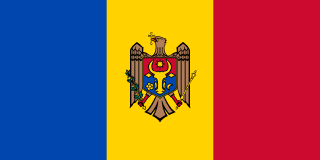
| Flag | Moldova Flag |
|---|---|
| Country | Moldova |
| Capital | Chișinău |
| Continent | Europe |
| Official Languages | Romanian |
| Currency | Moldovan Leu (MDL) |
| Dialling Code | +373 |
Moldova Flag Meaning
Flag Design
The flag of Moldova is a vertical tricolor of blue, yellow, and red, arranged from left to right. The central yellow stripe features the Moldovan coat of arms. The official flag proportions are 1:2, making it taller and narrower than most European flags. The three color bands are of equal width, with the coat of arms occupying about half the height of the flag and positioned slightly left of center for visual balance (some civilian versions place it in the center). Because it shares its design roots with the Romanian flag, the Moldovan flag is often described as the “Romanian tricolor with a coat of arms.”
Symbolism
The three colors originate from the Romanian flag and the traditions of the Principality of Moldavia: blue symbolizes the sky and freedom, yellow represents fields and harvest, and red stands for the courage and blood of the people. The central coat of arms features a golden eagle with outstretched wings, holding a cross in its beak and an olive branch and scepter in its talons. On its chest is a shield depicting a head of an aurochs, a rose, a crescent, and a star. This emblem originates from the coat of arms of the Moldavian Principality during the era of Stephen the Great and symbolizes the country’s historical legacy, faith, and aspirations for peace.
History and Legal Status
The current flag was adopted in April 1990 by the Supreme Soviet of the Moldavian Soviet Socialist Republic, predating the country’s independence. After Moldova gained independence in 1991, the flag was retained, and its specifications — including the placement, proportions, and official color standards of the coat of arms — were formally established in flag-related legislation enacted in 2010. The flag is widely used at government buildings, schools, on National Day (Independence Day on August 27), and during the National Wine Festival.
Due to its close resemblance to the Romanian flag, the two are often discussed together in international contexts. This “shared design with distinct emblem” reflects the deep linguistic and cultural ties between Moldova and Romania.
Moldova Overview
Country Details »Overview of Moldova
Moldova (officially the Republic of Moldova) is a landlocked country in Eastern Europe, bordered by Romania to the west and Ukraine to the north, east, and south. With an area of approximately 33,800 square kilometers, it is one of the smaller countries in Europe. Its capital, Chișinău, located in the central hilly region, serves as the nation’s political, economic, and cultural center. The population is about 2.5 million (excluding the Transnistria region), making it one of Europe’s least populous countries. The official language is Romanian, and Russian is also widely spoken among the public.
Moldova is a parliamentary republic, having declared independence after the dissolution of the Soviet Union in 1991. Notably, the region known as Transnistria, on the eastern bank of the Dniester River, has been de facto autonomous since the early 1990s. It issues its own currency and maintains an independent administrative system. The international community generally regards it as part of Moldovan territory, but travelers visiting the area will need to go through border checks on both sides.
Geography and Climate
Moldova lies between the Dniester and Prut rivers, characterized mainly by rolling hills and river valley plains. The highest point, Mount Balanesti, reaches only 429 meters, indicating a generally flat and open terrain. The country boasts fertile black soil, with a high proportion of land dedicated to farmland and vineyards, and a long tradition of winemaking. The main rivers are the Dniester, which flows along the northeastern border, and the Prut, which forms the western border with Romania.
The climate is temperate continental, with distinct seasons: summers (June to August) are hot and dry, with average temperatures of 20–27°C; winters (December to February) are cold, often below freezing with snowfall; spring and autumn are mild and comfortable, making them ideal for travel. Annual precipitation is around 500 millimeters, with ample sunshine, creating excellent conditions for grape cultivation — the natural foundation of Moldova’s thriving wine industry.
Historical Background
Moldova’s history is closely tied to the Principality of Moldavia. Established in the 14th century, it reached a golden age under the rule of Prince Stephen the Great (Ștefan cel Mare, 1457–1504), who defended against Ottoman invasions and built numerous monasteries and fortresses. He is revered as a national hero, with streets and statues named after him throughout the capital and the country. From the 16th century, the principality was successively under Ottoman suzerainty, and in 1812, the eastern region of Bessarabia was incorporated into the Russian Empire.
In 1918, Bessarabia briefly united with Romania, but in 1940 it was annexed by the Soviet Union and became the Moldavian Soviet Socialist Republic. Following the Soviet collapse in 1991, Moldova declared independence. This long and complex history has endowed the country with a deep Romanian cultural foundation as well as a strong imprint of the Soviet era.
Economy and Currency
Moldova is one of the smaller economies in Europe, with agriculture playing a prominent role. Grape growing and winemaking are national hallmarks: the country has one of the highest ratios of vineyard area to landmass in the world. The Mileștii Mici underground wine cellar, with its network of tunnels stretching approximately 200 kilometers, holds the Guinness World Record as the largest wine collection cellar. The Cricova wine cellars are also internationally renowned. Other key economic sectors include sunflower and wheat production, fruit cultivation, and remittances from labor in the EU. The national currency is the Moldovan Leu (MDL), issued by the National Bank of Moldova, with relatively stable exchange rates in recent years.
Culture and Society
Moldovan culture is deeply influenced by Romanian traditions, including language, folk songs, embroidery, and pottery. At the same time, Russian cultural elements and Orthodox Christian customs are also integrated into daily life, with the majority of the population adhering to Eastern Orthodoxy. Rural areas maintain a strong agrarian lifestyle, and hospitality is warm and generous. Traditional meals often feature mămăligă (a type of polenta), grilled meat, and homemade wine, with guests often encouraged to drink heartily.
Wine is not just an industry in Moldova, but part of the national identity. It is customary for locals to store wine in underground cellars for entertaining guests. The first weekend of October is National Wine Day, celebrated with wine tastings and parades in Chișinău, considered the best time to experience authentic Moldovan culture.
Tourism Overview
Moldova is one of Europe’s least visited and most pristine destinations. Exploring massive underground wine cellars, admiring the rock-hewn monastery overlooking the valley at Orheiul Vechi, visiting the medieval fortress in Soroca, and experiencing the Soviet-era atmosphere in Tiraspol offer a unique niche travel experience. Chișinău features low prices and a slow pace of life. While its tourism infrastructure is less developed than in Western Europe, the friendly locals and high level of safety make it an appealing destination for travelers seeking depth and authenticity, whether as a stopover or a dedicated trip.
Moldova Travel Guide
All Guides »Quick Guide to Moldova Before You Go: Visa, Seasons, Budget & Etiquette
One of Europe’s least-visited countries—getting clarity on e-visas, cash, and wi...
Classic 7-Day Moldova Itinerary: Wineries, Monasteries, and Transnistria 7 days
Centered around Chișinău, this route connects the world’s largest underground wi...
Moldova 4-Day Short Trip: Chișinău and the Essence of Wine 4 Days
Perfect for wine-loving travelers with limited time: two days of city sightseein...
Essential Attractions in Moldova: Wineries, Monasteries, and Fortresses
While Moldova doesn’t have a huge number of attractions, they are distinctive. H...
Moldova Food Guide: Polenta, Grilled Meats & Aged Wine
From the national staple mămăligă to winery feasts, Moldovan dining is hearty an...
Complete Guide to Transportation in Moldova: Airports, Minibuses, and Intercity Travel
Transportation in Moldova is straightforward: getting into Chișinău from the air...