Cuba Flag
The proportions, colors, and history of Cuba's flag - a banner that tells Cuba's own story.
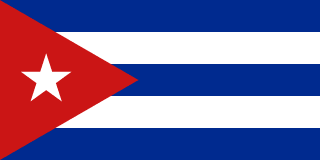
| Flag | Cuba Flag |
|---|---|
| Country | Cuba |
| Capital | Havana |
| Continent | North America |
| Official Languages | Spanish |
| Currency | Cuban Peso (CUP) |
| Dialling Code | +53 |
Cuba Flag Meaning
Flag Design
The flag of Cuba is rectangular with a 2:1 aspect ratio, consisting of five horizontal stripes: three blue and two white, alternating from top to bottom. On the hoist side (left), there is a red equilateral triangle with a white five-pointed star in the center. The three blue and two white stripes are of equal width, creating a strong contrast with the red triangle.
This flag is known in Cuba as La Estrella Solitaria (The Lone Star). The combination of the red triangle and white star is its most recognizable feature and makes it one of the most distinctive flags in the Caribbean.
Meaning
The three blue stripes represent the three original departments into which Cuba was divided during the colonial period, and are also interpreted as the sky and sea surrounding the island. The two white stripes symbolize the purity of patriotic ideals and the desire for peace. The red triangle stands for equality, fraternity, and liberty, as well as the blood shed in the struggle for independence. The white five-pointed star in the center represents independence, freedom, and the bright future of the nation—this is the origin of the name “Lone Star.”
The overall design, using blue, white, and red, is visually simple yet powerful, embodying the Cuban people’s pursuit of independence and sovereignty. It is also often associated with the historic call for a “free Cuba.”
History and Legal Status
The Cuban flag was designed in 1849 by Cuban poet Miguel Teurbe Tolón and revolutionary Narciso López, both living in exile in the United States. The design was partly inspired by the U.S. Stars and Stripes and the French Tricolore, intended to create a distinct symbol for the Cuban independence movement. The flag was first raised on Cuban soil in 1850.
After Cuba gained formal independence in 1902, the Lone Star Flag was adopted as the national flag and has remained in use ever since. It was retained after the 1959 revolution. Today, it is prominently displayed at government buildings, schools, commemorative events, and sporting events. National flag days include October 10 (the start of the War of Independence) and New Year’s Day, among others.
Cuba Overview
Country Details »About Cuba
Cuba is the largest island nation in the Caribbean, comprising the main island of Cuba and around 1,600 smaller islands and islets, including the Isle of Youth. It lies just north of the Florida Strait across from the United States, east of Haiti, south of Jamaica, and west of Mexico’s Yucatán Peninsula. With a land area of about 110,000 square kilometers, its capital Havana (La Habana) is located on the northwest coast and serves as the political, economic, cultural, and tourism hub of the country. The population is roughly 11 million, and the official language is Spanish. Cuba is the only socialist country in the Western Hemisphere.
Strategically located at the gateway between the Gulf of Mexico and the Caribbean Sea, Cuba has historically been a key Spanish colony in the Americas and a significant player during the Cold War. Today, it is renowned for its free education and healthcare systems, rich musical and literary traditions, and well-preserved colonial cities—but it also faces ongoing challenges such as shortages of goods and economic difficulties.
Geography and Climate
The main island of Cuba is shaped somewhat like a crocodile, stretching long and narrow from east to west and relatively narrow from north to south. Its terrain is mainly plains and hills, with the Sierra Maestra mountain range in the southeast forming the island’s backbone. The highest peak, Pico Turquino, rises to approximately 1,974 meters. Cuba features numerous short rivers, extensive karst landscapes, and a coastline dotted with coral reefs, mangroves, and white-sand cays (such as Cayo Coco and Cayo Santa María)—perfect for island holidays. The Viñales Valley in the west is famous for its unusual limestone mogotes (karst hills) and tobacco fields.
The climate is tropical, with an average annual temperature of around 25°C. The dry season from November to April brings pleasant, dry weather, making it the best time to visit. The rainy season and hurricane season from May to October are hotter and more humid, with frequent afternoon rain showers and the risk of tropical storms. In Havana and western parts of the country, winter temperatures may occasionally drop slightly due to cold air from North America—bring a light jacket for early mornings and evenings.
Historical Background
Christopher Columbus arrived in Cuba during his 1492 voyage, and Spain began colonizing the island in 1511, establishing Havana soon after. For centuries, Cuba was a major Spanish colony, driven by sugarcane plantations and the transatlantic slave trade. In the 19th century, independence movements gained momentum, with the Ten Years' War (1868–1878) and José Martí leading a new fight for independence starting in 1895. After the Spanish-American War in 1898, Cuba gained nominal independence in 1902 but remained heavily influenced by the United States politically and economically.
In 1953, Fidel Castro led an attack on the Moncada Barracks in Santiago, marking the start of the revolution. In 1956, he and Che Guevara returned to Cuba aboard the Granma yacht to begin a guerrilla campaign. The revolution succeeded in January 1959, leading to decades of rule by Castro, the nationalization of industries, and a sharp deterioration in relations with the United States. The 1962 Cuban Missile Crisis resulted in a comprehensive U.S. economic embargo that remains in place today, profoundly affecting Cuba’s economy and society. Raúl Castro took over leadership in 2008, and Miguel Díaz-Canel became President of the Council of State in 2018, ushering in a new political era.
Economy and Currency
Cuba’s economy relies primarily on tourism, sugar, tobacco (especially cigars), nickel mining, and medical service exports. It has long faced constraints due to the U.S. embargo, foreign currency shortages, and aging infrastructure, resulting in challenges with supply chains and maintenance. In recent years, the government has gradually allowed private enterprise and small businesses, and tourism has become one of the most important sources of foreign exchange.
The official currency is the Cuban Peso (currency code: CUP, symbol: $). Historically, Cuba used a dual-currency system, with the Convertible Peso (CUC)—pegged to the U.S. dollar—used for tourism and imported goods, while the CUP was used for local everyday transactions. On January 1, 2021, the CUC was officially eliminated, leaving the Cuban Peso as the sole legal tender and ending decades of dual-currency circulation.
Culture and Society
Cuban culture is a vibrant blend of Spanish, African, and indigenous influences. Music and dance are central to its identity: genres like son, salsa, rumba, and jazz intermingle, giving rise to world-renowned groups such as the Buena Vista Social Club. In literature, national hero José Martí was also a great poet. American writer Ernest Hemingway lived in Cuba for many years, leaving a legacy in Havana’s bars and fishing villages.
Baseball is Cuba’s most popular sport, while cigars and rum are iconic national products. Cubans are known for being warm, musical, and expressive, often playing spontaneous music in the streets. The typical diet includes rice, black beans, pork, and tropical root vegetables, with common dishes like grilled meats, fried bananas, and moros y cristianos (black beans and rice).
Tourism Overview
Cuban tourism highlights include colonial cities, Caribbean islands, and revolutionary heritage. Havana’s Old Town is a UNESCO World Heritage Site, featuring the Malecón seawall, classic American cars, and colorful colonial architecture. Trinidad, another World Heritage Site in central Cuba, is famed for its pastel-colored houses and cobblestone streets. In western Cuba, the Viñales Valley offers tobacco farms and cigar workshops. Santiago de Cuba in the east is the heart of Afro-Cuban music and carnival celebrations.
Varadero, Cayo Coco, and Cayo Santa María feature long stretches of white-sand beaches and all-inclusive resorts, ideal for relaxation. Santa Clara is home to Che Guevara’s mausoleum, while Cienfuegos and Baracoa showcase distinctive colonial architecture and natural scenery. Due to supply limitations and payment restrictions, it’s advisable to book accommodations in advance and carry enough cash for your trip.
Cuba Travel Guide
All Guides »Cuba Travel Quick Guide: Visa, Seasons, Budget, Cash & Essentials
Visa-free for 90 days, traveling in the dry season, how to carry cash, what supp...
Classic 7-Day Cuba Itinerary: Havana, Viñales, and Trinidad 7 days
This route covers three iconic Cuban highlights—Old Havana, the tobacco valley, ...
Cuba 4-Day Short Trip: Havana Deep Dive & Half-Day Beach Escape 4 days
Havana Alone Is Enough: Explore the Old Town, Revolutionary History, Classic Car...
Essential Attractions in Cuba: Old Town, Tobacco Valley, Colonial Villages, and Islands
A regional guide to Cuba’s top sights, including highlights and recommended stay...
Cuban Food Guide: Roast Pork, Black Beans and Rice, and Mojitos
From national home-cooked dishes to Hemingway’s favorite cocktails, discover the...
Cuba Transportation Guide: Airports, Classic Cars, Intercity Buses, and Private Transfers
How to get from the airport into town, how to ride a classic car, how to book in...