Saudi Arabia Flag
The proportions, colors, and history of Saudi Arabia's flag - a banner that tells Saudi Arabia's own story.
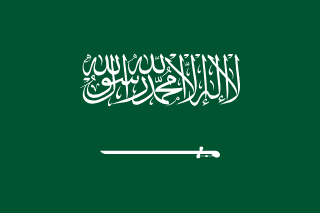
| Flag | Saudi Arabia Flag |
|---|---|
| Country | Saudi Arabia |
| Capital | Riyadh |
| Continent | Asia |
| Official Languages | Arabic |
| Currency | Saudi Riyal (SAR) |
| Dialling Code | +966 |
Saudi Arabia Flag Meaning
Flag Design
The Saudi Arabian flag is a green rectangle with a 2:3 width-to-length ratio. At the center, the Shahada (Islamic declaration of faith) is written in white Arabic calligraphy: “There is no god but Allah; Muhammad is the Messenger of Allah.” Below the text, a white curved sword is depicted, with its hilt on the side nearest the flagpole and the tip pointing outward. No other symbols or patterns are present. The combination of green, white, and elegant calligraphy gives the flag a simple yet dignified appearance.
Meaning
Green is a traditional color in Islam, symbolizing life, prosperity, and peace, and is said to have been the color of the Prophet’s banner. The Shahada at the center represents the core of Islamic faith and affirms Saudi Arabia’s role as the birthplace of Islam and guardian of its holy sites. White stands for purity and peace, while the curved sword symbolizes justice, strength, and the determination to defend faith and nation. It also reflects the legacy of Abdulaziz Ibn Saud in unifying the Arabian Peninsula. Together, the sword and the Shahada express both religious conviction and national resolve, making this flag one of the most recognizable in the world—it is likely the only national flag featuring a religious declaration rather than geometric patterns.
History and Legal Status
The current flag design dates back to the 1930s during Ibn Saud’s unification of the peninsula, featuring green with the Shahada and sword. The curved sword was officially adopted in 1938, and on March 15, 1973, the Saudi government standardized the calligraphy, sword shape, and proportions.
Because the flag includes the Shahada, Saudi Arabia’s flag is one of the few in the world that is identical on both sides—the text must face the correct direction, requiring double-sided weaving. Additionally, the flag must never be flown at half-mast, printed on clothing, packaging, or merchandise, or used for commercial or disrespectful purposes. Foreign visitors should treat items bearing the flag with utmost respect.
Saudi Arabia Overview
Country Details »Overview of Saudi Arabia
Saudi Arabia (Arabic: المملكة العربية السعودية) is located on the Arabian Peninsula in the southwest of Asia, covering about 80% of the peninsula’s total area. It borders Jordan, Iraq, and Kuwait to the north, the Persian Gulf to the east (with Qatar, the UAE, and Oman as neighbors), Yemen to the south, and the Red Sea to the west. With a land area of approximately 2.15 million square kilometers, it is one of the largest countries in the Middle East. The country has a population of around 37 million, and its capital, Riyadh, located on the central plateau, serves as the political, economic, and administrative center.
Saudi Arabia is a monarchy, where the king is both the head of state and government, and also holds the title of Custodian of the Two Holy Mosques, responsible for protecting Mecca and Medina. The throne is passed down within the House of Saud. The country is divided into 13 provinces, with Islam as the state religion, and the Quran and Hadith serving as the fundamental basis for governance. Thanks to its abundant oil resources and religious significance, Saudi Arabia plays a pivotal role in the Arab world and the global energy landscape.
Geography and Climate
Saudi Arabia’s terrain is dominated by plateaus and deserts. The Red Sea coast features narrow coastal plains and coral reefs, while the Persian Gulf coast is an important oil-producing region and port area. The Rub' al Khali Desert (meaning "The Empty Quarter") in the southeast is one of the world’s largest continuous sand deserts. The central region is the Najd Plateau, and the southwestern Asir and Taif areas consist of mountainous regions, with peaks reaching around 3,000 meters—popular summer retreats. There are no permanent rivers or lakes in the country, and water supply mainly relies on groundwater, desalination, and recycled water.
The climate is tropical desert, with inland cities often experiencing temperatures above 40°C in summer (June to August), and some areas reaching up to 50°C. Winters (December to February) are milder, with Riyadh daytime temperatures around 15–20°C and cooler nights. The Red Sea coast remains warm and humid year-round, suitable for beach activities. Rainfall is scarce and mostly occurs in winter and spring, with slightly more precipitation in the southwestern mountains. Travelers should prioritize sun protection, hydration, and avoiding outdoor activities during midday heat.
Historical Background
The Arabian Peninsula has long been a key route for ancient spice trade and commerce. Even before the rise of Islam, Mecca was already a hub for trade and religion. In the 7th century, the Prophet Muhammad spread Islam in Mecca and Medina, establishing the region as the birthplace of Islamic civilization. The peninsula later came under the influence of the Arab and Ottoman Empires, becoming an important crossroads between East and West.
In the mid-18th century, the House of Saud allied with Wahhabi scholars in Diriyah to establish the First Saudi State, which was later destroyed by Ottoman and Egyptian forces. In the early 20th century, Abdulaziz Ibn Saud unified the Najd and Hejaz regions, and officially founded the Kingdom of Saudi Arabia on September 23, 1932—now celebrated as Saudi National Day. Oil was discovered in the east in 1938, dramatically transforming the nation’s fortunes. In 2016, Saudi Arabia unveiled Vision 2030 to diversify its economy and open up society. In 2019, it began issuing tourist visas to multiple countries for the first time, ushering in rapid growth in the tourism sector.
Economy and Currency
Saudi Arabia is one of the world’s most important oil producers and exporters. Its national oil company, Saudi Aramco, is among the highest-valued corporations globally. Oil and petrochemical products have long accounted for the majority of export and fiscal revenues. To reduce dependence on oil, Saudi Arabia launched Vision 2030, focusing on developing tourism, entertainment, logistics, renewable energy, and manufacturing. Flagship projects include the NEOM smart city, the Red Sea resort, and the development of AlUla.
The capital, Riyadh, is the financial and administrative hub, while Jeddah serves as the Red Sea gateway and a commercial center. The official currency is the Saudi Riyal (SAR, symbol ﷼), issued by the Saudi Central Bank. It has long been pegged to the US dollar at an exchange rate of approximately 1 USD = 3.75 SAR, a stability that has made the Riyal one of the most dependable currencies in the Middle East.
Culture and Society
As the birthplace of Islam, religion plays a central role in Saudi society. During the five daily prayer times, shops and businesses briefly close, and eating or drinking in public during Ramadan is prohibited. Millions of pilgrims visit Mecca and Medina annually. Over the past decade, Saudi society has undergone significant changes: restrictions on women driving and working have been lifted, cinemas, concerts, and large-scale entertainment events have emerged, and dress codes for foreign tourists have relaxed. However, it’s still important to respect local customs—women are advised to wear modest clothing covering the shoulders and knees, and men should avoid shorts in public.
Traditional Saudi culture includes camel culture, poetry, Arabic coffee, and the hospitality of dates. Alcohol is completely banned, and it is illegal to bring alcoholic beverages into the country or purchase them locally. Public displays of affection should be avoided, and permission should always be asked before photographing people, especially women.
Tourism Overview
Saudi Arabia’s tourism industry has grown rapidly in recent years. Riyadh boasts the UNESCO-listed Diriyah Old Town, the National Museum, and the Kingdom Centre. Jeddah is known for its Red Sea beaches and the historic Al-Balad district. The Asir Mountains near Taif offer cool retreats, including the Green Mountain Cable Car. Northwest Saudi Arabia’s AlUla preserves Nabatean rock tombs at Hegra (Madain Salih) and the Elephant Rock, a UNESCO World Heritage archaeological site. The Red Sea coast is ideal for diving and relaxation, while the Rub' al Khali Desert and Jebel Fihrayn (Edge of the World) are popular for adventure and stargazing.
Note that non-Muslims are not allowed to enter Mecca, and there are similar restrictions in Medina—plan accordingly. Additionally, distances between Saudi attractions are considerable, so driving, private car hire, or domestic flights are efficient options.
Saudi Arabia Travel Guide
All Guides »Saudi Arabia Solo Travel Quick Guide: Visas, Seasons, Budget, and Religious Etiquette
How to apply for an e-visa, which seasons are most comfortable to visit, daily s...
Classic 7-Day Itinerary in Saudi Arabia: Riyadh, AlUla, and Jeddah 7 days
From the history and skyline of the capital, to the Nabatean rock tombs and dese...
4-Day Short Trip to Saudi Arabia: Riyadh City and Desert Heritage Sites 4 Days
Even with just four days, you can have a fulfilling experience: base yourself in...
Essential Attractions in Saudi Arabia: Riyadh, AlUla, Jeddah, and the Red Sea
Organized by direction — capital city, northwest archaeological region, Red Sea ...
Saudi Arabia Food Guide: How to Eat Kabsa, Mandi, and Arabic Coffee
Saudi tables revolve around spiced rice, grilled meats, and dates. From national...
Saudi Arabia Transportation Guide: Ride-Hailing Apps, Car Rental, and Haramain High-Speed Rail
Cities in Saudi Arabia are far apart with frequent flights. Within cities, ride-...