Tunisia Flag
The proportions, colors, and history of Tunisia's flag - a banner that tells Tunisia's own story.
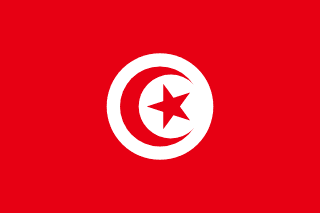
| Flag | Tunisia Flag |
|---|---|
| Country | Tunisia |
| Capital | Tunis |
| Continent | Africa |
| Official Languages | Arabic |
| Currency | Tunisian Dinar (TND) |
| Dialling Code | +216 |
Tunisia Flag Meaning
Flag Design
The Tunisian flag is a rectangular red field with a white circle in the center. Inside the white circle is a red crescent moon and a red five-pointed star, with the crescent opening upward and the star positioned inside it. The flag has a 2:3 aspect ratio, with a design dominated by red and white, and the central circle and crescent-star forming a strong visual focus. This flag design dates back to the 19th-century Beylik of Tunis period. After independence in 1956, it was retained with minor modifications and officially confirmed as the national flag in the 1959 constitution.
Symbolism
Red symbolizes the blood of martyrs who sacrificed for freedom and independence, as well as the courage of the Tunisian people in resisting foreign domination. White stands for purity and peace. The crescent and star are classic Islamic symbols, also widely recognized globally, representing faith and national unity. The juxtaposition of red and white, with the crescent and star within the circle, gives the Tunisian flag high visibility among Arab nation flags. The shared red color of the star and crescent is also interpreted as a reflection of national unity and resolve.
History and Legal Status
The origins of this flag can be traced back to the Husainid Dynasty of Tunis around 1831, when the ruler ordered the adoption of a flag featuring a crescent and star to distinguish it from the Ottoman flag. The flag remained in use during the French protectorate period and continued after Tunisia’s independence in 1956. The 1959 constitution officially designated it as the national flag. Minor adjustments were made around 1999 to standardize the proportions and colors.
Today, this flag is flown at Tunisian government buildings, schools, airports, and embassies abroad, and is prominently displayed during national holidays and sporting events. It carries the memory of the Mediterranean heritage since Carthaginian times and symbolizes the national identity of modern Tunisia as an independent republic.
Tunisia Overview
Country Details »Tunisia Overview
Tunisia (officially the Republic of Tunisia) is located at the northernmost tip of the African continent, bordered by the Mediterranean Sea to the north and east, Algeria to the west, and Libya to the southeast. Covering an area of approximately 163,600 square kilometers, it is the smallest country in the Maghreb region. The capital, Tunis, lies on a narrow strip of land between Lake Tunis and the Mediterranean Sea in the northeastern coastal area, and serves as the country’s political, economic, and cultural hub. Tunisia sits at a strategic crossroads along historic east-west Mediterranean maritime routes and faces Italy’s Sicily Island across the Strait of Tunis, making it a longstanding connection point between Africa and Europe, as well as the East and West.
Tunisia gained independence from French protectorate rule in 1956 and abolished the monarchy to become a republic in 1957. Its first president, Habib Bourguiba, introduced major reforms in education and women’s rights, helping establish Tunisia as one of the more socially progressive nations in the Arab world. From late 2010 to early 2011, the country experienced what became known internationally as the Jasmine Revolution, a popular uprising that inspired political change across the region. In 2014, Tunisia adopted a new constitution and held democratic elections for parliament and the presidency.
Geography and Climate
Tunisia’s landscape is generally divided into three regions from north to south: the northern area features low mountains and fertile valleys that extend from the Tell Atlas range, with a humid climate suitable for growing wheat, olives, and citrus fruits; the central region is made up of inland plateaus and grasslands (steppes), where cities such as Kairouan and Sousse are located, along with extensive olive cultivation; the southern part gradually transitions into the Sahara Desert, with landmarks such as the Chott el Jerid salt flats and oases like Tozeur and Djerba, leading to the vast sand dunes of the Grand Erg Oriental.
Climatically, the northern coastal zone enjoys a Mediterranean climate with mild, wet winters and hot, dry summers. The inland and southern areas experience a semi-arid to desert climate, with significant daily temperature swings and summer highs that often exceed 40°C. The Mediterranean coastline is most popular in the summer, while historical sites and desert areas are better visited in spring, autumn, or winter. The peak beach season runs from May to September, while the cooler months from October to April are ideal for sightseeing in cities and exploring the desert.
Historical Background
Tunisia’s history reflects the influence of many civilizations. In 814 BC, Phoenician settlers from the eastern Mediterranean established Carthage, which grew into a powerful commercial empire across the western Mediterranean. The legendary Carthaginian general Hannibal famously led his forces across the Alps to challenge Rome, a key moment in ancient military history. In 146 BC, Carthage was destroyed by Rome during the Third Punic War, but the Romans later rebuilt the city nearby. Tunisia then became the center of the Roman province of Africa, supplying grain and olive oil to the empire and earning the nickname “breadbasket of Rome.”
In the 7th century, Arab armies conquered the region and founded the city of Kairouan in 670, initiating the spread of Islam across the Maghreb. Over the following centuries, the area was governed by various dynasties, including the Aghlabids, Fatimids, and Hafsids. From the 16th century, it fell under Ottoman influence, and during the 19th century, French colonial power increased until Tunisia officially became a French protectorate in 1881. After gaining independence in 1956, Tunisia became the first Arab country to adopt secular reforms. The Jasmine Revolution of 2011 brought it back into the global spotlight as a catalyst for regional political transformation.
Economy and Currency
Tunisia’s economy relies mainly on services, manufacturing, and agriculture. Tourism is a major source of foreign income, and key exports to Europe include textiles, garments, electronic wiring, and mechanical parts. The agricultural sector focuses on olive oil, dates, citrus fruits, and grains, and the country also has a long history of phosphate mining. The national currency is the Tunisian Dinar (TND), issued by the Central Bank of Tunisia. Tunisia maintains strict foreign exchange controls, and the dinar is not freely convertible. Regulations govern the import and export of both local and foreign currency.
Culture and Society
Tunisian culture blends Mediterranean influences with Arab-Islamic traditions. Historical sites from Carthage and Rome, vibrant souks and mosques in traditional medinas, and distinctive blue-and-white Andalusian-style architecture all contribute to a unique cultural setting. The vast majority of the population is Muslim, and social norms are generally moderate and open, with women actively involved in public life. French is commonly spoken in tourism, business, and education, alongside Arabic.
Tunisian cuisine features ingredients such as harissa chili paste, olive oil, tomatoes, and a variety of spices. Couscous is the national dish, and other local favorites include fried triangular pastries (brik), stews (tajine), and spiced lamb soup (lablabi). Mint tea with pine nuts and strong coffee are important elements of local hospitality.
Tourism Overview
Tunisia is one of the most developed and affordable travel destinations in North Africa. It is home to eight UNESCO World Heritage Sites, including the medina of Tunis, the ruins of Carthage and Dougga, the Great Mosque of Kairouan, the medina of Sousse, the Roman amphitheater of El Djem, and Ichkeul National Park. Visitors can enjoy the Mediterranean coast and urban attractions in Tunis and Hammamet, explore the southern Sahara to see sand dunes, oases, and cave dwellings in places like Djerba, Tozeur, and Matmata, or visit iconic Star Wars filming locations in southern Tunisia. Tunisia’s mix of historical sites, natural beauty, and affordability makes it a great choice for first-time visitors to North Africa.
Tunisia Travel Guide
All Guides »Tunisia Pre-Travel Guide: Visa-Free Entry, Best Seasons, Budget, and Etiquette Taboos
Learn how to enter visa-free, which season is most comfortable, how much you’ll ...
Tunisia 7-Day Classic Route: Tunis – Kairouan – Sousse – Sahara 7 days
From the Mediterranean medinas and Carthage, to Kairouan, Dougga, and deeper int...
Tunisia 4-Day Itinerary: In-Depth Exploration of Tunis and the Northern Coast 4 days
Make the most of limited time by exploring the north: connect Medina, Bardo, Car...
Essential Attractions in Tunisia: From Carthage to Sahara Oases
A region-by-region guide to Tunisia’s most significant UNESCO World Heritage Sit...
Tunisia Food Guide: Couscous, Brik, and Harissa
The flavors of Tunisia—built from spicy sauces, olive oil, and tomatoes—start wi...
Tunisia Transport Guide: TGM Trams, Trains, Louages, and Airport Transfers
In Tunis, use TGM trams; for intercity travel, take trains or louage minibuses; ...