Dominican Republic Flag
The proportions, colors, and history of Dominican Republic's flag - a banner that tells Dominican Republic's own story.
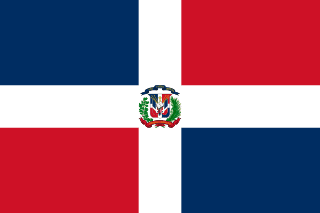
| Flag | Dominican Republic Flag |
|---|---|
| Country | Dominican Republic |
| Capital | Santo Domingo |
| Continent | North America |
| Official Languages | Spanish |
| Currency | Dominican Peso (DOP) |
| Dialling Code | +1 809 / 829 / 849 |
Dominican Republic Flag Meaning
Flag Design
The Dominican flag is rectangular, with a width-to-length ratio of about 2:3. A white cross in the center divides the flag into four rectangles: blue on the top-left and bottom-right, and red on the top-right and bottom-left. The cross intersects at the center, where the national coat of arms is superimposed on a white square. The width of the white cross is about one-third of the flag’s height, and the color blocks are diagonally symmetrical, giving the flag a highly distinctive appearance among national flags in the Americas.
Meaning
Blue symbolizes the sky fought for freedom and the patriotic spirit of heroes; red represents the blood shed during the struggle for independence and the vitality of the nation. The white cross stands for peace, redemption, and the sacrifices of the people. At the center of the flag is the national coat of arms, featuring an open Bible with a golden cross and blue and red rays above it, flanked by the Dominican flag and spears, encircled by laurel branches. A ribbon bears the national motto “Dios, Patria, Libertad” (God, Homeland, Liberty), with the country name inscribed below.
History and Legal Status
The flag was designed by Juan Pablo Duarte, one of the founding fathers, during the 1830s under the secret independence society “La Trinitaria.” It was first raised on the gates of Santo Domingo on February 27, 1844, the day the Dominican Republic declared independence from Haiti — a date now celebrated as National Independence Day. The 1844 Constitution officially established the flag’s legal status. Initially, the central cross was plain white, but the national coat of arms was later added at its center. On National Day, Santo Domingo holds grand parades and flag-raising ceremonies. The flag is displayed at government buildings, schools, embassies, consulates, and on balconies across the country.
Dominican Republic Overview
Country Details »Overview of the Dominican Republic
The Dominican Republic (República Dominicana) is located on the eastern part of Hispaniola Island in the Greater Antilles of the Caribbean Sea. It borders Haiti to the west, faces the Atlantic Ocean to the north, the Caribbean Sea to the south, and is separated from Puerto Rico by the Mona Passage to the east. With a land area of approximately 48,671 square kilometers, it is the second-largest and second-most populous country in the Caribbean. Its capital, Santo Domingo, situated on the southern coast, is the oldest European-founded city in the Americas.
Note: The Dominican Republic is a completely different country from Dominica, an English-speaking Commonwealth island nation in the Eastern Caribbean. The former speaks Spanish and uses the Dominican Peso, while the latter speaks English and uses the East Caribbean Dollar. Be sure not to confuse the two when booking flights or hotels. The Dominican Republic is a presidential republic, divided into 31 provinces and 1 national district. Tourism and remittances are key pillars of its economy.
Geography and Climate
The Dominican Republic features a mountainous terrain, with the Cordillera Central mountain range running through the center of the country. Its highest peak, Pico Duarte, rises 3,098 meters above sea level, making it the tallest point in the Caribbean. The country has fertile valleys and plains, along with long stretches of white-sand beaches along the northern and eastern coasts — the most famous being the coral sand beaches from Punta Cana to Bávaro on the east coast. Lake Enriquillo is one of the largest lakes in the Caribbean and is also a rare inland saltwater lake below sea level in the region.
The country has a tropical maritime climate, with an average annual temperature of around 25 degrees Celsius, cooler in the mountains. The dry season from December to April is the peak tourist season, while the rainy season lasts from May to November, with more active hurricane activity between August and October. The Samaná Peninsula in the northeast is covered in dense rainforests and hosts thousands of humpback whales migrating from the North Atlantic to Samaná Bay between January and March to mate and give birth, making it one of the world’s top whale-watching destinations.
Historical Background
Christopher Columbus first landed in the Americas on Hispaniola Island in 1492. In 1496, his brother Bartholomew Columbus established Santo Domingo on the southern coast of the island — the first permanent European settlement in the Americas. During the early colonial period, it served as the capital of the Spanish Empire in the Americas. The Americas’ first cathedral, first university, first street, and first fortress were all built here. Today, the Colonial City of Santo Domingo is a UNESCO World Heritage Site.
In 1697, the western part of the island was ceded to France, forming the division between present-day Dominican Republic and Haiti. The country briefly declared independence in 1821 but was annexed by Haiti for 22 years. On February 27, 1844, independence was proclaimed by founding father Juan Pablo Duarte, establishing the Dominican Republic. Since then, the country experienced brief Spanish reconquest, U.S. military occupation (1916–1924), and over thirty years of authoritarian rule under the Trujillo family before gradually transitioning to a constitutional democracy after the civil war in 1965.
Economy and Currency
The Dominican Republic is one of the largest economies in the Caribbean, with a diverse economic structure: tourism, manufacturing in free trade zones (textiles, medical equipment, electronics), mining (gold, silver, nickel), and agriculture (cocoa, coffee, cigars, bananas) are all key sectors. It is a globally recognized exporter of cigars, with the Cibao Valley in the north being a prime tobacco-growing region. The national currency is the Dominican Peso (DOP), issued by the Central Bank of the Dominican Republic, denoted as RD$.
In recent years, the country has maintained economic growth rates that outpace the Latin American average. Tourism attracts millions of international visitors annually, with Punta Cana Airport being one of the busiest in the Caribbean. The large Dominican diaspora in the United States also contributes significantly to the economy through remittances.
Culture and Society
Dominican culture is a blend of Spanish, African, and Taíno indigenous influences. Spanish is the official language, and the majority of the population is Roman Catholic. Music is central to Dominican identity: Merengue is a UNESCO-listed Intangible Cultural Heritage, known for its lively rhythm and easy dance steps; Bachata, with its passionate style, has gained worldwide popularity and live bands can often be heard performing in streets and venues across Santo Domingo and other cities.
Baseball is the national sport, and hundreds of Dominican players compete in Major League Baseball (MLB), making it one of the top countries for baseball talent export. Traditional Dominican cuisine includes “La Bandera” (the flag) for lunch — white rice, red beans, and stewed meat — and “Mangu” for breakfast — mashed plantains served with eggs and fried cheese. Rum and freshly squeezed juice are staples at meals.
Tourism Overview
The Dominican Republic is the most visited country in the Caribbean. Punta Cana in the east is famous for all-inclusive resorts, pristine white-sand beaches, and top-tier golf courses, making it a favorite for vacationers. The capital, Santo Domingo, offers rich history and culture, with the Americas’ first cathedral and Columbus’s palace nearby. Puerto Plata in the north features natural limestone waterfalls like Damajagua, ideal for cliff jumping. The Samaná Peninsula in the northeast is ideal for whale watching, island hopping to Cayo Levantado, and exploring well-preserved rainforest waterfalls.
With four international airports connecting to major cities in Europe and the Americas, a well-developed network of intercity buses and private transfers, and relatively affordable prices compared to other Caribbean destinations, the Dominican Republic suits a wide range of travel styles — from all-inclusive beach holidays to in-depth island exploration.
Dominican Republic Travel Guide
All Guides »Dominican Republic Travel Quick Guide: Visas, Seasons, Budgets & Local Etiquette
Before traveling to the Dominican Republic, understand visa options, dry season ...
Classic 7-Day Dominican Republic Itinerary: Colonial City – Samaná Whale Watching – Punta Cana 7 days
Experience historic cities, premier whale-watching sites, and resort beaches in ...
Dominican Republic 4-Day Short Trip: All-Inclusive Resort Experience in Punta Cana 4 days
Perfect for travelers who prefer a relaxed pace: four full days on the beach, pl...
Must-visit attractions in the Dominican Republic: Colonial City, Samaná Bay for whale watching, and waterfall cliff jumps
From the UNESCO-listed Colonial City to Samaná whale watching and the 27 Waterfa...
Dominican Republic Food Guide: National Flag Meal, Bachata Eateries & Street Flavors
Understanding the Dominican Table: National Lunch La Bandera, Breakfast Mangu, C...
Complete Guide to Transportation in the Dominican Republic: Getting to and from Airports, Intercity Buses, and Ride-Hailing Apps
How to choose among four international airports, take first-class buses or share...