Nepal Flag
The proportions, colors, and history of Nepal's flag - a banner that tells Nepal's own story.
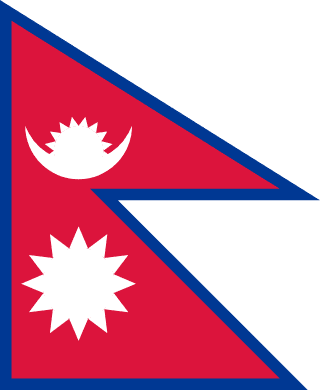
| Flag | Nepal Flag |
|---|---|
| Country | Nepal |
| Capital | Kathmandu |
| Continent | Asia |
| Official Languages | Nepali |
| Currency | Nepalese Rupee (NPR) |
| Dialling Code | +977 |
Nepal Flag Meaning
Flag Design
The Nepalese flag is the only non-rectangular national flag in the world, consisting of two overlapping right-angled triangles (a pennant shape). The flag is deep red with dark blue borders. The upper triangle contains a white crescent moon with eight rays, and the lower triangle features a white sun with twelve rays. The flag’s proportions are not defined by simple measurements but are determined by a geometric construction method specified in the constitution, so it must be made according to official guidelines and cannot be arbitrarily resized.
Meaning
The deep red color symbolizes the rhododendron, Nepal’s national flower, representing courage and national unity. The dark blue border stands for peace and harmony. The moon and sun were historically emblems of two ruling families, but today they symbolize the hope that Nepal will last as long as the sun and moon. The two triangles represent both the Himalayan peaks and the coexistence of Buddhism and Hinduism, reflecting Nepal’s multi-ethnic and multi-faith society.
History and Legal Status
The double-triangle flag dates back to the Shah and Rana periods of the 19th century, when the two triangular flags represented the royal family and the government respectively. In the mid-20th century, the two flags were merged into one and used de facto for a long time. In 1962, the shape and construction method were formally established in the constitution, and the human faces on the sun and moon were removed, resulting in the current design.
As the world’s only non-rectangular national flag, it is not only a national symbol of Nepal but also a source of pride, appearing on government buildings, schools, trekking trailheads, and souvenirs for tourists.
Nepal Overview
Country Details »Nepal Overview
Nepal (officially the Federal Democratic Republic of Nepal) is a landlocked mountainous country located in the southern foothills of the Himalayas. It borders Tibet (China) to the north and India to the east, south, and west. The country covers an area of approximately 147,181 square kilometers, with terrain that transitions from the Terai Plain in the south to the hills and then the high Himalayas in the north, with elevations ranging from below 100 meters to the world’s highest peak. The capital, Kathmandu, is situated in the Kathmandu Valley and serves as the political, economic, and cultural center of the country.
The population is around 30 million, with Nepali as the official language. English is widely spoken in tourist areas. Nepal is the only country in the world with a non-rectangular national flag. The dominant religion is Hinduism, which coexists closely with Buddhism. The 2015 constitution established a federal system, dividing the country into seven provinces.
Geography and Climate
Of the world’s 14 peaks over 8,000 meters, eight are located in Nepal, including Mount Everest (known locally as Sagarmatha, at 8,848.86 meters). The dramatic vertical relief includes the Terai Plain in the south at less than 200 meters above sea level with a hot climate, the Kathmandu Valley at around 1,400 meters with a mild climate, Pokhara at about 800 meters where snow-capped peaks reflect in lakes, and the northern high mountains and trekking routes that are snow-covered year-round.
The climate is generally divided into four seasons: spring (March–May) sees rhododendron blooms and is one of the best times for climbing and trekking; the monsoon season (June–September) brings heavy rain, slippery trails, and landslides; autumn (October–November) offers the clearest skies and best mountain views, making it the prime trekking season; winter (December–February) is cold at high altitudes but still suitable for sightseeing at lower elevations. Air pollution in the Kathmandu Valley can be heavy, so wearing a mask is advised.
Historical Background
The Kathmandu Valley has long been the center of the Newar civilization, with the Licchavi and Malla dynasties leaving behind many temples and palaces. In 1768, Prithvi Narayan Shah unified the various principalities to establish the Shah dynasty, forming the foundation of modern Nepal. From the mid-19th century, the Rana family ruled for a long period, isolating the country internationally. The Shah monarchy was restored in 1951, and the country became a constitutional monarchy in 1990.
From 1996 to 2006, Nepal experienced a decade-long armed conflict; in 2001, a royal massacre took place; in 2008, the Constituent Assembly abolished the monarchy and declared the country a federal democratic republic. In 2015, a major earthquake struck the Kathmandu Valley and Everest region, damaging many historical sites, leading to a long reconstruction period. The same year, a new constitution established the federal system and the division into seven provinces.
Economy and Currency
Nepal’s economy is primarily agricultural, with main crops including rice, maize, wheat, tea, and medicinal herbs. Key economic pillars also include hydropower development, tourism, and remittances from overseas workers. Although rich in hydropower resources, development remains limited. Tourism attracts global visitors for trekking, mountaineering, and cultural experiences.
The official currency is the Nepalese Rupee (NPR, symbol Rs or रू), issued by the Nepal Rastra Bank. The rupee has a long-standing fixed exchange rate with the Indian Rupee, at 1 Indian Rupee = 1.6 Nepalese Rupees, contributing to overall currency stability. Indian Rupees are accepted in Nepal, but large denomination notes (e.g., 500 and 1,000) are often refused.
Culture and Society
Nepal is a blend of Hinduism and Buddhism. Pashupatinath Temple is an important Shiva shrine, while Boudhanath Stupa and Swayambhunath (Monkey Temple) are major centers of Tibetan Buddhism. Lumbini is the birthplace of the Buddha. The living goddess Kumari is a unique tradition of the Newar people. Major festivals include Dashain (September–October), the most important national holiday, Tihar with its illuminated streets, Holi with colored powders, and Indra Jatra featuring chariot processions.
The national dish is dal bhat (lentil soup with rice), and other local specialties such as momo (dumplings), thukpa (noodle soup), sel roti (rice bread), and yak yogurt are worth trying. A common greeting is a “Namaste” with hands pressed together. Shoes are usually removed before entering temples or homes, and items are passed or received with the right hand.
Tourism Overview
Nepal is a paradise for trekkers and pilgrims. The three Durbar Squares in the Kathmandu Valley, Boudhanath Stupa, Swayambhunath, and Pashupatinath form a UNESCO World Heritage Site ensemble. Pokhara is famous for Phewa Lake, sunrise views from Sarangkot, and the Annapurna range, and is a top destination for paragliding. The Everest Base Camp trek and the Annapurna Circuit and ABC treks attract mountaineers from around the world. Chitwan National Park offers close encounters with one-horned rhinos and Bengal tigers. Lumbini is the ultimate pilgrimage site for Buddhists. Trekking requires obtaining a TIMS card and park permits, and it’s wise to allow time for altitude acclimatization.
Nepal Travel Guide
All Guides »Nepal Travel Quick Guide: Visa Processing, Trekking Seasons, Budget Tips & Religious Etiquette
Learn how to get a visa on arrival, the best months for trekking, how to budget,...
Classic 8-Day Nepal Itinerary: Kathmandu Valley, Pokhara, and Chitwan 8 days
This route connects an ancient capital, a snowy mountain lake city, and a jungle...
Nepal 4-Day Short Trip: In-Depth Guide to World Heritage Sites in the Kathmandu Valley 4 days
Stay close to home and explore the Kathmandu Valley, the area with the highest c...
Essential Attractions in Nepal: Ancient Valley Capitals, Pokhara’s Snowy Peaks, and Himalayan Treks
From the UNESCO World Heritage sites of Kathmandu to the snow-capped lakes of Po...
Nepal Food Guide: Mountain Flavors of Lentil Soup Rice, Dumplings, and Trekking Teahouses
Nepali cuisine is simple yet filling. Lentil soup rice and dumplings are must-tr...
Nepal Transportation Guide: Tourist Buses, Domestic Flights, Ride-Hailing Apps, and Trekking Permits
How to get from the airport into town, whether to take a bus or flight from Kath...