Malawi Flag
The proportions, colors, and history of Malawi's flag - a banner that tells Malawi's own story.
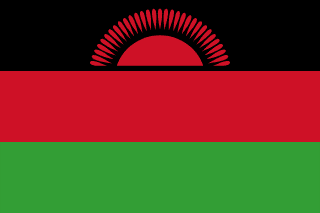
| Flag | Malawi Flag |
|---|---|
| Country | Malawi |
| Capital | Lilongwe (administrative), Blantyre (economic) |
| Continent | Africa |
| Official Languages | English, Chichewa |
| Currency | Malawian Kwacha (MWK) |
| Dialling Code | +265 |
Malawi Flag Meaning
Flag Design
The Malawian flag consists of three equal horizontal stripes: black at the top, red in the middle, and green at the bottom, in a 3:2 ratio. A red rising sun with a semi-circular shape and upward rays is centred on the black stripe. The combination of three horizontal bands and the central emblem gives it a visual resemblance to flags of other East African nations, such as Kenya.
Meaning
Black represents the people of Africa and their skin colour; red commemorates the blood and courage of those who fought for independence; green symbolises the country’s vegetation and nature; the rising sun signifies the dawn of freedom and hope in Africa, expressing aspirations for the continent’s future. Together, these colours form a bold national statement and are a key symbol of Malawian identity. The three colours and the rising sun encapsulate themes of land, people, sacrifice, and hope in a single, striking design.
History and Legal Status
The Malawian flag was officially adopted on July 6, 1964, the day of independence, replacing the colonial flag. In 2010, the Malawian parliament approved a design change featuring three horizontal stripes (red, black, green) with a white full sun in the centre, which sparked considerable domestic controversy. In 2012, the original 1964 flag was reinstated by parliamentary vote and remains in use today. The flag’s colour scheme is directly inherited from the flag of the Malawi Congress Party, the leading independence movement party, symbolising the close link between the independence struggle and national identity. The rising sun also appears on the Malawian coat of arms and government emblems, serving as a core element of the national image.
Malawi Overview
Country Details »Overview of Malawi
Malawi (officially the Republic of Malawi) is a landlocked country in southeastern Africa, bordered by Tanzania to the north, Mozambique to the east and south, and Zambia to the west. It covers an area of about 118,500 square kilometres and has a long, narrow shape from north to south. The capital, Lilongwe, is the administrative centre, while the largest city, Blantyre, is the economic and commercial hub. The third-largest city, Zomba, was the colonial capital. The official languages are English and Chichewa. Known for its friendly people and peaceful society, Malawi is often called the “Warm Heart of Africa” by travellers.
Malawi is a presidential republic divided into three regions—Northern, Central, and Southern—comprising 28 districts. Its economy is primarily agricultural, and it is one of the least developed countries in the world. However, its simple lifestyle and low cost of living make it a great destination in southern Africa for immersive overland travel and lakeside holidays.
Geography and Climate
The East African Rift Valley runs from north to south through Malawi, forming the famous Lake Malawi, also known as Lake Nyasa. Covering about 29,600 square kilometres—nearly a quarter of the country’s total area—Lake Malawi is the third-largest lake in Africa and the ninth-largest in the world, with a maximum depth of over 700 metres. It is home to more than 1,000 species of cichlid fish, most of which are endemic, making it a hotspot for evolutionary biology research and a paradise for divers. Lake Malawi National Park is a UNESCO World Heritage Site.
The terrain is higher in the west and lower in the east. The west consists of plateaus and mountains, while the south features the Shire River and Mulanje Mountain. The climate is tropical savanna, with a dry season (May–October) and a rainy season (November–April). Lowland areas around the lake are hot and humid, while the plateau regions have a milder climate. Towns at higher altitudes, such as Mzuzu, can get cool at night, so bring long sleeves and light jackets.
Historical Background
The earliest inhabitants of the Malawi region were the Khoisan people, later joined by Bantu migrants moving from west to east. Around the 15th century, the Maravi people established a kingdom that controlled trade routes for ivory, iron, and other goods between the interior and the Indian Ocean—the origin of the name “Malawi.” In the mid-19th century, Scottish missionary David Livingstone travelled along the Zambezi and Shire rivers into the region, promoting Western missionary work and colonial interests.
In 1891, the British declared the area a protectorate called Nyasaland. In 1953, Britain merged Nyasaland with Northern and Southern Rhodesia to form the Federation of Rhodesia and Nyasaland, sparking local nationalist movements. On July 6, 1964, Malawi gained independence under its first president, Hastings Banda, and became a republic in 1966. The first multi-party elections were held in 1994, and the political situation has remained generally stable since then.
Economy and Currency
Malawi’s economy is heavily reliant on agriculture, with about 80% of the population working in the sector. Tobacco is the top export crop, along with tea, sugar, cotton, and coffee. The country’s renowned highland tea-growing areas—such as Thyolo and Mulanje—produce high-quality tea, and the scenic tea estates have become emerging tourism attractions. The industrial base is weak, focusing mainly on agricultural processing, though tourism has been gradually developing in recent years.
The official currency is the Malawian Kwacha (MWK), issued by the Reserve Bank of Malawi. Foreign currency exchange for the kwacha, such as USD or EUR, is available at banks and authorised exchange bureaus, but exchange rates can be volatile. Travellers are advised to carry cash in USD or EUR for onshore exchange and keep small denominations for daily expenses.
Culture and Society
Malawi is a multi-ethnic nation, with major ethnic groups including the Chewa, Tumbuka, and Yao. Chichewa is the lingua franca, while English is the official language. Society is based on extended families and village communities, where elders hold high status. A respectful handshake often involves resting the left hand on the right forearm. Local music and dance are distinctive, with traditional dances like Gule Wamkulu (masked dance) and Vimbuza (healing dance) recognised by UNESCO as intangible cultural heritage.
The staple food is a cornmeal dish called nsima, usually served with vegetables, beans, or lake fish. Chambo, a type of tilapia from Lake Malawi, is considered the national dish. Grilled chambo with nsima is a classic lake-region meal. Malawians are generally friendly and talkative, and rural areas maintain rich traditions in handicrafts and markets.
Tourism Overview
Malawi’s tourism focuses on nature and lakes. Areas like Nkhata Bay and Cape Maclear on Lake Malawi are ideal for snorkelling, kayaking, sailing, and fish watching. Likoma Island, located in the lake, preserves a grand St. Peter’s Cathedral and tranquil island life. Liwonde National Park offers boat safaris to see hippos, elephants, and buffalo. During the dry season, wildlife gathers near the Shire River, creating some of Malawi’s most spectacular wildlife viewing—often called a “wildlife feast.” Mzuzu serves as the northern tourism gateway, with nearby attractions like Nyika Plateau and Vwaza Marsh.
Malawi is generally safer than some neighbouring countries, but travellers should still take care of their belongings, avoid walking alone at night, and consider travel insurance covering medical and emergency evacuation. Medical facilities in remote areas are limited, so prepare for mosquitoes and safe drinking water before your trip.
Malawi Travel Guide
All Guides »Malawi Independent Travel Quick Guide: Visas, Best Seasons, Budget, and Local Etiquette & Taboos
How to get a visa, when is the most comfortable time to visit, how much you migh...
Classic 7-Day Malawi Itinerary: Lilongwe – Lake Malawi – Liwonde – Blantyre 7 days
Explore the best of Malawi’s lakeside scenery and wildlife over a week, travelin...
Malawi 4-Day Short Trip Itinerary: Lake Malawi Relaxation and Liwonde National Park Wildlife 4 days
Even with limited time, you can experience the two most iconic highlights of Mal...
Must-visit attractions in Malawi: Lake Malawi, national parks, and southern highland scenery
A regional guide to Malawi’s top natural and cultural destinations, from the lak...
A Complete Guide to Malawian Cuisine: Nsima, Chambo Fish, and Flavors by Lake Malawi
From the national staple nsima to freshly grilled chambo fish by Lake Malawi, di...
Complete Guide to Transportation in Malawi: Airport Transfers, Travel Around Lake Malawi, and Private Car Hire
Malawi is a landlocked country where transportation mainly relies on road travel...