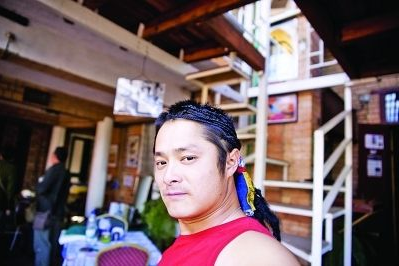
Zhang, who traveled alone in Africa
“Nanjing–Guangzhou–Shenzhen–Hong Kong–South Africa–Namibia—back to South Africa–Eswatini–Mozambique–Malawi–Zambia–Zimbabwe–Tanzania–Burundi–Rwanda–Uganda–Kenya–Madagascar–Mauritius–Thailand–Guangzhou–Nanjing.” From April 12 to October 26 of that year, in just over six months and spending less than $8,000 (around 49,000 RMB), a young man from Nanjing solo-traveled through 15 countries, crossing the entire African continent. Not only that, he also “ventured into” African jungles and took over 80,000 photos of more than 150 rare bird species.
A Nanjing University graduate quits his job to go on an African “adventure”
Experiencing the dream of “budget travel,” even bringing a “water heater” to warm up food
Yesterday morning, a post titled “A Thousand Birds, A Thousand Searches — An African Dream” appeared on the Xici Hutong forum. The post featured many photos of rare birds, with the poster labeling each species and briefly describing the shooting conditions. The post is still being updated and saw its click-through rate skyrocket to nearly 10,000 in just one day, quickly becoming a pinned post at the top of the forum. A reporter subsequently contacted the poster, Mr. Zhang, whose online name is “Taiping Su Da.” He is 34 years old, from Nanjing, and after graduating from the Physics Department of Nanjing University, he worked in the management of an internet company. But since childhood, he has had a deep love for nature and a passion for photography. In April 2012, he resolutely quit his job and came to the African savannah to embark on his adventure.
In the past, he often admired foreigners coming to China to travel, carrying big backpacks and walking through streets and alleys, which filled him with longing and envy. “When will I be able to travel so stylishly too?” Zhang thought to himself, and began to plan his trip abroad. In 2009, he traveled to Malaysia with several online friends, a destination relatively cheaper to visit. “I’ve forgotten how much I spent at the time, but it was definitely cheaper than joining a tour group.” This also marked the beginning of his “backpacker” life. He pursued his dream of “budget travel”: spending the least amount of money, visiting the most places, and maximizing savings.
Zhang introduced a cost-effective yet comfortable way to eat: bringing your own “water heater.” It turns out that many Chinese travelers abroad often struggle with the local food — foreigners usually eat cold meals, and hot food isn’t readily available everywhere. Staying outside for long periods can be tough on the stomach. One traveler came up with the idea of using a “water heater” to warm up food, and Zhang adopted the method too. Besides saving on food, he also minimized costs on accommodation. At each destination, he typically chose low-cost tent campsites, then bought relatively affordable and appetizing local dishes to cook himself, followed by sightseeing, chatting with locals, looking for birds, and taking photos.
Slept in a tent every day for over six months
Even with airfare included, spending only $8,000 still called “extravagant” by fellow travelers
Mr. Zhang told reporters that this trip to Africa was, in his eyes, a magnificent and thrilling journey: he hadn’t slept in a bed for over six months and slept in his own tent and sleeping bag every day. He mostly cooked for himself, buying various African delicacies and preparing them himself. He did many exciting things, including drinking bull’s blood with locals, going on one rafting trip, one bungee jump, one paragliding aerial photography session, two surfing trips, two mountain climbs, four canoe trips, six dives, twelve hikes, and sixteen wildlife tracking tours in national parks. The total cost was $8,000, which also included early equipment purchases and 11 flight segments. But Mr. Zhang still modestly said he spent too much. He concluded that he did too many activities, and foreign travelers often joked that he was “too extravagant.”
Before departure, his biggest worry was overcoming the “language barrier,” but upon arrival, he found it wasn’t actually a problem. “A smile is the best language,” Zhang said. His English wasn’t very advanced, but communicating wasn’t as hard as he had imagined. He joked that he combined high school-level English with sign-language-level gestures, yet everything went smoothly. His advice is to say thank you often and smile a lot. Once in South Africa, while looking for a dock, sudden heavy rain forced him to take shelter in a roadside bus stop, but the rain still poured down on him. As he bent over to look at a map, an umbrella appeared over his head. Looking up, he saw an elderly black grandmother in her 80s looking at him kindly and asking, “Child, do you need help?” Many such warm moments greatly benefited him. His greatest wish is to visit 108 countries before turning 50. Next, he plans to explore South America.
Traveled across six major African bird sanctuaries in search of birds
Currently selecting his 80,000 photos, planning to compile them into an album for publication
Mr. Zhang said that during this trip to Africa, one of his main personal missions was to seek out, observe, and photograph birds. He was inspired after watching a documentary about bird migration, which deeply moved him, and he immediately resolved to go to Africa—the place with the most well-preserved bird habitats—to find the kingdom of birds. This time, he specifically visited six bird sanctuaries in Tanzania, Kenya, Uganda, and Madagascar, admiring over 300 bird species and photographing more than 150 different ones. He was also fortunate enough to meet the British professional bird photography team TEES, and eventually, those Brits would invite him to join them in their vehicles when they went bird searching. Mr. Zhang said that the photos currently posted on Xici Hutong are just a small portion of what he took, as some bird names are still being organized and updates will continue. He will also include fun facts about various birds to help everyone better understand them. “I’m doing this simply to let more people learn about these little creatures and about nature. That’s all,” he explained in the end when talking about the purpose of his travels.
After returning home, he is now rigorously selecting the 80,000+ photos he took, planning to publish a selection in an album, and also preparing to submit his favorite works to some internationally renowned photography competitions.