St. Kitts and Nevis Flag
The proportions, colors, and history of St. Kitts and Nevis's flag - a banner that tells St. Kitts and Nevis's own story.
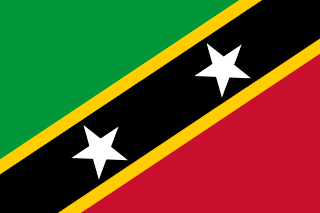
| Flag | St. Kitts and Nevis Flag |
|---|---|
| Country | St. Kitts and Nevis |
| Capital | Basseterre |
| Continent | North America |
| Official Languages | English |
| Currency | East Caribbean Dollar (XCD) |
| Dialling Code | +1-869 |
St. Kitts and Nevis Flag Meaning
Flag Design
The flag of Saint Kitts and Nevis is rectangular, with a 2:3 aspect ratio. A diagonal black stripe stretches from the bottom left to the top right, dividing the flag into two triangles: green on the upper left and red on the lower right. The black stripe is bordered with thin yellow lines, and features two white five-pointed stars aligned side by side. The color combination of green, yellow, black, red, and white—with its distinctive twin-star motif—makes it instantly recognizable among flags of the Lesser Antilles, symbolizing unity between the two islands.
Symbolism
Green represents the fertile land and agriculture, red stands for the struggle and sacrifice for freedom, and the yellow borders signify the sunshine that shines year-round. The black diagonal band represents the African heritage and resilience of the people. The two white stars symbolize Saint Kitts and Nevis respectively, with white standing for hope and freedom. Their placement side by side conveys the idea of the two federated nations advancing together in equality and hope. This design is also simplified and used in tourism logos and souvenirs.
History and Legal Status
The flag was designed by artist Edrice Lewis and selected in a national competition prior to independence. It was officially adopted on September 19, 1983, the day of independence. Flag protocols and usage guidelines are established by government regulations. The flag is prominently displayed at official buildings, schools, and during national events such as Independence Day (September 19) and the Sugar Mas festival. The twin-star motif also appears on the national coat of arms, passport, and tourism authority logo, symbolizing the unity of the two-island nation. During the independence celebrations, Basseterre is adorned with decorations in the national colors, and the twin-star flag is displayed widely.
St. Kitts and Nevis Overview
Country Details »Overview of Saint Kitts and Nevis
Saint Kitts and Nevis is located in the central Leeward Islands of the Lesser Antilles in the Caribbean Sea. It consists of two volcanic sister islands—Saint Kitts (approximately 168 square kilometers) and Nevis (approximately 93 square kilometers)—separated by a strait about 3 kilometers wide. The total land area is around 261 square kilometers, with a population of about 48,000. It is the smallest sovereign country by area and population in the Americas, as well as the world’s smallest federal state. Its capital, Basseterre, is situated on the southeastern coast of Saint Kitts. English is the official language, and the country is a member of the Commonwealth. Despite its small size, it is renowned for its high-quality holiday experiences and rich colonial heritage, representing understated luxury tourism in the Caribbean.
Geography and Climate
Both islands are of volcanic origin. The central part of Saint Kitts features Mount Liamuiga, an inactive volcano about 1,156 meters high, covered in dense rainforest and home to troops of black-faced vervet monkeys. The southeastern peninsula boasts largely undeveloped beaches and salt ponds, with clear waters and white sands at Conaree Bay and the Southeast Peninsula. Nevis is dominated by Mount Nevis, a 985-meter-high volcanic peak often shrouded in mist, surrounded by sugarcane fields and coconut groves. The climate is tropical maritime, with temperatures ranging from 24–30°C year-round. The dry season lasts from December to April, while the hurricane season runs from June to November. Tourist infrastructure is mainly concentrated along the coastal ring road.
Historical Background
Saint Kitts was the first British colony in the Caribbean. The British landed on Saint Kitts in 1623, followed by the French the next year. The two nations co-governed the island, which led to its nickname as the “Mother Colony of the West Indies.” Over the next two centuries, the sugar plantation economy and the transatlantic African slave trade shaped the islands’ societies. The 1782 French siege of Brimstone Hill Fortress was a notable battle in Caribbean colonial warfare. Saint Kitts and Nevis gained independence on September 19, 1983. Nevis enjoys a high degree of autonomy and retains the right to secede via referendum. In 1999, Brimstone Hill Fortress National Park was inscribed as a UNESCO World Heritage Site, the first cultural heritage site in the Eastern Caribbean.
Economy and Currency
Sugarcane cultivation was once the economic backbone, but after the closure of the state-owned sugar factory in 2005, tourism, financial services, and the Citizenship by Investment program (one of the world’s earliest passport investment schemes) became the three main pillars. The official currency is the East Caribbean Dollar (XCD, symbol EC$), issued by the Eastern Caribbean Central Bank. It is pegged to the US Dollar at a fixed rate of 2.7 XCD to 1 USD, making it a stable currency. Travelers can estimate the US dollar equivalent by dividing the local price by 2.7. ATMs are mainly found in Basseterre and Charlestown, with few rural locations, so withdraw enough cash before island-hopping tours. The cost of living is mid- to high-range by Caribbean standards, with long-established presence of upscale brands like Four Seasons resorts.
Culture and Society
Saint Kitts maintains strong British traditions, with cricket being the national sport. The August cultural festival and the post-Christmas Sugar Mas carnival ignite both islands with Soca music and street parades. Legend says Columbus named Saint Kitts after his patron saint, Saint Christopher, and locals often refer to the island as Liamuiga, meaning “fertile land.” The cuisine blends British and African flavors, with popular dishes like goat water stew, concocny drinks, and a rich rum culture. Common activities for visitors include cycling around the islands, monkey-watching hikes, and yachting.
Tourism Overview
Saint Kitts and Nevis is a classic example of experiential tourism in the Caribbean. On Saint Kitts, the last operational colonial-era sugar train in the Western Hemisphere—the St. Kitts Scenic Railway—circumnavigates the island, offering views of sugarcane fields, coastlines, and cliffs. Dominating the landscape, Brimstone Hill Fortress is the best-preserved military architecture complex in the Caribbean. The Southeast Peninsula is ideal for snorkeling and laid-back beach holidays. Nevis is much quieter, with upscale resorts and the historic district of Charlestown (birthplace of Alexander Hamilton) attracting travelers seeking privacy. A short ferry or boat ride of about 20–45 minutes connects the two islands, making combined visits convenient.
St. Kitts and Nevis Travel Guide
All Guides »Saint Kitts and Nevis Travel Quick Guide: Visa-Free Entry, Best Time to Visit, Budget, and Etiquette
How to Explore the Smallest Federation in the Americas: How Long You Can Stay Vi...
Classic 7-Day Itinerary in St. Kitts: Fort Heritage – Scenic Railway – Nevis Island Combo Tour 7 Days
Explore Two Islands in One Week: World Heritage Forts, Island Train Ride, Rainfo...
4-Day Short Trip to St. Kitts: Colonial Heritage, Scenic Railway, and Southeast Peninsula Beaches 4 Days
A Fulfilling Four Days Without Nevis: Centered around Basseterre, explore histor...
Must-visit attractions in St. Kitts: From UNESCO-listed forts to Nevis volcano peaks
All 13 highlights across two islands in one list: UNESCO-listed fort, island-cir...
Saint Kitts and Nevis Food Guide: Goat Water Stew, Lobster, and Rum Culture
A Volcanic Island Table Where British and African Flavors Meet: How to Order the...
Complete Guide to Transportation in St. Kitts: Airport Transfers, Island Hopping, and Ferries Between the Two Islands
How to negotiate airport taxi fares, whether to take minibuses or rent a car for...