Tonga Flag
The proportions, colors, and history of Tonga's flag - a banner that tells Tonga's own story.
| Flag | Tonga Flag |
|---|---|
| Country | Tonga |
| Capital | Nukuʻalofa |
| Continent | Oceania |
| Official Languages | Tongan, English |
| Currency | Tongan paʻanga (TOP) |
| Dialling Code | +676 |
Tonga Flag Meaning
Flag Design
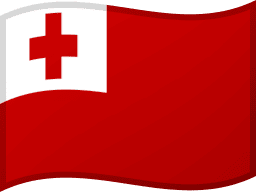
The Tongan flag is rectangular with a 1:2 aspect ratio. The field is solid red, with a white canton (occupying roughly half the length of the flag) in the upper left corner. Centred in the white canton is a red Greek-style cross. The flag uses only red and white, with an exceptionally simple and striking design—one of the world’s most straightforward and oldest flag layouts.
Meaning
Red symbolises the blood of Jesus Christ shed for humanity, as well as the courage of those who sacrifice for their country. White represents purity and sincerity. The red cross directly signifies the Christian faith—since King George Tupou I embraced Christianity in the 19th century, faith and monarchy have been deeply intertwined in Tonga. The cross’s position in the most honoured location (upper left) reflects the nation’s constitutional foundation as a Christian state. The red field also echoes the reddish-brown hue of ngatu (traditional Polynesian bark cloth) used by Tongan nobility.
History and Legal Status
The current flag design was finalised by King George Tupou I around 1862 and officially enshrined in the 1875 Constitution, remaining unchanged for over 150 years—it is one of the world’s longest-used national flags. The constitution explicitly declares Sunday as the day of rest and Christianity as the foundation of the state, with the cross on the flag visually representing this principle. The flag is prominently displayed daily at the Royal Palace, government buildings, and schools, and is ubiquitous during royal ceremonies and church events. In Tonga, disrespect toward the flag or the monarchy is both socially and legally prohibited. When Tonga regained full independence in 1970, the flag was reaffirmed, and it has continued to fly proudly at every coronation since, serving as a living testament to the enduring union of monarchy and faith over a century and a half.
Tonga Overview
Country Details »About Tonga
Tonga (the Kingdom of Tonga) is located in the southwestern South Pacific, situated east of Fiji, south of Samoa, and west of the Cook Islands. It comprises 171 islands, about 36 of which are permanently inhabited. The country covers an area of approximately 747 square kilometres and has a population of around 105,000. The capital, Nukuʻalofa, is situated on the northern coast of the largest island, Tongatapu, and is home to the Royal Palace, royal tombs, and a bustling seaside commercial district. Both Tongan and English are official languages. As the only Pacific nation never formally colonised, Tonga is a constitutional monarchy with a royal lineage spanning roughly a thousand years. Its constitution, enacted in 1875, remains in force today, making it the world’s oldest uninterrupted Polynesian monarchy.
Geography and Climate
Tonga’s islands are divided into three main island groups from south to north: the southern Tongatapu Group, characterised by flat, fertile land that houses most of the population and agricultural activity; the central Haʻapai Group, known for its white-sand beaches and birdwatching spots; and the northern Vavaʻu Group, composed of dozens of volcanic and coral islands with deep, winding bays—renowned as a top sailing and whale-watching destination in the South Pacific. The archipelago spans both volcanic and coral zones, with active underwater volcanic activity. In 2022, the massive underwater eruption of Hunga Tonga–Hunga Haʻapai triggered a trans-Pacific tsunami. The climate is tropical maritime, with a cool, dry season from May to November and a warm, wet season from December to April, when tropical cyclones can occur.
Historical Background
Polynesians settled in Tonga around 3,000 years ago. Around 950 AD, the Tuʻi Tonga dynasty was established, reaching its peak with influence over Tonga, Samoa, parts of Fiji, and even more distant islands—earning Tonga the title of the “Sea Empire” of Polynesia. Dutch navigators Schouten and Le Maire were the first Europeans to record Tonga in 1616, and Captain Cook visited multiple times in the 18th century, naming it the “Friendly Islands.” In 1845, George Tupou I unified the islands, introduced Christianity, and in 1875, enacted a constitution that laid the foundation for the modern state. Tonga became a British protectorate under the 1900 Treaty of Friendship but retained full control over internal affairs and the monarchy. The treaty ended in 1970, restoring Tonga’s full diplomatic independence. This history of “never having lost sovereignty” remains a source of deep national pride.
Economy and Currency
Tonga’s economy relies on agriculture (including pumpkin exports to Japan, vanilla, taro, and kava), fishing, remittances, and foreign aid, with tourism playing an increasingly important role. The official currency is the paʻanga (currency code: TOP, symbol: T$), with 1 paʻanga = 100 seniti. Issued by the National Reserve Bank of Tonga since 1967, it replaced the former Tongan pound. Nukuʻalofa has banks and ATMs, but financial facilities on outer islands are limited, so cash is king for travellers.
Culture and Society
Tongan society is built on three pillars: extended family, the church, and the monarchy. Tongans take pride in their Polynesian physique and culture of sharing, where a fuller figure is seen as a sign of health and prosperity. Rugby is the national obsession—the national team, the ’Ikale Tahi, can bring the entire nation to a standstill during the World Cup, and many Tongan-descended players star in professional leagues in New Zealand and Australia. Culinary highlights include ʻumu (an earth-oven feast where bananas leaf-wrapped taro, breadfruit, and whole pigs are slow-cooked over hot stones) and ota ika (a raw fish salad marinated in lemon juice and coconut milk, a popular starter). Tonga is also known for two unique cultural traits: “Tongan Time,” a relaxed attitude to punctuality where being an hour or two late is normal (travellers should adjust expectations), and strict Sunday observance—by law, all commercial activity ceases, including shops, markets, domestic flights, ferries, and even ceremonial guard duties at the palace. Visitors should plan their Sundays around church services and family lunches.
Tourism Overview
Tonga is a gem for experiential travel in the South Pacific. From July to October, humpback whales migrate from Antarctica to the Vavaʻu Islands to breed and nurse their calves. Licensed operators offer guided swims alongside these gentle giants—one of the few legal, controlled whale-swimming destinations in the world. Vavaʻu’s waterways are also renowned as some of the best sailing grounds in the region, with well-established liveaboard and sailing charter options. On the southwestern coast of Tongatapu, the Mapu a Vaea Blowholes feature a dramatic shoreline where ocean waves blast through coral rock formations, sending plumes of water dozens of metres into the air. On the eastern coast, the Haʻamonga ʻa Maui Trilithon is a mysterious 13th-century structure made of three massive coral limestone slabs, each weighing around 40 tonnes. Add the rainforest-clad cliffs of ʻEua and the regal charm of Nukuʻalofa’s Royal Palace, and Tonga offers a week’s worth of unforgettable experiences.
Tonga Travel Guide
All Guides »Tonga Travel Quick Guide: Visa-Free Entry, Whale Watching Season, Budget Tips & Sunday Rules
The Pacific’s Only Non-Colonized Kingdom: 30-Day Visa-Free Stay, July–October Wh...
Tonga 7-Day Classic Itinerary: Tongatapu – Whale Watching and Island Hopping in Vava’u 7 days
Two cultural days in the kingdom’s capital, plus four days of whales and sailing...
Tonga 4-Day Short Trip: In-Depth Exploration of Tongatapu Island 4 days
Skip the outer islands and still have an amazing time: explore the capital’s cul...
Top Attractions in Tonga: Whale Watching, Blowholes, and the Haʻamonga ʻa Maui Trilithon
From whale songs in Vavaʻu to ancient megaliths, here are ten unmissable experie...
Tongan Cuisine Guide: Umus, Ota Ika, and Roast Suckling Pig
Polynesia’s Richest Table: Understanding Tonga’s Flavor Profile of Earth-Oven Fe...
Tonga Transport Guide: Airports, Domestic Flights, and Driving on the Right
International arrivals and departures use Fua'amotu Airport, while inter-island ...