Vatican City Flag
The proportions, colors, and history of Vatican City's flag - a banner that tells Vatican City's own story.
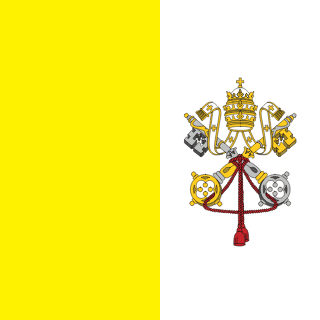
| Flag | Vatican City Flag |
|---|---|
| Country | Vatican City |
| Capital | Vatican City |
| Continent | Europe |
| Official Languages | Italian, Latin |
| Currency | Euro (EUR) |
| Dialling Code | +379 |
Vatican City Flag Meaning
Flag Design
The Vatican flag consists of two vertical equal-width bands: gold (hoist side) and white. The white band features the papal coat of arms—two crossed keys (one gold, one silver/white) beneath a papal tiara (triple crown). The flag is nearly square (approximately 1:1 ratio), one of the few nearly square national flags in the world. The keys, one gold and one silver, cross in an X shape with their teeth interlocked. The tiara sits above the key intersection, rendered in gold and white with decorative ribbons symbolizing papal authority. The gold and silver palette is known as the “colors of heaven.”
Meaning
The crossed gold and silver keys originate from the Bible (Matthew 16:19), where Jesus tells St. Peter, “I will give you the keys of the kingdom of heaven.” The gold key symbolizes the power to bind and loose in heaven, while the silver key represents earthly ecclesiastical authority. Together, they signify the Holy See’s theological role as the successor to St. Peter’s pastoral mission. The tiara historically represented the Pope’s triple role as Bishop of Rome, Patriarch of the West, and leader of the universal Church. Though no longer physically worn, it remains a historical symbol of papal authority. The gold and silver colors also derive from traditional church banners, signifying heavenly glory and purity.
History and Legal Status
The papal flag (featuring keys and the tiara) had long been the symbol of the Holy See, traditionally displayed on a white background. The current gold-white vertical design gradually took shape in the 19th century to distinguish it from the Italian tricolor. After the 1929 Lateran Treaty established Vatican City State, this flag became its official banner and was codified in the Fundamental Law of Vatican City State alongside the coat of arms and seal. The flag flies over St. Peter’s Square, Vatican institutions, and Holy See embassies (apostolic nunciatures), representing the Holy See or Vatican City at events like the Olympics and United Nations. Strict protocols govern its use, and the papal coat of arms requires approval from the Secretariat of State for public display.
Vatican City Overview
Country Details »Overview of Vatican City
Vatican City (officially Vatican City State) is an “enclave country” entirely surrounded by Rome, the capital of Italy. Covering just 0.44 square kilometers—about the size of a mid-sized park—it is the world’s smallest and least populous sovereign state. Centered on Vatican Hill on the west bank of the Tiber River and enclosed by walls, it has a permanent population of only a few hundred, including around 500 Vatican citizens such as the Pope, cardinals, Swiss Guards, and a small number of technical staff. Vatican City State and the “Holy See” (or Holy Father/Seat) are distinct concepts: the Holy See is the central governing body of the global Catholic Church, with international legal personality and extensive diplomatic relations, while Vatican City State is the physical territory established under the 1929 Lateran Treaty for the Holy See. The Pope is the head of state, ruling as an elected monarch chosen for life by the College of Cardinals.
Geography and Climate
Vatican City has gently rolling terrain, with Vatican Hill as its highest point (less than 100 meters above sea level). Despite its small size, the state is highly functional: St. Peter’s Square and Basilica dominate the eastern side, the Vatican Museums and Apostolic Palace stretch along the northern edge, the Vatican Gardens cover about half the area to the west, and the southern section houses a radio station, train station, and administrative buildings. It also has a short railway branch (about 852 meters) and the world’s smallest national train station. The climate is identical to Rome’s Mediterranean climate: hot, dry summers (often reaching 35°C in July–August), mild, rainy winters (around 8–13°C in January), and sunny springs and autumns—ideal for queueing in the square or strolling through the gardens.
Historical Background
The site of Vatican City has been a Christian sacred place since the 1st century. According to tradition, the apostle St. Peter was martyred in Rome between 64–67 AD and buried in a cemetery on Vatican Hill. In the 4th century, Emperor Constantine built the original St. Peter’s Basilica over his tomb. From the Middle Ages onward, the Pope, as Bishop of Rome, gradually acquired both spiritual and secular power, ruling the Papal States in central Italy for over a thousand years. Key cultural treasures such as the Apostolic Palace, Sistine Chapel, and core collections of the Vatican Library were formed during this period.
In the 19th century, Italian unification movements annexed Papal States territories. By 1870, the Pope retreated to Vatican City, leading to the “Roman Question” that lasted decades. In 1929, the Holy See and the Kingdom of Italy signed the Lateran Treaty, establishing Vatican City State as an independent sovereign entity. Since then, it has continued as a microstate. Vatican City has since gained international recognition for its diplomatic mediation and humanitarian efforts. In 2013, Argentine Cardinal Jorge Mario Bergoglio was elected Pope Francis, the first pope from the Americas. In 2025, Pope Leo XIV succeeded him, and Vatican City remains the spiritual center for over a billion Catholics worldwide.
Economy and Currency
Vatican City has no agriculture or industry. Its income mainly comes from museum ticket sales, donations at St. Peter’s Basilica, publications, postal services, souvenir sales, and revenues from the Vatican Bank (Institute for the Works of Religion) and real estate. Though tiny, it maintains a full postal system, broadcasting service (Vatican Radio), and newspaper (L’Osservatore Romano). Its post office is famous for sending postcards “from the world’s smallest country.” Under a monetary agreement with the EU, Vatican City has used the euro since 2002 (previously the Vatican lira, pegged 1:1 to the Italian lira). It also has the right to mint its own euro coins, which feature the Pope’s portrait and the Vatican coat of arms—one side of the 2-euro Vatican commemorative coin often sells for many times its face value due to collector demand.
Culture and Society
Vatican City boasts the highest density of humanistic and artistic heritage globally. The Vatican Museums house Michelangelo’s Sistine Chapel ceiling and The Last Judgment, Raphael’s Rooms and The School of Athens frescoes, numerous ancient Greek and Roman sculptures, and the Gallery of Maps—making it one of Europe’s top three museums. St. Peter’s Basilica, constructed over a century by masters like Bramante, Michelangelo, and Bernini, features a 136.6-meter dome that can hold 60,000 people. The Swiss Guard, protecting the Pope since 1506, wears iconic red, yellow, and blue striped uniforms and halberds—some of the most photogenic sights in Vatican City. Italian is the common language, while the Holy See uses Latin and multiple languages for official documents. The state has its own passports, license plates, pharmacies, and the world’s smallest national population.
Tourism Overview
Vatican City is the absolute highlight of any trip to Rome. The colonnade of St. Peter’s Square welcomes visitors, and climbing the basilica’s dome offers panoramic views of Rome. Tickets for the Vatican Museums and Sistine Chapel require advance online booking (often sold out in peak season). The Tomb of St. Peter (Scavi) archaeological tour requires email reservations months in advance. The Pope’s weekly Wednesday general audience and Sunday Angelus prayer at noon provide unique spiritual experiences. Dress modestly (cover shoulders and knees), and note that selfie sticks are banned and large backpacks must be checked. Queues in summer often exceed one hour—early morning or evening slots are ideal.
Vatican City Travel Guide
All Guides »Vatican City Travel Quick Guide: Schengen Visa, Best Seasons, Budget, and Dress Code
Everything you need to know about visiting the world’s smallest country: how to ...
Vatican City 2-Day In-Depth Itinerary: St. Peter’s Basilica, Museums, and Rome Connection 2 Days
Explore the world’s smallest country—just 0.44 square kilometers—in two days: Da...
Vatican City 1-Day Highlights: Square, Basilica, Museums & Sistine Chapel 1 day
Even with just one day, see all three highlights of Vatican City: beat the crowd...
Must-visit attractions in Vatican City: the dome of St. Peter’s Basilica, the Sistine Chapel, and treasures of the museums
Ten must-see highlights including the dome climb of St. Peter’s Basilica, the ce...
Vatican City Food Guide: Quick Bites Inside the Walls and Italian Dining Map on the Rome Side
Within just 0.44 square kilometers, you’ll mostly find supermarkets and coffee k...
Vatican City Transportation Guide: Navigating Rome Metro Line A, Airport Transfers, and Walking Routes with Security Checks
Vatican City has no airport or train station—all arrivals are via Rome. Detailed...