San Marino Flag
The proportions, colors, and history of San Marino's flag - a banner that tells San Marino's own story.
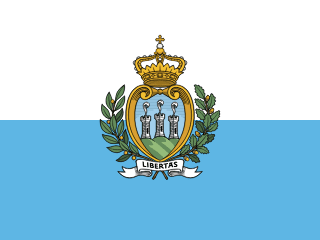
| Flag | San Marino Flag |
|---|---|
| Country | San Marino |
| Capital | City of San Marino |
| Continent | Europe |
| Official Languages | Italian |
| Currency | Euro (EUR) |
| Dialling Code | +378 |
San Marino Flag Meaning
Flag Design
The flag of San Marino consists of two equal horizontal bands, white on top and light blue below, with the national coat of arms in a circular medallion at the centre. It is one of the few flags in Europe with a vertically elongated shape, with an official ratio of 3:4. The soft contrast between white and blue reflects the limestone of Mount Titano and the sky over the Apennines, giving the flag a clean and dignified appearance.
Meaning
White symbolises peace and also represents the snow that often covers Mount Titano in winter. Light blue stands for liberty and the clear skies above the mountain. The central coat of arms is a blue shield featuring three green peaks, each topped with a silver-white tower—Guaita, Cesta, and Montale—symbolising the three fortresses defending the republic. The shield is surrounded by oak and laurel branches, topped with a mural crown, and bears the Latin inscription LIBERTAS on a ribbon beneath, meaning “freedom,” the core value upon which the ancient republic was founded.
History and Legal Status
The white and blue colours have been traditional in San Marino’s symbolism since the medieval era, even appearing in earlier versions of the flag without the coat of arms. The current design with the national emblem was legally formalised. The coat of arms itself was redefined by specific legislation in 2011. The flag is raised daily at the Town Hall and government buildings, and on April 1st, October 1st (Captains Regent inauguration), and September 3rd (National Day), the city is adorned with flags, offering visitors a vivid sense of the republic’s ceremonial spirit.
San Marino Overview
Country Details »Overview of San Marino
San Marino (officially the Republic of San Marino) is a tiny nation on the Apennine Peninsula in southern Europe, entirely surrounded by Italy’s Emilia-Romagna region. It lies about 20 kilometres northeast of the Adriatic coastal city of Rimini. Covering just 61.2 square kilometres with a population of around 34,000, it is the world’s fifth smallest and Europe’s third smallest sovereign state, as well as the oldest surviving republic. Its capital, the City of San Marino, sits on the western slopes of Mount Titano at an elevation of 749 metres. The entire city is built along the mountain’s contours, with well-preserved stone streets, walls, and towers. The country is divided into nine municipalities (castelli). With no airport, railway, or seaport, it remains one of Italy’s most popular cross-border travel destinations, thanks to its intact medieval charm and centuries-old tradition of autonomy.
San Marino operates as a parliamentary republic. Legislative power lies with the Great and General Council, made up of 60 members. The head of state is shared equally by two Captains Regent (Capitani Reggenti), who serve six-month terms and are inaugurated in traditional ceremonies on April 1st and October 1st each year. This dual leadership system has continued since the 13th century and is considered one of the oldest continuously functioning political systems in the world, reflecting the Sammarinese people’s strong commitment to freedom and republican ideals.
Geography and Climate
Mount Titano runs through the centre of the country, with its highest peak at 749 metres. Along its ridge stand three medieval towers—Guaita, Cesta, and Montale—which form iconic images on the national flag and coat of arms. The mountain’s flanks consist of gentle slopes and valleys. Though the elevation difference across the country is only a few hundred metres, the contrast between the mountain town and the countryside is striking: the mountaintop is a bustling historic area attracting tourists, while the base features orchards, vineyards, and quiet residential neighbourhoods.
The climate is a transitional type between temperate continental and Mediterranean, with cool days and mild nights in summer—the average July temperature is around 25°C. Winters are cold, with January averages near 0°C and occasional snowfall. Snow-covered towers and old town streets create a highly picturesque scene. Spring and autumn generally have clear weather, and on days with good visibility, the Adriatic Sea and Po Plain can be seen from observation points.
Historical Background
According to tradition, in 301 AD, a stonemason named Marinus from the island of Rab off the Dalmatian coast fled Roman Emperor Diocletian’s persecution of Christians and established a stonemason community on Mount Titano. This event is regarded as the founding moment of the republic, making San Marino the oldest republic in the world. During the Middle Ages, the mountain town gradually developed as an autonomous municipality. In 1243, the system of Captains Regent was established, and in 1600, a six-volume codified legal statute—the oldest surviving constitutional document of its kind—was promulgated.
During the 19th-century Italian unification movement, San Marino earned special respect in Italy for sheltering figures like Giuseppe Garibaldi, and it has since maintained friendly relations with its neighbours. It declared neutrality in both World Wars and was largely spared from conflict. In 2008, Mount Titano and the Historic Centre of San Marino were inscribed on the UNESCO World Heritage List, with the mountain town itself serving as a living museum.
Economy and Currency
San Marino’s economy relies mainly on tourism, banking, and artisanal manufacturing such as ceramics. Historically, revenue from stamp and commemorative coin issuance played a significant role in public finances, and these remain draws for collectors visiting today. Although not an EU member, San Marino has used the euro as its official currency since 2002 under a monetary agreement with the EU. It is also authorised to issue euro coins featuring national designs and releases annual commemorative coin sets. Industrially, the country specialises in tiles, construction materials, and small machinery, and is highly integrated with the Italian economy. Most goods are imported via Italian ports.
Culture and Society
The official language is Italian. The vast majority of residents are Catholic, and festive customs and dietary habits closely resemble those of the neighbouring Emilia-Romagna region. Liberty (freedom) is the national motto, symbolised by a neoclassical statue of the goddess of liberty near the civic square, together with the Three Towers of Mount Titano. Traditional crossbow competitions, medieval flag-waving performances, and historical parades are common in summer. The staple diet and wine preferences are similar to those of Italy’s Emilia region, with locally produced Sangiovese wine and mountain honey being particularly popular.
Tourism Overview
San Marino is a classic mountain microstate destination. Buses from Rimini take about an hour to reach it, and many visitors come for a day trip. However, staying overnight allows you to experience the old town without daytime crowds. Highlights include the three towers linked by the city walls, the Palazzo Pubblico (Town Hall) and Liberty Square, the National Museum, the Stamp and Coin Museum, and several quirky themed exhibitions. Shopping focuses on local ceramics, stamps, coins, and leather goods. Summer historical festivals, Adriatic sunsets, and tower night views leave lasting impressions. Itineraries often combine San Marino with stops in Rimini, Bologna, San Leo, or Urbino.
San Marino Travel Guide
All Guides »San Marino Travel Quick Guide: Schengen Entry, Seasons, Budget & Mountain Etiquette
How to get there, where to stay, and how much it costs — a complete pre-trip gui...
Classic 7-Day Route in San Marino: Mountain Town Exploration and Emilia-Romagna Ancient Town Loop 7 days
Centered around the world’s oldest republic, this route connects Rimini, San Leo...
4-Day Short Trip to San Marino: Exploring the Mountain City by District 4 Days
Experience a full four days without leaving the country: explore the historic ci...
A Must-Visit Attractions List in San Marino: Three Towers, Historic Old Town, and Hidden Museums
From UNESCO-listed mountain towns to quirky themed museums, this small country o...
San Marino Food Guide: Romagna Flavors and Mountain Table
Though a small country with no independent cuisine, it excels in serving authent...
San Marino Travel Guide: How to Get There and Get Around Without an Airport or Railway
Relied on Italy’s transport system to reach the mountains, and on your feet and ...