Central African Republic Flag
The proportions, colors, and history of Central African Republic's flag - a banner that tells Central African Republic's own story.
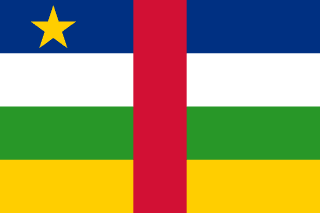
| Flag | Central African Republic Flag |
|---|---|
| Country | Central African Republic |
| Capital | Bangui |
| Continent | Africa |
| Official Languages | French, Sango |
| Currency | Central African CFA franc (XAF) |
| Dialling Code | +236 |
Central African Republic Flag Meaning
Flag Design
The flag of the Central African Republic consists of four horizontal stripes and one central vertical stripe. The horizontal stripes, from top to bottom, are blue, white, green, and yellow, with a red vertical stripe running from the top to the bottom center of the flag. A yellow five-pointed star is located in the upper left corner where the blue stripe meets the vertical red stripe. The flag has a 2:3 aspect ratio and blends Pan-African colors with elements of the French tricolor. It was designed by Barthélemy Boganda, a leader of the Central African independence movement, and adopted in 1958 when the autonomous republic was established.
Meaning
The design symbolizes the connection between Africa and Europe (France): the blue and white are taken from the French flag, representing historical ties to France, with blue also symbolizing the sky and freedom. The red vertical stripe stands for the blood of those who died for independence and serves as a lifeline connecting all directions. Green represents hope and the southern forests, yellow symbolizes the northern savanna and the nation’s wealth, and the yellow star signifies the guiding light of independence and progress toward the future. The unique cross layout of the stripes makes the flag highly distinctive among African nations.
History and Legal Status
The flag was designed and adopted in 1958 and became the national flag upon independence in 1960. Notably, even during the 1976–1979 period when Bokassa established the "Central African Empire," the flag was largely retained (only the imperial crest and related symbols were changed), reflecting its deep national recognition. The current constitution affirms it as one of the national symbols. Today, the flag is flown at government buildings in Bangui, M’Poko International Airport, and Central African diplomatic missions abroad, and is commonly seen at public events by both MINUSCA personnel and locals.
Central African Republic Overview
Country Details »Overview of Central African Republic
The Central African Republic (CAR), or simply Central Africa, is a landlocked country in Central Africa. It borders Chad to the north, Sudan and South Sudan to the east, the Republic of the Congo and the Democratic Republic of the Congo to the south, and Cameroon to the west, covering an area of about 623,000 square kilometers. The capital, Bangui, is located on the northern bank of the Ubangi River (a tributary of the Congo River) on the southwestern edge of the country, facing Zongo in the Democratic Republic of the Congo across the river. It hosts the nation’s most important government institutions, ports, and population, making it an essential hub for understanding the country.
The Central African Republic gained independence from France in 1960. Between 1976 and 1979, it briefly became the "Central African Empire" under Emperor Bokassa before reverting to a republic. Since then, the country has experienced frequent coups. A civil war broke out in late 2012, leading to the fragmentation of the country among various armed groups. Although peace agreements have been signed with international mediation, security remains precarious in many areas. The United Nations Multidimensional Integrated Stabilization Mission in the Central African Republic (MINUSCA) has been deployed long-term, representing one of the UN’s largest peacekeeping operations.
Geography and Climate
Located in the transition zone of sub-Saharan Africa, the Central African Republic features mainly gently undulating plateaus, with elevations mostly between 600 and 900 meters. The northern region consists of Sudanese-Sahelian savanna, gradually transitioning into semi-arid zones, while the southern part merges into the equatorial rainforest at the edge of the Congo Basin, forming one of Africa’s significant tracts of primary forest. Major rivers include the Ubangi and its tributaries, with the upper Chari River system in the north.
The Sangha River basin in the southwest corner is an ecological treasure: the Dzanga-Sangha Special Reserve and the adjacent UNESCO World Heritage Site of the Sangha Tri-National Protected Area (shared with Cameroon and the Republic of the Congo) are known for gatherings of forest elephants, gorillas, and hippopotamuses in the "Dzanga Bai" forest clearings, as well as the confluence of three rivers in the Sangha Basin. Climatically, the country has a tropical climate, with hot and humid conditions and abundant rainfall in the south, and dry heat in the north. The rainy season runs from May to October, and the dry season from November to April.
Historical Background
The Central African region has historically served as a migration corridor for Bantu and Sudanic-speaking peoples. The north was home to early states and trade networks such as the Raqei, while the Ubangi River basin was dominated by village-based societies. By the late 19th century, French colonizers gradually took control of the Ubangi region, establishing the Oubangui-Chari colony in 1903, which later became part of French Equatorial Africa. The colonial period left deep scars through forced labor and heavy taxation, with the 1928–1931 Kongo-Wara rebellion marking a significant chapter in the region’s resistance history.
After 1946, Barthélemy Boganda, a politician prior to Bokassa, pushed for self-governance, leading to the establishment of an autonomous republic in 1958 and full independence in 1960. In 1976, Bokassa declared himself emperor and established the "Central African Empire," which was overthrown by France in 1979. Decades of political instability followed, culminating in a large-scale civil war marked by the 2012 attack on Bangui by the Séléka coalition. Sectarian violence in 2013–2014 was particularly brutal. Although a 2019 peace agreement and international mediation have taken place, armed groups still control or contest vast rural areas, with renewed conflict around elections around 2020.
Economy and Currency
The Central African Republic is one of the world’s least developed countries, with an economy heavily reliant on primary resources. Diamonds are a traditional export pillar, though the industry has long been plagued by illegal mining and smuggling. Timber (especially tropical hardwoods) is another major source of foreign exchange. Cotton, coffee, coffee beans, and livestock support rural livelihoods. Weak infrastructure, landlocked geography, and high transportation costs hinder economic development. The official currency is the Central African CFA franc (XAF), issued by the Bank of Central African States (BEAC), and shared among six members of the Central African Economic and Monetary Community (Cameroon, Gabon, Chad, the Republic of the Congo, Equatorial Guinea, and CAR). Its value is pegged to the euro.
Culture and Society
Though sparsely populated, the Central African Republic is ethnically diverse. French is the official language, but Sango, an indigenous and more widely spoken language, was declared a national language in 1991 and holds a status comparable to French in daily communication. Music and dance are highlights of Central African culture, with Bangui known for modern music, traditional drumming, and the likembe (a thumb piano). The polyphonic singing of the Aka Pygmies in the southwestern rainforest has been inscribed on UNESCO’s Representative List of the Intangible Cultural Heritage of Humanity, making it one of the country’s most unique cultural assets.
Religiously, Christianity and Islam each account for roughly 40% of the population, with a significant number adhering to traditional beliefs. There are notable differences between the north and south, as well as urban and rural areas. Society is centered around family and village networks, with markets, churches, and mosques serving as key public spaces in rural areas.
Tourism Overview
Objectively speaking, the Central African Republic is not a conventional tourist destination: foreign governments have repeatedly advised against travel. Large areas outside Bangui are controlled by armed groups or prone to conflict, with high risks of kidnapping and robbery, and poor medical and road infrastructure. From a cultural and ecological perspective, the country does possess rare attractions: close encounters with forest elephants and gorillas in the Dzanga-Sangha rainforest, the vibrant streets of Bangui along the Ubangi River, Boali Falls, and the forest culture of the Aka people all offer compelling insights—but these are currently presented for informational purposes only. Actual visits should await a fundamental improvement in security conditions and be organized through professional agencies.
Central African Republic Travel Guide
All Guides »Central African Republic Travel Preview: Safety Situation, Visa, Seasons & Budget Reference
Understand the safety situation and armed group distribution first, then check v...
Central African Republic 7-Day Cultural & Geographic Route: Bangui – Ubangi River – Sangha Rainforest (Currently Not Accessible) 7 days
This route links Bangui, Boali, and the Dzanga-Sangha Rainforest for educational...
4-Day Short Trip to the Central African Republic: Knowledge Tour of Bangui and the Ubangi River (Currently Not Advisable to Visit) 4 days
A conceptual 4-day itinerary centered on downtown Bangui and its surroundings to...
A list of cultural and ecological highlights in the Central African Republic: from Bangui to the Sangha Rainforest
A regional breakdown of Central Africa’s most significant historical sites, urba...
Central African Republic Food Guide: Cassava, Peanut Stews, and Rainforest Flavors
Central African cuisine is based on cassava, sorghum, peanuts, and palm oil, sha...
Travel Guide: Transportation and Safety in the Central African Republic – Flights, River Transport, and Private Transfers
The Central African Republic has no coastline. Transportation mainly relies on i...