Ukraine Flag
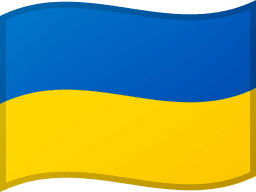
The proportions, colors, and history of Ukraine's flag - a banner that tells Ukraine's own story.
| Flag | Ukraine Flag |
|---|---|
| Country | Ukraine |
| Capital | Kyiv |
| Continent | Europe |
| Official Languages | Ukrainian |
| Currency | Ukrainian hryvnia (UAH) |
| Dialling Code | +380 |
Ukraine Flag Meaning
Flag Design
The Ukrainian flag is a horizontal bicolor consisting of two equal horizontal bands of blue (top) and yellow (bottom), in a 2:3 ratio. The blue is a slightly grayish sky blue, and the yellow is a bright golden color. The national emblem is not displayed on the flag; Ukraine’s coat of arms is a standalone trident (Tryzub), commonly used on government buildings and official documents, and is often displayed alongside the flag. On national holidays, the blue-and-yellow flag and the trident emblem are often seen together at official ceremonies and public buildings.
Meaning
The blue symbolizes the peaceful sky, and the yellow represents golden wheat fields. Together, they evoke the image of “golden wheat fields under a blue sky,” visually representing Ukraine’s identity as an agricultural nation. This color combination is also interpreted as a reflection of the nation’s values of freedom, land, and harvest, making it one of Ukraine’s most recognizable national symbols. In daily life, the blue-and-yellow palette appears widely on clothing, festive decorations, and sports paraphernalia, becoming a ubiquitous national symbol beyond official contexts. The colors are also commonly used by the Ukrainian diaspora as an identity marker worldwide.
History and Legal Status
The blue-and-yellow color scheme was first used in the mid-19th century in the Galicia region: during the 1848 revolution, Ukrainians in Lviv (then part of the Austro-Hungarian Empire) raised the blue-and-yellow flag for the first time. It was officially adopted as the national flag by the Ukrainian People's Republic in 1918 but was banned during the Soviet era. During Soviet times, the flag was prohibited from public display but occasionally appeared in hidden or modified forms at national celebrations and among the diaspora, symbolizing the struggle for independence. After Ukraine regained independence in 1991, the flag was reinstated and officially legislated as the national flag by the Verkhovna Rada (parliament) on January 28, 1992. Following the declaration of independence, the blue-and-yellow flag was rapidly re-raised across the country and became the official emblem of the parliament, government, and military. August 23 is celebrated as Ukraine Flag Day. Today, the blue-and-yellow colors are internationally recognized as the symbol of Ukraine.
Ukraine Overview
Country Details »Overview of Ukraine
Ukraine is located in Eastern Europe, bordering the Black Sea and Sea of Azov to the south, Belarus to the north, Russia to the northeast, Poland and Slovakia to the west, and Hungary, Romania, and Moldova to the southwest. It covers an area of approximately 603,700 square kilometers, making it one of the largest countries in Europe. Its capital, Kyiv, situated along the middle reaches of the Dnipro River, is the country’s political, economic, and cultural center and an important cradle of East Slavic civilization.
Ukraine operates under a semi-presidential republic system and is divided into 24 oblasts (regions), the Autonomous Republic of Crimea, and two cities with special status: Kyiv and Sevastopol. Since 2022, the entire country has been under wartime conditions, with limitations on aviation and certain border crossings, making travel conditions significantly different from normal times.
Geography and Climate
The Ukrainian landscape is predominantly flat, with the East European Plain covering most of the territory. The famous fertile black soil (chernozem) belt accounts for about two-thirds of the country, earning Ukraine the title “breadbasket of Europe.” The western part features the Carpathian Mountains, with Mount Hoverla being the highest peak at around 2,061 meters; the Crimean Peninsula in the south includes the Crimean Mountains. The Dnipro River flows from north to south through the country, serving as a vital artery for shipping and hydropower, along with other major rivers such as the Southern Bug and the Dniester.
The climate is mainly temperate continental, with cold winters and warm summers. Winters are longer in the north, while the southern Black Sea coast enjoys relatively milder weather, and the southern Crimean coast has subtropical characteristics. The Carpathian Mountain region receives more precipitation and has cooler summers, making it a traditional summer retreat and skiing destination.
Historical Background
From the 9th to the 13th centuries, Kievan Rus centered around Kyiv was one of the earliest powerful states in Eastern Europe; in 988, Grand Prince Vladimir was baptized, establishing Eastern Orthodoxy in the region. In 1240, the Mongol invasion led to the fall of Kyiv and the fragmentation of Kievan Rus. Over the following centuries, the area was ruled by the Principality of Galicia-Volhynia, the Grand Duchy of Lithuania, and the Polish–Lithuanian Commonwealth, until the mid-17th century when Cossack leader Bohdan Khmelnytsky established a Cossack Hetmanate.
In the late 18th century, Ukrainian lands were divided between the Russian Empire and the Austro-Hungarian Empire. Ukraine briefly declared independence as the Ukrainian People's Republic from 1917 to 1921 and became a Soviet republic in 1922. The Holodomor famine of 1932–1933 caused massive loss of life, and the Chernobyl nuclear disaster occurred here in 1986. Ukraine declared independence on August 24, 1991, underwent major changes in 2014, and has been embroiled in a full-scale war since 2022, with ongoing serious security concerns.
Economy and Currency
Ukraine’s economy relies heavily on agriculture, steel and metallurgy, machinery manufacturing, and information technology outsourcing. It is one of the world’s leading exporters of grain and sunflower oil. The national currency is the Ukrainian hryvnia (UAH, symbol ₴), issued by the National Bank of Ukraine. The wartime economy has been significantly affected, with possible controls on currency exchange rates and cash withdrawals. Usage of foreign bank cards and cross-border remittances depends on prevailing policies.
Culture and Society
Ukrainian culture is rooted in Eastern Orthodox and Greek Catholic traditions, with the Ukrainian language written in the Cyrillic script. Distinctive cultural symbols include embroidered shirts (vyshyvanka), decorated eggs (pysanky), and folk polyphonic singing. In cuisine, borscht was inscribed on UNESCO’s Intangible Cultural Heritage List in 2022 as an element in need of urgent safeguarding. Other representative dishes include cherry varenyky (dumplings), potato varenyky, salo (cured pork fat), Kyiv chicken, and dark rye bread.
Ukraine has a rich literary and artistic heritage. Poet Taras Shevchenko is regarded as a national symbol, and its composers and artists enjoy international recognition. The society values family and festive traditions, with well-preserved Easter and Christmas customs.
Tourism Overview
Please note: due to the impact of war, Ukraine currently does not have the conditions for conventional tourism. Authorities have repeatedly issued safety advisories advising against travel and recommending that those in Ukraine take safety precautions and stay informed about evacuation information. Therefore, the content in this section mainly serves as an introduction to the country’s culture and geography to help understand its history and culture, for future reference when conditions allow.
In peaceful times, Ukraine offers abundant travel resources: the Saint Sophia Cathedral and Kyiv Pechersk Lavra in Kyiv are both UNESCO World Heritage Sites, and Saint Andrew’s Church and Andriyivskyy Descent are rich in old town charm; Lviv in the west is known for its Central European-style old town, cafés, and chocolate culture; Odesa on the Black Sea coast features the famous Potemkin Stairs; the medieval castles of Kamianets-Podilskyi, wooden churches and pristine villages in the Carpathians, and the landscaped gardens of Uman together present a diverse mix of religious heritage and natural scenery.
Ukraine Travel Guide
All Guides »Ukraine Pre-Travel Snapshot: Safety Alerts, Visa Policy, Travel Seasons & Budget Reference
Currently, Ukraine is under a state of war. This page first outlines the Ministr...
Sample 7-day cultural itinerary in Ukraine: Kyiv — Lviv — Carpathians 7 days
This itinerary connects the Orthodox UNESCO World Heritage sites of Kyiv with th...
4-Day Short Trip to Ukraine: Kyiv’s History, Religious Heritage, and Old Town Streets 4 days
This 4-day cultural route based in Kyiv connects two UNESCO World Heritage Sites...
Must-visit attractions in Ukraine: UNESCO-listed churches, historic old towns, and the Potemkin Stairs by the Black Sea
From Kyiv’s UNESCO-listed churches to Lviv’s Old Town and Odesa’s Potemkin Stair...
A Guide to Ukrainian Cuisine: Borscht, Cherry Varenyky, Salo, and Honey Cake
Borscht has been inscribed on UNESCO’s Intangible Cultural Heritage list. This g...
Ukraine Transport Guide: Kyiv Metro System, Sleeper Trains, and Intercity Buses
An overview of airport transfers, metro, train, and long-distance bus services i...