Cyprus Flag
The proportions, colors, and history of Cyprus's flag - a banner that tells Cyprus's own story.
| Flag | Cyprus Flag |
|---|---|
| Country | Cyprus |
| Capital | Nicosia |
| Continent | Asia |
| Official Languages | Greek, Turkish |
| Currency | Euro (EUR) |
| Dialling Code | +357 |
Cyprus Flag Meaning
Flag Design
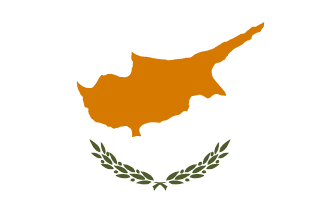
The flag of Cyprus features a white background with a copper-orange silhouette of the island in the center, beneath which are two green olive branches crossed at the bottom. The flag has a 3:5 aspect ratio, with the island and olive branches centrally aligned in a simple, symmetrical design. The white, copper-orange, and green color scheme is fresh and highly distinctive among Mediterranean flags.
The island silhouette is an abstract geometric outline, and the olive branches consist of two symmetrically crossed boughs, with clean lines that remain recognizable even from a distance.
Meaning
The white background symbolizes peace. The copper-orange shape represents the island itself and also nods to Cyprus’s historic copper resources—the country’s name is etymologically linked to copper (cuprum), making the color a national symbol. The two crossed green olive branches signify peace and reconciliation between the island’s Greek Cypriot and Turkish Cypriot communities, expressing hopes for unity and coexistence.
The flag deliberately avoids blue and red, the dominant colors of the Greek and Turkish flags, to remain neutral and avoid favoring either community. This reflects the designers’ intent to promote balance between the two groups.
History and Legal Status
The flag of Cyprus was designed by Turkish Cypriot artist İsmet Güney and officially adopted on August 16, 1960, when the country gained independence. The designer intentionally chose neutral white, copper-orange, and green colors to avoid matching the primary colors of either Greece or Turkey, symbolizing equality and coexistence. Initially, the flag was intended to serve as a shared national symbol for both communities.
After the 1974 division of the island, the Republic of Cyprus continued to use this flag, while the northern administration adopted its own. As a result, different flags are now used on the island. Understanding the flag’s origins provides insight into the complex modern history of Cyprus.
Cyprus Overview
Country Details »About Cyprus
Cyprus (officially the Republic of Cyprus) is located in the eastern Mediterranean and is the third-largest island in the region. It lies about 75 kilometers north of Turkey, east of Syria and Lebanon, and faces Egypt across the sea. The country covers an area of approximately 9,251 square kilometers, with its capital Nicosia situated in the central part of the island. The official languages are Greek and Turkish, and the population mainly consists of Greek Cypriots and Turkish Cypriots. The island is home to both Eastern Orthodox Christianity and Islam. Cyprus gained independence in 1960, joined the European Union in 2004, and adopted the euro in 2008.
It is important to note that since 1974, Cyprus has been de facto divided into the south and the north. The internationally recognized Republic of Cyprus (commonly referred to as South Cyprus) governs the southern part, while the northern part is administered by a Turkish Cypriot administration recognized only by Turkey (commonly known as North Cyprus). Nicosia is one of the few capitals in the world that remains divided, and crossing between the two sides requires using designated border crossings and following relevant regulations. The information below primarily refers to the Republic of Cyprus.
Geography and Climate
Cyprus features a landscape of central plains and mountain ranges to the north and south. The Troodos Mountains in the southwest include Mount Olympus, the highest peak at about 1,952 meters, while the Kyrenia Mountains lie in the north. The coastline is dotted with numerous beaches and headlands. Ayia Napa and Protaras in the southeast are known for their fine sandy beaches and clear waters, while the Paphos area in the west is associated with the legend of Aphrodite, the goddess of love and beauty, said to have been born there.
The climate is typically Mediterranean, with hot, dry, and sunny summers (June to August) and mild, wet winters (December to February). Snow can fall in the mountains, making skiing possible. Spring and autumn offer the most pleasant weather, making them ideal times to visit. With over 300 days of sunshine per year, the island’s sunshine and beaches are among its most celebrated features.
History
Situated at the crossroads of East and West, Cyprus has long been a hub of cultural exchange and trade. The island has been inhabited since the Neolithic period and has been ruled by the Mycenaeans, Assyrians, Egyptians, Persians, Romans, and Byzantines, leaving behind a wealth of underground mosaics, theaters, and churches. In 1191, Richard the Lionheart captured the island, which later became the Kingdom of Cyprus established by the Crusaders, followed by Venetian rule. It was then occupied by the Ottoman Empire in 1571, came under British administration in 1878, and became a British Crown Colony in 1925.
Cyprus gained independence in 1960, forming a joint Greek Cypriot and Turkish Cypriot state. Following intercommunal violence between 1963 and 1964, tensions remained high. A coup in 1974 led to external military intervention, resulting in the island’s division. Since then, the Republic of Cyprus in the south has pursued stable development, joining the EU in 2004 and the eurozone in 2008.
Economy and Currency
Cyprus has an economy based on tourism, shipping, finance, and professional services. It is one of the Mediterranean’s key maritime management centers and a high-income economy within the EU. Agriculture focuses on specialty products such as citrus fruits, olives, grapes, and Halloumi cheese. In 2013, Cyprus experienced a banking crisis but has since recovered through adjustments and reforms, returning to economic growth.
The official currency of the Republic of Cyprus is the euro (EUR, symbol €), issued by the Eurosystem, which comprises the European Central Bank and the central banks of the eurozone countries. The northern part of the island primarily uses the Turkish lira (TRY), creating a separate currency system. Travelers should be aware of currency and exchange rate differences when crossing the border or making purchases.
Culture and Society
Cypriot culture blends Greek and Middle Eastern influences. The predominantly Greek Cypriot population in the south is mainly Eastern Orthodox, celebrating Easter, Christmas, and various saints’ days with great festivity. The Turkish Cypriot population in the north preserves Islamic cultural traditions. Life on the island is generally relaxed, with a diet based on olive oil, legumes, seafood, and grilled meats. Meze, a selection of small shared dishes, is a hallmark of Cypriot cuisine. Halloumi cheese, olives, and wines (such as Commandaria) are local specialties.
Traditional crafts such as Lefkara embroidery, pottery, and silverwork are well-known. The people are hospitable, and café culture is popular. Family and festivals are important, with summer beach festivals and autumn wine festivals offering a glimpse into local life.
Tourism Overview
Cyprus offers a blend of sun, sea, and ancient sites. The Paphos Archaeological Park, with its UNESCO-listed mosaics, nearby royal tombs, and Aphrodite’s Rock, attracts many visitors. Limassol is a hub for beach holidays and nightlife, and is also home to the ancient Kourion Theatre. Larnaca features the Church of Saint Lazarus and a salt lake. Ayia Napa and Protaras are known for their beaches and sea caves. Nicosia’s Old Town retains Venetian walls, Ledra Street, and the dividing Green Line, providing insight into the island’s modern history. The Troodos Mountains are home to Byzantine painted churches and wine-producing villages.
Cyprus drives on the left, and renting a car is a convenient way to explore the island. With good security and well-developed tourism infrastructure, it is suitable for a mix of beach holidays, historical exploration, and mountain hiking. Travelers planning to visit the north should check border crossing and documentation requirements in advance and arrange their itinerary and insurance accordingly.
Cyprus Travel Guide
All Guides »Cyprus Travel Quick Guide: Visa, Seasons, Budget & Key Facts on the North-South Divide
Cyprus is an EU member but not part of the Schengen Area. Before you go, underst...
7-Day Cyprus Island Loop: Paphos – Limassol – Larnaca – Nicosia 7 days
Traveling from west to east and then inland, this loop connects the mosaics of P...
4-Day Cyprus Road Trip: Nicosia and Troodos Mountains Loop 4 Days
This 4-day itinerary focuses on the capital and mountainous region, connecting t...
Must-visit attractions in Cyprus: Paphos, Nicosia, and the Troodos Mountains
Explore Cyprus’s top archaeological sites, divided capital’s historic quarters, ...
Cyprus Food Guide: Halloumi Cheese, Meze Platters, and Mediterranean Seafood
From sizzling halloumi cheese that stays chewy even when grilled, to generous me...
Cyprus Travel Guide: Left-Hand Drive, Airport Transfers, and Public Transport Essentials
How to get from Cyprus’s two main airports into town, rules for driving on the l...