Uzbekistan Flag
The proportions, colors, and history of Uzbekistan's flag - a banner that tells Uzbekistan's own story.
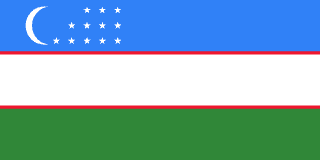
| Flag | Uzbekistan Flag |
|---|---|
| Country | Uzbekistan |
| Capital | Tashkent |
| Continent | Asia |
| Official Languages | Uzbek |
| Currency | Uzbekistani Som (UZS) |
| Dialling Code | +998 |
Uzbekistan Flag Meaning
Flag Design
The flag of Uzbekistan is a horizontal rectangle with a 1:2 aspect ratio. It consists of three horizontal parallel bands of blue, white, and green from top to bottom, with a thin red line separating the white band from both the blue and green bands above and below. In the upper left corner of the flag, on the blue band near the hoist, there is a white crescent moon and twelve white five-pointed stars arranged in three rows — three stars on the top row, four in the middle, and five on the bottom — forming the most distinctive pattern on the flag. The three color bands are of equal width, and the overall design is simple and symmetrical.
Meaning
Blue symbolizes the sky and water, representing eternity and vastness. White stands for peace and purity, and also reflects Uzbekistan’s abundant cotton production. Green represents nature and fertility, and is also associated with Islamic cultural traditions. The thin red lines separating the color bands symbolize life and vitality, and are often interpreted as the veins connecting the earth and water. The crescent moon is a symbol of Islam, renewal, and rebirth, while the twelve stars represent the twelve months of the year and the twelve signs of the zodiac, expressing hopes for the nation’s lasting stability, prosperity, and harmony. The arrangement of the twelve stars — three on top, four in the middle, and five at the bottom — emphasizes visual balance and is also seen as a reflection of order and harmony.
History and Legal Status
The flag of Uzbekistan was officially adopted on November 18, 1991, replacing the flag of the Uzbek Soviet Socialist Republic and becoming an important symbol of Uzbekistan’s independence and national identity. The direction of the crescent, the number and arrangement of the stars, and the combination of the three color bands were determined through public consultation and discussion at the time of independence. Today, this flag is widely used in government institutions, schools, sporting events, and festivals. The colors blue, white, and green have also become the core palette of the country’s visual identity and are often used in national emblems and various public signs, making it a highly familiar and resonant visual symbol for the citizens.
Uzbekistan Overview
Country Details »Overview of Uzbekistan
Uzbekistan (Uzbek: Oʼzbekiston), located in the heart of Central Asia, is one of only two doubly landlocked countries in the world, covering an area of approximately 448,900 square kilometers. It borders Kazakhstan to the northwest, Kyrgyzstan to the east, Tajikistan to the southeast, Afghanistan to the south, and Turkmenistan to the southwest. The capital, Tashkent (Tashkent), situated in the Chirchik River valley in the northeast, is one of the most populous and economically developed cities in Central Asia. The official language is Uzbek, a Turkic language, while Russian is widely spoken in daily life.
With a population of about 36 million, Uzbekistan is the most populous country in Central Asia. The majority of its residents are ethnic Uzbeks, and Islam is the main religion. As a core region of the ancient Silk Road, Uzbekistan connects deserts, oases, and millennia-old cities, making it one of the most established and popular travel destinations in contemporary Central Asia.
Geography and Climate
The terrain of Uzbekistan is mainly composed of deserts, plains, and oases. The northwest is dominated by the vast Kyzylkum Desert, the central part consists of the Turan Lowland, and the eastern and southeastern regions feature spurs of the Tien Shan and Gissar-Alai mountain ranges. The Amu Darya and Syr Darya are the two most important rivers in the country, nourishing the surrounding oases and agricultural areas. Due to extensive water diversion for irrigation, the Aral Sea has been shrinking continuously since the late 20th century, becoming a globally significant environmental issue. The fertile and densely populated Fergana Valley in the east is an important agricultural and industrial region.
The climate is continental and arid, with long, hot summers where temperatures often exceed 35°C, and cold winters marked by large diurnal and seasonal temperature variations. Precipitation is concentrated in the winter and spring and is generally scarce. Spring and autumn are the most comfortable seasons for travel. Summer visits require attention to heat protection and hydration, and many ancient cities have stone-paved roads and open squares with limited shade.
Historical Background
This land was a hub of ancient Central Asian civilization: the Sogdians managed oasis trade routes that spanned East and West, and historical names such as Khwarezm and Bactria frequently appear in records. It was successively incorporated into the territories of the Achaemenid Persian Empire, Alexander the Great, and the Kushan Empire, where Buddhism, Zoroastrianism, and later Islamic civilization converged. The 9th–10th century Samanid Dynasty, with Bukhara and Samarkand as its cultural centers, is regarded as one of the golden ages of Persian–Islamic culture, and the poet Rudaki lived during this period.
In 1220, the armies of Genghis Khan captured Samarkand, which suffered severe damage. From the 14th century, Timur (Tamerlane) established a vast empire with Samarkand as its capital, and his descendant Ulugh Beg was a renowned astronomer. After the 16th century, the Bukhara Khanate, Khiva Khanate, and Kokand Khanate successively ruled the region. In the second half of the 19th century, the area came under the influence of the Russian Empire, with Bukhara and Khiva becoming protectorates. In 1924, the Uzbek Soviet Socialist Republic was established, and it declared independence in 1991 following the dissolution of the Soviet Union. Since 2016, Uzbekistan has implemented economic and social reforms, opening up tourism and simplifying visa procedures, leading to rapid improvements in urban landscapes and tourism infrastructure.
Economy and Currency
Uzbekistan’s economy is supported by agriculture, mining, and manufacturing. Cotton has long been known as “white gold” and is one of the country’s most important agricultural products. The country is rich in mineral resources such as gold, natural gas, and copper, and its automobile manufacturing and textile industries are also developing. As a landlocked country, its trade relies on rail and road connections to neighboring countries. The official currency is the Uzbekistani Som (currency code: UZS, symbol: soʼm), issued by the Central Bank of Uzbekistan. It comes in relatively high denominations, so it is important to pay attention to the units when exchanging or settling payments.
Culture and Society
Uzbek culture is rooted in Silk Road commerce and Islamic traditions. Mosques, madrasas, and mausoleums in the ancient cities serve as shared vessels of architecture and faith. Handicrafts are exceptionally diverse: suzani embroidery, Rishtan pottery, wood carving, miniature painting, and gold-thread embroidery are all highly regarded. Plov (pilaf) is considered the national dish, and Tashkent even has a dedicated plov center. Navruz (Persian New Year at the spring equinox) is the most important national holiday, during which people prepare malted sweet porridge, visit family and friends, and engage in music, dance, and equestrian activities.
Society places great importance on family and hospitality. Bringing a small gift when visiting is considered polite. The diet mainly consists of flatbread, plov, samsa (savory pastries), kebabs, and tea. The fruits are sweet, with grapes, melons, and pomegranates being particularly famous in autumn. Uzbek is the main language, English is moderately spoken in tourist areas, and Russian is more widely used.
Tourism Overview
The highlights of tourism in Uzbekistan are concentrated in several iconic Silk Road cities: Samarkand is known for Registan Square, Gur-e Amir Mausoleum, Bibi-Khanym Mosque, and the Shah-i-Zinda necropolis; Bukhara preserves the Kalyan Minaret and an intact ancient city fabric; Khiva’s Itchan Kala is a well-preserved inner city and a UNESCO World Heritage Site; Tashkent showcases contemporary Central Asia through its metro station architecture, markets, and modern urban landscape. Additionally, Shakhrisabz is the hometown of Timur, while Nurata and Aidarkul Lake offer cool mountain and lakeside experiences.
In recent years, the high-speed railway (Afrosiyob) has closely connected Tashkent, Samarkand, and Bukhara, significantly improving travel convenience. Most ancient cities are within walking distance, allowing for a relaxed pace and the opportunity to explore at a leisurely “one city over several days” pace. Amid the blue domes of mosques, the spices, and handicrafts in bazaars, visitors can experience the millennia-old essence of the Silk Road.
Uzbekistan Travel Guide
All Guides »Quick Guide to Traveling in Uzbekistan: Visa, Best Seasons, Budget, and Local Etiquette
Key visa and entry requirements, ideal travel seasons in spring and autumn, esti...
Uzbekistan 7-Day Silk Road Classic Route: Tashkent – Samarkand – Bukhara – Khiva 7 days
Starting from the capital, Tashkent, take high-speed rail to connect the three i...
Uzbekistan 4-Day Short Trip: Highlights of Samarkand and Bukhara 4 Days
Even with limited holiday time, you can experience the essence of the Silk Road:...
Essential Attractions in Uzbekistan: Registan, Bukhara Old Town, and Khiva’s Itchan Kala
Organized by Samarkand, Bukhara, Khiva, and Tashkent, this guide highlights the ...
Uzbekistan Food Guide: Plov, Samsa, Kebabs, and the Culture of Bread and Tea
From the national dish plov to samsa, kebabs, and melons—this guide covers Uzbek...
Complete Guide to Transportation in Uzbekistan: High-Speed Rail, Metro, Airports, and Taxis
This guide covers travel between Tashkent Airport and the city, how to book Afro...