Belarus Flag
The proportions, colors, and history of Belarus's flag - a banner that tells Belarus's own story.
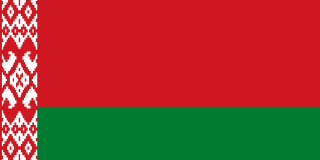
| Flag | Belarus Flag |
|---|---|
| Country | Belarus |
| Capital | Minsk |
| Continent | Europe |
| Official Languages | Belarusian, Russian |
| Currency | Belarusian ruble (BYN) |
| Dialling Code | +375 |
Belarus Flag Meaning
Flag Design
The flag of Belarus is a horizontal bicolor of red over green, with the red band occupying two-thirds of the flag’s height and the green band one-third. The flag’s aspect ratio is 1:2, which is relatively uncommon in Europe. Along the hoist side, there is a vertical red-and-white decorative pattern featuring traditional embroidery motifs composed of geometric elements such as eight-pointed stars, diamonds, and crosses, arranged symmetrically. This white-and-red embroidered band is the most distinctive part of the Belarusian flag and one of the few national flags in the world decorated with traditional embroidery patterns.
Meaning
Red symbolizes freedom, courage, and the sacrifices made by the Belarusian people in their historical struggle for independence, as well as the nation’s glorious traditions. Green represents life, hope, forests, and fields, reflecting Belarus’s natural landscape rich in woodlands and wetlands. The white embroidery pattern on the hoist side is derived from traditional Belarusian folk embroidery, symbolizing diligence, harvest, unity, and spiritual wealth. It also emphasizes the continuity of national culture and craftsmanship. This design is believed to originate from a traditional pattern created by folk weaver Matrena Markevich in the early 20th century.
History and Legal Status
After gaining independence in 1991, Belarus initially adopted a tricolor flag of white, red, and white, which was a continuation of the flag used by the Belarusian People's Republic in 1918. In June 1995, a national referendum led to the decision to replace the flag and national emblem. On June 7 of the same year, the current red-and-green flag with the embroidered pattern was introduced, followed by adjustments to the design proportions. Due to differing historical interpretations, the Belarusian flag holds varying symbolic meanings among different groups. For travelers, showing respect and exercising caution when in the vicinity of government buildings, monuments, and public gatherings is advised.
Belarus Overview
Country Details »Overview of Belarus
Belarus (Беларусь) is a landlocked country in Eastern Europe, bordered by Russia to the east and north, Ukraine to the south, Poland to the west, and Lithuania and Latvia to the northwest. The country covers an area of approximately 207,600 square kilometers, with a population of about 9.2 million. Its capital, Minsk, is the political, economic, and cultural center of the nation. The official languages are Belarusian and Russian, with Russian being more commonly used in daily communication. Belarus is a presidential republic that gained independence in 1991 following the dissolution of the Soviet Union. It is a member of the Commonwealth of Independent States (CIS) and the Eurasian Economic Union, maintaining close ties with Russia in economics, energy, and security.
Geography and Climate
Belarus features predominantly flat terrain and gentle hills, with forests covering about 40% of the land. The country has numerous lakes and rivers, including the Neman, Dnieper, Pripyat, and Western Dvina, all of which originate or flow through Belarus. The southwestern Belovezhskaya Pushcha Forest is one of Europe’s best-preserved primeval forests and a crucial habitat for the European bison (zubr). The southern Pripyat River basin includes one of Europe’s largest wetland areas (the Polesie region), an important site for migratory birds.
The climate is temperate continental, with cold winters featuring long snow cover and mild, humid summers. The months from May to September offer pleasant temperatures, making it the best time for travel and outdoor activities. December to February sees temperatures often below freezing, ideal for enjoying snowy landscapes and winter forests. Precipitation is fairly evenly distributed throughout the year, with slightly more rainfall in summer, so it’s advisable to carry rain gear.
Historical Background
The Belarusian region was part of Kievan Rus and the Principality of Polotsk from the 9th to 13th centuries. From the 13th century, it gradually became part of the Grand Duchy of Lithuania, and after the Union of Lublin in 1569, it was included in the Polish–Lithuanian Commonwealth. By the late 18th century, following the three partitions of Poland, all of Belarus came under the Russian Empire. After the October Revolution in 1917, Belarus established the Belarusian Soviet Socialist Republic in 1919 and became one of the founding republics of the Soviet Union in 1922. During World War II, Belarus was occupied by Nazi Germany and suffered immense devastation. The defense of Minsk and the Brest Fortress became significant historical events. In 1986, southern Belarus was heavily affected by the Chernobyl nuclear disaster.
In 1991, the Soviet Union dissolved, and Belarus declared independence in August of the same year. Minsk served as the signing site for the establishment of the CIS. Since then, Belarus has pursued integration within the framework of the Union State with Russia, maintaining a high degree of economic and energy dependence on Russia. Since 2020, Belarus’s domestic politics and foreign relations have drawn international attention, with some Western countries imposing sanctions. Travelers are advised to check the latest travel advisories issued by their own government and embassy or consulate in Belarus before visiting.
Economy and Currency
Belarus’s economy is based on machinery manufacturing, chemicals, potash fertilizer production, timber processing, and agriculture. Enterprises such as the Minsk Tractor Works, BelAZ mining trucks, and MAZ trucks have significant international influence, and the country holds a notable share in the global potash fertilizer export market. Agriculture focuses on potatoes, flax, grains, and dairy products. Belarus is known within the CIS for the quality of its dairy products, and potatoes are considered its most iconic food. The national currency is the Belarusian ruble (currency code BYN, symbol Br), issued by the National Bank of Belarus. On July 1, 2016, Belarus implemented a currency reform, replacing the old ruble at a rate of 1 new ruble for 10,000 old rubles. The currently circulating ruble is the reformed version.
Culture and Society
Belarusian culture is rooted in East Slavic traditions, with well-preserved folk embroidery, wood carving, pottery, and folk songs. The red-and-white embroidery pattern on the left side of the national flag, linen fabrics in traditional clothing, and the widespread Eastern Orthodox and Catholic churches across urban and rural areas form the cultural backdrop of Belarus. The cuisine centers around potatoes, with dishes like potato pancakes, potato pies, potato dumplings, and potato cutlets forming the so-called potato cuisine, typically served with black bread, pickled cucumbers, and dairy products. Cold borscht, red borscht, and homemade sausages are also common. Literary and artistic figures such as poets Yanka Kupala and Yakub Kolas, and writer Vasil Bykaŭ, hold significant cultural importance.
Tourism Overview
Belarus tourism highlights include historic castles, primeval forests, and remnants of Soviet-era urban landscapes. The Stalinist architecture along Independence Avenue in Minsk is grand and imposing, with Victory Square and Independence Square serving as city landmarks. The Mir Castle and Nesvizh Castle, located east of Minsk, were inscribed on the UNESCO World Heritage List in 2000 and 2005, respectively, representing outstanding examples of Central and Eastern European castle architecture. The Belovezhskaya Pushcha Forest in the southwest offers opportunities to observe European bison up close, while the swamps and river wetlands near Pinsk in the south are great for birdwatching and nature photography. The Brest Fortress in the west carries solemn memories of war. Belarus offers low prices and convenient public transportation, making it suitable for travelers interested in Eastern European history and nature. However, due to regional developments, it is important to pay close attention to flight schedules, border policies, and safety advisories when planning a trip.
Belarus Travel Guide
All Guides »Belarus Travel Quick Guide: Visa-Free Stay, Best Seasons, Budget & Safety Tips
How long you can stay visa-free, which season is best to visit, how much you’ll ...
Classic 7-day Belarus itinerary: Minsk — Mir — Nesvizh — Brest — Belovezhskaya Pushcha 7 days
From Stalinist boulevards to two UNESCO-listed castles, pristine forests, and wa...
Belarus 4-Day Short Trip: 4 Days in Minsk and 1 Day at Mir Castle 4 days
Based in Minsk, this 4-day itinerary covers key urban landmarks, war memorials, ...
Essential Attractions in Belarus: Minsk, UNESCO Castles, and Primeval Forests
From Stalinist boulevards to two UNESCO-listed castles, primeval forests home to...
A Guide to Belarusian Cuisine: The Flavors of Fried Potato Pancakes, Potato Dumplings, and Cold Beet Soup
Fried potato pancakes, potato dumplings, cold beet soup, and rye bread—Belarusia...
Belarus Transport Guide: Getting from Minsk Airport to the City, Using the Metro, and Taking Intercity Trains
This guide covers how to get from Minsk Airport to the city, how to use the metr...