Portugal Flag
The proportions, colors, and history of Portugal's flag - a banner that tells Portugal's own story.
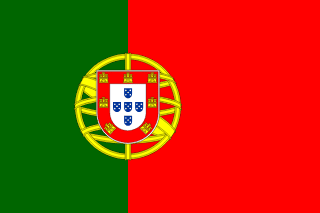
| Flag | Portugal Flag |
|---|---|
| Country | Portugal |
| Capital | Lisbon |
| Continent | Europe |
| Official Languages | Portuguese |
| Currency | Euro (EUR) |
| Dialling Code | +351 |
Portugal Flag Meaning
Flag Design
The Portuguese flag consists of two vertical bands, green on the left (about two-fifths of the flag width) and red on the right (about three-fifths). The flag has a 2:3 aspect ratio. At the boundary between the green and red is the Portuguese coat of arms: an armillary sphere (a yellow celestial globe) surrounded by a white shield. Inside the white shield are five small blue shields (quinas) arranged in a cross, each with five white dots (bezants). The white shield is bordered by a red frame containing seven golden castles. The proportions of the coat of arms and color bands are strictly defined.
Meaning
Green symbolizes hope and is also interpreted as a representation of the nation’s future. Red stands for the blood shed for the country’s independence and freedom, as well as courage and passion. The armillary sphere on the coat of arms is a navigational instrument from the Age of Exploration, commemorating Portugal’s achievements in maritime discovery. The five blue shields are said to represent Afonso Henriques’ victory over five Moorish kings at the Battle of Ourique, with the five dots symbolizing the Five Wounds of Christ. The red border’s seven castles signify the Moorish fortresses captured by Afonso III. This combination is one of Portugal’s oldest national emblems.
History and Legal Status
After abolishing the monarchy in 1910 and establishing the republic, Portugal needed a new flag to replace the former blue-and-white royal banner. Following the design work of a special committee and contributions from artists such as Columbano Bordalo Pinheiro, the current green-red flag with the armillary sphere coat of arms was officially adopted on June 30, 1911, along with the national anthem. Since then, the flag’s design, proportions, and colors have been legally standardized and displayed at government buildings, military installations, schools, and public institutions. Today, the Portuguese flag is used on Republic Day (October 5), Portugal Day (June 10), and international sporting events. The green-red colors and armillary sphere have become iconic symbols of Portugal’s national identity.
Portugal Overview
Country Details »Overview of Portugal
Portugal (Portuguese Republic) is located at the western end of the Iberian Peninsula in southwestern Europe, bordered by the Atlantic Ocean to the west and south, and Spain to the northeast. It is the westernmost continental country along the Atlantic coast. In addition to the mainland, Portugal also includes two autonomous regions in the Atlantic Ocean: the Azores and Madeira. The country covers an area of approximately 92,200 square kilometers, with a population of about 10.4 million. Its capital, Lisbon (Lisboa), is situated at the mouth of the Tagus River and serves as the national center for politics, economy, and culture.
Portugal operates under a semi-presidential republic system, with the president as the head of state and the prime minister leading the government. As a member of the European Union, the Schengen Area, and the Eurozone, Portugal is also one of the founding members of NATO and maintains a long-standing alliance with the United Kingdom. Porto in the north and Lisbon in the south are the two major urban centers, while the southern region of the Algarve is a renowned beach destination.
Geography and Climate
Portugal’s terrain is higher in the north and lower in the south: the northern and central regions are mountainous, with inland areas consisting of plateaus and hills. The Douro and Tagus Rivers flow from east to west, cutting through the country into the Atlantic Ocean. The southern Algarve region features gentle coastal lines and limestone cliffs, while the western coastline is long, with many sandy bays and surfing spots. Cape Roca, located near Lisbon, is the westernmost point of mainland Europe. A monument at the cliff’s edge reads “Here, where the land ends and the sea begins,” making it a must-visit spot for many travelers.
Climatically, the northern and northwestern parts are influenced by the Atlantic, resulting in mild, humid weather with relatively high rainfall. The central inland areas have a slightly more continental climate. The southern and Algarve regions have a typical Mediterranean climate, with hot, dry summers and mild winters. The Azores and Madeira Islands have an oceanic climate, with mild temperatures year-round, making them suitable for travel throughout the year. The best travel seasons are April to June and September to October. Summers are the busiest along the coast, while winters offer quieter ancient cities and pleasant temperatures.
Historical Background
Portugal gained independence from the Kingdom of León in the 12th century. In 1139, Afonso Henriques declared himself king, and his status was recognized by treaty in 1143. By 1249, Portugal had completed the Reconquista of the southern Moorish territories, forming the basis of its modern mainland. The 15th and 16th centuries marked the golden age of the Age of Exploration: under the patronage of Prince Henry the Navigator, Portuguese explorers ventured into the Atlantic and Africa. In 1488, Bartolomeu Dias rounded the Cape of Good Hope, in 1498, Vasco da Gama opened the sea route to India, and in 1500, Pedro Álvares Cabral reached Brazil. Portugal established a vast maritime empire spanning Brazil, Africa, the Indian Ocean, and Southeast Asia, with Lisbon becoming one of Europe’s most important trade hubs.
From 1580 to 1640, Portugal and Spain shared a monarch. The devastating Lisbon earthquake of 1755 led to the city’s reconstruction under the guidance of the Marquis of Pombal. In the 19th century, Brazil gained independence (1822), and in the 20th century, the 1974 Carnation Revolution ended decades of dictatorship under Salazar, leading to democracy. Portugal joined the European Economic Community (now the EU) in 1986, achieving rapid economic and social development since then.
Economy and Currency
Portugal’s economy is driven by services, tourism, and manufacturing. It is the world’s largest producer of cork and has competitive industries in wine (especially port and green wine), textiles, footwear, automotive parts, and renewable energy. Tourism has seen strong growth in recent years, with Lisbon, Porto, Madeira, and the Azores attracting many international visitors.
Portugal uses the euro (EUR, symbol €), which officially replaced the former Portuguese escudo in 2002. Euro banknotes feature a unified design across Europe, while the reverse side of coins is designed individually by each member state, often featuring historical elements such as royal seals. For details on denominations and payment practices, see the currency section.
Culture and Society
Portuguese culture is deeply rooted in maritime and exploration traditions. Lisbon’s Belém Tower and Jerónimos Monastery reflect the glory of the Age of Exploration, while Manueline architecture is known for its intricate maritime motifs. Musically, fado is a melancholic folk song originating from Lisbon’s streets, combining singing with the Portuguese guitar. It was inscribed on UNESCO’s Intangible Cultural Heritage list in 2011. Blue-and-white azulejo tiles, found throughout the country, are one of Portugal’s most distinctive architectural decorations.
Cuisine includes pastel de nata (custard tarts), bacalhau (salt cod dishes), grilled sardines, and Portuguese seafood rice. Wine is a staple at both lunch and dinner. Portuguese society is generally mild-mannered and relaxed, with a slower pace of life and deep Catholic cultural influences. Portuguese is one of the most widely spoken languages globally, used in countries such as Brazil and several African nations.
Tourism Overview
Portugal is one of the most popular European travel destinations in recent years, offering great value, safety, and friendliness. Lisbon features the historic Alfama district, São Jorge Castle, and the Belém area, along with the iconic yellow 28 tram. Nearby Sintra is famous for its colorful Pena Palace and hilltop palaces, while Cape Roca is a prime spot for Atlantic sunsets. Northern Porto is known for the Dom Luís I Bridge, Douro River wine cellars, and port wine, with the Douro Valley upstream being a UNESCO-listed wine region. Southern Algarve attracts vacationers with its cliffside beaches and sea caves, while the Atlantic islands of Madeira and the Azores offer volcanic landscapes, hiking, and whale watching.
Portugal’s rail network, including high-speed trains, connects cities like Lisbon, Porto, and Coimbra. Travelers can also choose to drive or take intercity buses. Urban trams, subways, and funiculars provide unique transportation experiences. With its sunshine, seafood, wine, and relaxed lifestyle, Portugal is an ideal destination for immersive travel in Western Europe.
Portugal Travel Guide
All Guides »Portugal Travel Quick Guide: Visas, Seasons, Budget & Table Manners
Schengen Visa, Best Time to Visit, Daily Budget & Dining Etiquette: Must-Know Ti...
Classic 7-Day Portugal Itinerary: Lisbon – Sintra – Porto – Douro Valley 7 days
Connect the maritime capital, mountain palaces, wine country, and the Douro Vall...
Portugal 4-Day Itinerary: Lisbon, Sintra, and Cape Roca 4 Days
Based in Lisbon, this four-day trip covers the Old Town, Belém district, the mou...
Must-visit attractions in Portugal: From Belém Tower to the Douro Valley
Organized by four key regions—Lisbon, Porto, Central & Southern Portugal, and th...
A Guide to Portuguese Cuisine: Pastries, Codfish, and Port Wine
From corner pastelarias to bacalhau dishes and Douro Valley port wine, explore P...
Portugal Transportation Guide: Intercity Trains, Trams, and Travel Cards
Understand CP trains, Lisbon Tram 28, and the Viva Viagem card — your complete g...