Argentina Flag
The proportions, colors, and history of Argentina's flag - a banner that tells Argentina's own story.
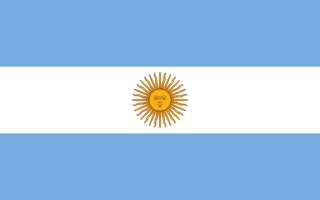
| Flag | Argentina Flag |
|---|---|
| Country | Argentina |
| Capital | Buenos Aires |
| Continent | South America |
| Official Languages | Spanish |
| Currency | Argentine Peso (ARS) |
| Dialling Code | +54 |
Argentina Flag Meaning
Flag Design
The flag of Argentina consists of three equal horizontal stripes of light blue, white, and light blue, with a golden Sun of May (Sol de Mayo) in the centre. The sun has 32 rays—16 straight and 16 wavy. The flag’s aspect ratio is 9:14, making its length approximately one and a half times its width.
Meaning
The light blue and white colours are said to originate from the ribbons worn during the May Revolution of 1810. They are often interpreted as symbolising the dawn between sky and clouds, or representing the pursuit of freedom and independence. The Sun of May commemorates the May Revolution of 25 May 1810 and symbolises the birth of a new nation and the dawn of liberty. The 32 rays represent the illumination of the nation, with alternating straight and wavy rays symbolising the connection between the sun and the earth.
History and Legal Status
The flag was first raised by independence leader Manuel Belgrano in 1812, and the Sun of May was added in 1818. Over time, the flag’s proportions, colours, and sun design have been standardised, with further colour specifications established around 2010 to ensure visual consistency in flags produced nationwide. Today, the flag is prominently displayed on 25 May (National Day), 9 July (Independence Day), at sporting events, and at government buildings. The light blue and white stripes and the Sun of May are among Argentina’s most recognisable national symbols, appearing on sports jerseys, currency, and various official emblems.
Argentina Overview
Country Details »Overview of Argentina
Argentina (officially the Argentine Republic) is located in the southern part of South America, bordered by the Atlantic Ocean to the east, Chile to the west across the Andes, Bolivia and Paraguay to the north, Brazil to the northeast, and Uruguay to the east across the Uruguay and Paraná rivers. Covering about 2.78 million square kilometres, it is the second-largest country in South America, the eighth-largest in the world, and the largest Spanish-speaking nation by area. Its capital, Buenos Aires, situated on the southern bank of the Río de la Plata, has a metropolitan population exceeding 15 million and serves as the national political, economic, and cultural hub.
Argentina is a federal presidential republic. Its southern region includes Patagonia and the Tierra del Fuego archipelago, extending to the southernmost tip of the Americas. It also claims sovereignty over the Falkland Islands (Islas Malvinas), which are controlled by the United Kingdom, leading to an ongoing territorial dispute.
Geography and Climate
Stretching about 3,700 kilometres from north to south, Argentina features highly diverse landscapes: the Andes mountain range extends along the western edge, with Aconcagua at 6,961 metres, the highest peak in the Americas and the Southern Hemisphere; the central region is home to the fertile Pampas grasslands, the agricultural and population core of the country; the north has the Chaco Plain and highland canyons; the northeast lies in the Mesopotamia region between the Paraná and Uruguay rivers, where Iguazu Falls is located; the south consists of the arid and windswept Patagonian Plateau, beyond which lies Tierra del Fuego.
The climate ranges from subtropical in the north to temperate in the centre and cold in the south: summers are hot and humid in the north, seasons are distinct in the centre, and the south remains cool year-round with strong winds. Patagonia is best visited from November to March, while Iguazu sees moderate water flow and pleasant temperatures from April to August.
Historical Background
The area now known as Argentina was originally home to various Indigenous peoples. Spanish colonisation began in the 16th century, and in 1776 the Viceroyalty of the Río de la Plata was established, with Buenos Aires as a key port city. The May Revolution broke out in Buenos Aires on 25 May 1810, and independence was declared on 9 July 1816 in Tucumán. Beginning in the late 19th century, large-scale immigration from Italy, Spain, and other European countries shaped Argentina’s demographic and cultural identity.
In the first half of the 20th century, Argentina briefly ranked among the wealthiest nations in the world. It later experienced periods of political instability, including the rise of Peronism, frequent coups, and military rule. From 1976 to 1983, the country was under military dictatorship. In 1982, it fought the Falklands War against the United Kingdom, and democracy was restored in 1983. Since then, the economy has faced multiple crises, including a severe debt default and financial collapse in 2001. Persistent issues with currency devaluation and inflation continue to affect the economy and influence how travellers exchange money.
Economy and Currency
Argentina is a major agricultural exporter, renowned for soybeans, corn, wheat, and beef. It also possesses resources such as lithium and shale oil and gas, and maintains solid foundations in industry and services. Mendoza is one of South America’s most important wine-producing regions, with Malbec wines enjoying international acclaim. The official currency is the Argentine Peso (ARS). The country has undergone several currency reforms and periods of hyperinflation, resulting in significant fluctuations in purchasing power and exchange rates—factors that travellers should pay close attention to.
Culture and Society
Argentinian culture is heavily influenced by European immigration, yet also deeply rooted in the traditions of the gaucho (cowboy) culture of the South American plains. Tango, inscribed on UNESCO’s Representative List of the Intangible Cultural Heritage of Humanity in 2009 and jointly nominated by Argentina and Uruguay, finds its vibrant expression in neighbourhoods like La Boca and San Telmo in Buenos Aires. Mate (a herbal tea) is the national drink, while asado (barbecue) is central to weekend gatherings. Other local favourites include dulce de leche (caramelised milk spread), medialunas (croissants), empanadas (savory pastries), and choripán (sausage sandwiches). Football is a national passion, with icons like Diego Maradona and Lionel Messi deeply woven into the country’s cultural narrative.
Tourism Overview
Argentina is one of South America’s most diverse travel destinations: the capital, Buenos Aires, offers iconic urban experiences such as the Obelisk, Plaza de Mayo, colourful Caminito in La Boca, and Recoleta Cemetery; the majestic Iguazu Falls lie in the northeast; the southern region features natural wonders like Perito Moreno Glacier, Patagonia, and Ushuaia—known as the end of the world and a gateway to Antarctica; central Argentina is home to Mendoza’s vineyards, whales and sea lions around Valdés Peninsula, and the striking coloured mountains of Salta and Jujuy in the northwest. Given the country’s vast size, intercity travel often relies on flights or long-distance buses, so allow ample time when planning itineraries.
Argentina Travel Guide
All Guides »Argentina Travel Quick Guide: Visa, Seasons, Budget, and Currency Exchange Essentials
How to get a visa, when to go and where, how much to spend per day, and essentia...
Classic 8-Day Argentina Itinerary: Buenos Aires – Iguazu – Glaciers 8 days
Experience the city, waterfalls, and Patagonian glaciers all in one trip – the m...
Argentina 4-Day Short Trip: In-Depth Exploration of Buenos Aires 4 Days
Explore the capital without going far: historical sites, art, neighborhoods, and...
Essential Attractions in Argentina: Capital City, Iguazú, and Patagonia
From the plazas of Buenos Aires to world-class natural wonders, here’s a regiona...
Argentina Food Guide: Asado BBQ, Empanadas, and Mate Tea
From grilled meats to street turnovers, explore Argentina’s national flavors wit...
Argentina Travel Guide: Domestic Flights, SUBE Card & Long-Distance Buses
With its vast territory, flying is the best way to hop between cities. In the ca...