Slovenia Flag
The proportions, colors, and history of Slovenia's flag - a banner that tells Slovenia's own story.
| Flag | Slovenia Flag |
|---|---|
| Country | Slovenia |
| Capital | Ljubljana |
| Continent | Europe |
| Official Languages | Slovenian |
| Currency | Euro (EUR) |
| Dialling Code | +386 |
Slovenia Flag Meaning
Flag Design
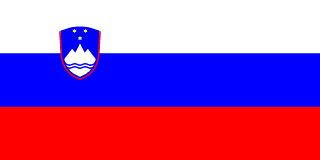
The Slovenian flag consists of three equal horizontal bands of white, blue, and red, in that order from top to bottom, with a 1:2 width-to-length ratio. On the upper left side, near the hoist (where the white and blue bands meet), the Slovenian coat of arms is displayed: a blue shield featuring the silhouette of Mount Triglav, Slovenia’s highest peak, in white, with two wavy blue lines beneath the peaks representing water, and three golden six-pointed stars arranged in an arc above the shield.
Meaning
The white, blue, and red colors originate from Pan-Slavic colors, shared with flags of countries like Russia and Serbia, symbolizing Slavic unity and identity. The mountain in the coat of arms, Mount Triglav (2,864 meters), is Slovenia’s highest peak and a national emblem, representing the nation’s backbone. The two wavy lines symbolize the Adriatic Sea and major rivers like the Sava and Drava, reflecting the country’s mountain-and-water geography. The three golden stars come from the coat of arms of the Counts of Celje from the Middle Ages, signifying Slovenia’s historical legacy and connection to Europe.
History and Legal Status
The tricolor of white, blue, and red was first proposed in 1848 during the European Spring of Nations by students in Ljubljana and became a long-standing symbol of Slovenian identity. During the Yugoslav era, the Socialist Republic of Slovenia used a similar tricolor without the coat of arms. After declaring independence in June 1991, the new Slovenian constitution officially adopted the tricolor with the coat of arms as the national flag. June 25, the date of independence, became a national holiday commemorating the flag. The use of the flag is regulated by the National Symbols Act, and it is flown at government buildings, border posts, schools, and embassies abroad. During major sporting events like the Euros and World Cup, the tricolor is a powerful symbol of Slovenian national pride.
Slovenia Overview
Country Details »About Slovenia
Slovenia (officially the Republic of Slovenia) is located in Central-Southern Europe at the northwestern tip of the Balkan Peninsula. It borders Italy to the west, Austria to the north, Hungary to the northeast, and Croatia to the southeast, with a short coastline along the Adriatic Sea to the southwest. The country covers an area of approximately 20,273 square kilometers and has a population of about 2.12 million. It is the most economically developed and highest-income-per-capita nation among the former Yugoslav republics. Its capital, Ljubljana, lies on the banks of the Ljubljanica River and serves as the national center for politics, economy, and culture. The old town, centered around the Dragon Bridge and Ljubljana Castle, is compact and walkable, and has been named a European Green Capital multiple times.
Slovenia declared independence on June 25, 1991, joined the EU and NATO in 2004, became the first Central and Eastern European transitional country to adopt the euro in 2007, and joined the Schengen Area by the end of the same year. It enjoys political stability and safety, ranking among the safest countries in Europe.
Geography and Climate
Although small in size, Slovenia lies at the meeting point of four major geographical regions—the Alps, the Pannonian Plain, the Mediterranean, and the Dinaric Karst—boasting an unusually diverse landscape for Europe. The northwestern part consists of the Julian Alps, where Mount Triglav (2,864 meters), the country’s highest peak and a national symbol, is located; it also appears on the national coat of arms. Forests cover about 60% of the country, and together with its karst caves, the Pohorje Plateau, and its 46-kilometer-long Adriatic coastline, Slovenia has earned the title of the Green Heart of Europe. It is also a pioneer in sustainable tourism practices, with destinations like Bled and Ljubljana regularly featured on lists of Europe’s top green travel spots.
The climate is transitional: the mountainous regions have an alpine climate with long, snowy winters, perfect for ski resorts like Kranjska Gora; the inland areas experience a temperate continental climate with warm summers and cool springs and autumns; the coastal zone has a Mediterranean climate with mild, rainy winters. Overall, the best travel period is May to September, while December to March is the prime time for skiing.
Historical Background
The ancestors of the Slovenes settled in the region in the 6th century and established the Duchy of Carantania in the 7th century, one of the earliest Slavic states in the Alpine region. From the Middle Ages onward, the area was successively ruled by the Holy Roman Empire, the Habsburg Monarchy, and the Austro-Hungarian Empire, with strong influences from German and Italian cultures. Coastal cities like Piran and Koper were long under the Republic of Venice and still retain a distinct Venetian flair. After the dissolution of the Austro-Hungarian Empire in 1918, Slovenia became part of the Kingdom of Serbs, Croats, and Slovenes (later the Kingdom of Yugoslavia), and after World War II, it was one of the constituent republics of the Socialist Federal Republic of Yugoslavia.
In June 1991, Slovenia declared independence after a brief 10-day conflict, rapidly transitioning to a market economy. It joined the EU and NATO in 2004, adopted the euro in 2007, and entered the Schengen Area by the end of that year. It is the former Yugoslav republic that has integrated most successfully and earliest into Europe.
Economy and Currency
Slovenia has a highly developed open economy, with one of the highest per capita GDPs in Central and Eastern Europe. Key industries include automotive components and electrical manufacturing, pharmaceuticals, wood processing, logistics, and tourism. The port of Koper is an important outlet for landlocked Central and Eastern European countries. The official currency is the euro (EUR), which was officially adopted on January 1, 2007, making Slovenia the first country to join the eurozone after the EU’s 2004 enlargement. The reverse sides of Slovenian euro coins feature national motifs such as the white stork, the Prince’s Stone of Carantania, the Sower, the Lipizzaner horse, and Mount Triglav, reflecting strong national identity. Card payments are widely accepted in urban areas and tourist sites, with Visa and Mastercard commonly used; however, cash is still preferred in rural shops and markets.
Culture and Society
The official language is Slovenian, a South Slavic language. Due to historical ties with German- and Italian-speaking regions, most Slovenians speak English, and many also know Italian or German. The predominant religion is Catholicism, with Easter and Christmas celebrated in ways that reflect Alpine traditions. The cuisine blends Central European and Mediterranean influences. A traditional festive dessert, potica (a rolled nut cake), is a staple at national banquets and Christmas tables. Kranjska klobasa (Carniolan sausage) and Idrijski žlikrofi (Idrija dumplings) are protected by the EU’s geographical indication system. Slovenia has a long winemaking tradition, with distinctive white wines from the eastern Styria region and red wines from the Karst area. The national bird is the white wagtail, and the Lipizzaner horse stud farm in Lipica, established in 1580, is home to the famous white horses used by the Spanish Riding School in Vienna.
Tourism Overview
Slovenia combines Alpine peaks, emerald lakes, karst caves, hot springs, and Adriatic coastlines within a small area, offering an exceptionally high density of scenic diversity. Iconic Lake Bled, famous for its church island and cliff-top castle, is the country’s most recognizable landmark. Triglav National Park covers the heart of the Julian Alps and offers excellent hiking, kayaking, and skiing. Postojna Cave features the world-renowned cave railway, while Predjama Castle, built into a cliffside cave, is a unique architectural marvel. Ljubljana’s Dragon Bridge, castle hill, and riverside old town are ideal for leisurely exploration, while Piran on the short Adriatic coast is often called a mini-Venice. The entire country can be traversed east to west in just three hours by car, making it perfect for road trips and in-depth exploration based in Ljubljana or Bled.
Slovenia Travel Guide
All Guides »Slovenia Travel Quick Guide: Schengen Visa, Best Seasons, Budget & Etiquette
Before visiting the Green Heart of Europe, read this: how to apply for a Schenge...
Classic 7-Day Slovenia Itinerary: Ljubljana – Lake Bled – Caves – Piran Full-Country Loop 7 days
Explore a small country in one week: slow travel in the capital, Alpine lakes an...
Slovenia 4-Day Short Trip: A Lakes-and-Mountains Journey Between Ljubljana and Lake Bled 4 days
Even with limited time, you can experience the highlights: base yourself in the ...
Must-visit attractions in Slovenia: From Lake Bled to cave castles
A region-by-region guide to the top sights of the Green Heart of Europe, each wi...
Slovenian Food Guide: Potica Pastry, Carniolan Sausage, and Local Wines
A Culinary Gem Between the Alps and the Mediterranean: National Desserts, EU-Pro...
Slovenia Transport Guide: Getting from the Airport to Town, Lake Buses, Trains, and Driving
One guide to cover all public transport: how to get from Ljubljana Airport to th...