Nicaragua Flag
The proportions, colors, and history of Nicaragua's flag - a banner that tells Nicaragua's own story.
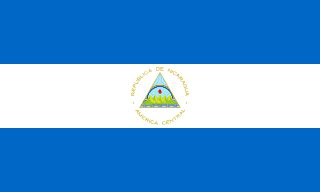
| Flag | Nicaragua Flag |
|---|---|
| Country | Nicaragua |
| Capital | Managua |
| Continent | North America |
| Official Languages | Spanish |
| Currency | Nicaraguan Córdoba (NIO) |
| Dialling Code | +505 |
Nicaragua Flag Meaning
Flag Design
The flag of Nicaragua is rectangular with a 3:5 aspect ratio, consisting of three equal horizontal stripes of blue, white, and blue. At the center of the white stripe is the Nicaraguan coat of arms. The coat of arms is a circular emblem featuring five green volcanoes (symbolizing the five Central American nations), triangular peaks, a rainbow, a Phrygian cap (liberty cap), and surrounding Spanish text, all set within the white band, flanked by symmetrical blue stripes.
The blue on the flag is a deep shade, close to indigo. The white center contrasts sharply with the blue, making the central emblem highly prominent. The flag is nearly perfectly symmetrical top and bottom, giving it a balanced and dignified appearance, and is a typical example of the common Central American design of blue-white-blue.
Meaning
The two blue stripes represent the Pacific Ocean to the west and the Caribbean Sea to the east, continuing the color scheme of the Federal Republic of Central America’s flag, symbolizing ideals of freedom and independence. The white stripe symbolizes peace and purity. The five volcanoes in the central emblem represent the unity of the five Central American nations under shared ideals, the rainbow symbolizes peace, the liberty cap represents freedom, and the surrounding text reads “República de Nicaragua” and “América Central.” Nicaragua’s flag shares color schemes with those of Honduras, El Salvador, and others, all derived from the Federal Republic of Central America’s flag.
History and Legal Status
The current design of the Nicaraguan flag has been in use since 1908 and was further standardized in relevant laws in 1971. After the 1979 Sandinista Revolution, a different version of the emblem and flag was briefly used, but the current design was reinstated. The flag is widely displayed on Independence Day (September 15), at government buildings, and during sporting events. The coat of arms also appears on the passport, currency, and official documents, serving as an important symbol of national identity.
Nicaragua Overview
Country Details »Nicaragua Overview
Nicaragua is the largest country in Central America, bordered by Honduras to the north, Costa Rica to the south, the Caribbean Sea to the east, and the Pacific Ocean to the west, covering an area of approximately 130,400 square kilometers. The capital, Managua, is located on the Pacific volcanic and lake region in the west and serves as the country’s political, economic, and transportation hub. With a population of about 6.6 million, Nicaragua operates under a presidential republic system.
The country is divided into several departments and indigenous autonomous regions. The North Atlantic and South Atlantic Autonomous Regions are home to indigenous groups such as the Miskito people and Afro-descendant communities along the Caribbean coast. Their languages and cultures are more closely aligned with the Caribbean English-speaking world and differ markedly from the Spanish-speaking regions of the west.
Geography and Climate
Nicaragua is situated in the volcanically active Central American isthmus. The Pacific side features a chain of active volcanoes, including Masaya, Momotombo, and San Cristóbal, some of which remain active today. The central region consists of highlands and mountains, while the northern and eastern areas are covered by vast tropical rainforests. The country has two major lakes: Lake Nicaragua (also called Cocibolca), the largest in Central America, which uniquely hosts islands and once recorded sightings of freshwater sharks, and is also home to the Ometepe Island formed by two volcanoes; the other is Lake Managua.
The climate is tropical, with distinct dry and wet seasons. On the Pacific side, the dry season runs from November to April and the wet season from May to October. The Caribbean side experiences more rainfall and is humid throughout the year.
Historical Background
Nicaragua was originally inhabited by indigenous groups such as the Nahuatl. In 1524, Spanish colonists established the cities of Granada and León, representing conservative and liberal factions respectively, and political disputes often revolved around these two cities. Nicaragua gained independence from Spain in 1821, briefly joining the Mexican Empire before becoming part of the Federal Republic of Central America, and achieved full independence as a republic in 1838.
In the mid-19th century, Nicaragua was a key transit route across the isthmus. Throughout the 20th century, it was long ruled by the Somoza family. In 1979, the Sandinista National Liberation Front overthrew the Somoza regime, and the country experienced civil war in the 1980s. Since then, the political situation has undergone multiple changes, with the current government in power since 2007.
Economy and Currency
Nicaragua is a Central American country with a relatively small economy primarily based on agriculture. Major exports include coffee, beef, sugar, gold, shrimp, and beans. Textile and garment processing, as well as remittances, are also important sources of income. Tourism has been growing rapidly in recent years, with a focus on colonial cities, volcanoes, and lakes.
The official currency is the Nicaraguan Córdoba (currency code NIO, symbol C$), issued by the Central Bank of Nicaragua. The currency has experienced severe inflation and multiple reforms in the past, with the current Córdoba introduced in 1991. U.S. dollars are widely accepted in tourism and large transactions.
Culture and Society
Nicaraguan culture blends Spanish colonial heritage with indigenous and Afro-Caribbean elements. The official language is Spanish, while Miskito and Creole English are spoken in the Caribbean coastal regions. The country has a rich literary tradition, with poet Rubén Darío regarded as a pioneer of modernist poetry. The predominant religion is Catholicism, and local patron saint festivals are vibrant celebrations.
The cuisine is based on corn, beans, rice, and plantains. Popular national dishes and snacks include gallo pinto (rice and beans), nacatamal (corn husk-wrapped tamale), vigorón (fried pork rinds with yuca and cabbage salad), and quesillo (cheese wrapped in onion). The rum brand Flor de Caña is internationally renowned.
Tourism Overview
Nicaragua’s main tourism attractions are concentrated in the western and southern regions: Granada is a well-preserved colonial city with colorful facades and a cathedral overlooking the lake; León is known for having the largest cathedral in Central America (a UNESCO World Heritage Site) and its liberal history; Masaya Volcano National Park offers views of volcanic smoke and nighttime lava flows; Ometepe Island allows hiking on twin volcanoes, seeing waterfalls, and enjoying pristine lake scenery; the San Juan River winds through rainforest and historic fortresses toward the Caribbean; the Caribbean-facing Corn Islands are famous for diving and coral reefs. This blend of nature and culture makes it one of the least commercialized destinations in Central America.
Objective advisory: In recent years, Nicaragua’s political and social environment has been unique. Many countries have issued travel advisories. Following election disputes, the government closed many civil society organizations and media outlets, and there is uncertainty regarding entry and freedom of expression. Travelers should monitor their home country’s consular advisories, avoid participating in demonstrations or political activities, maintain a low profile, and safeguard their documents.
Nicaragua Travel Guide
All Guides »Nicaragua Travel Snapshot: Visa, Seasons, Budget & Safety Tips
Visa & Entry, Dry vs Wet Season Choices, Budget Guide, and Essential Safety & Et...
Nicaragua 7-Day Classic Itinerary: Volcanoes, Lakes, and Colonial Cities 7 days
Managua, Masaya, Granada, Ometepe, and León form the most essential route throug...
Nicaragua 4-Day Short Trip: Granada and Masaya Volcano 4 days
Base yourself in Granada to pack colonial architecture, lakeside islands, and an...
Must-visit attractions in Nicaragua: volcanoes, sanctuaries, and lake islands
From UNESCO-listed cathedrals to twin volcanic islands in the lake, here’s a gui...
Nicaragua Food Guide: Gallo Pinto and National Snacks
Red bean rice, tamales steamed in corn husks, and fried pork rinds—sample Nicara...
Nicaragua Transportation Guide: Airports, Buses, Ferries, and Car Rentals
From getting into town from the airport, to intercity buses, the Ometepe ferry, ...