Vietnam Flag
The proportions, colors, and history of Vietnam's flag - a banner that tells Vietnam's own story.
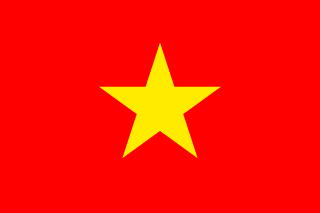
| Flag | Vietnam Flag |
|---|---|
| Country | Vietnam |
| Capital | Hanoi |
| Continent | Asia |
| Official Languages | Vietnamese |
| Currency | Vietnamese Dong (VND) |
| Dialling Code | +84 |
Vietnam Flag Meaning
National Flag Design
The Vietnamese flag is officially called the “Red Flag with a Gold Star” (Cờ đỏ sao vàng). It is a red rectangle with a 2:3 aspect ratio, featuring a bright yellow five-pointed star in the center. The star’s five points point toward the four corners and the center top of the flag, creating a simple yet highly recognizable design.
Meaning
The red background symbolizes revolution and the blood shed by the Vietnamese people in their struggle for independence and freedom. The yellow five-pointed star represents the leadership of the Communist Party of Vietnam (now the ruling party) and stands for the unity of the five main social classes: workers, peasants, soldiers, intellectuals, and youth.
History and Legal Status
The red flag with a gold star was first used in 1940 by southern insurgents. On September 2, 1945, when Ho Chi Minh read the Declaration of Independence in Ba Dinh Square, Hanoi, and proclaimed the establishment of the Democratic Republic of Vietnam, it was officially raised as the national flag. In 1955, the star’s slightly pointed tips were modified to the current smooth five-pointed design. After the reunification of North and South Vietnam in 1976, the flag became the official emblem of the unified Socialist Republic of Vietnam and was enshrined in the constitution.
Today, the red flag with a gold star is displayed at government buildings, schools, streets, residential balconies, and during various national celebrations, serving as the most visible symbol of Vietnamese national identity. The flag is protected by law and must not be displayed upside down, defaced, or used for inappropriate commercial purposes.
Vietnam Overview
Country Details »Vietnam Overview
Vietnam (officially the Socialist Republic of Vietnam) is located on the eastern edge of the Indochinese Peninsula. It stretches around 1,650 kilometers in a long, narrow S-shape from north to south, with the narrowest point being about 50 kilometers wide. The country shares borders with China to the north, Laos and Cambodia to the west, and the South China Sea to the east, which it refers to as the East Sea. Vietnam has a coastline of approximately 3,260 kilometers and covers a total area of about 331,000 square kilometers. Its capital, Hanoi, is located in the Red River Delta in the north, while Ho Chi Minh City (formerly Saigon), the largest city, lies in the Mekong Delta in the south.
Vietnam is a socialist country led by the Communist Party of Vietnam. It is divided into 58 provinces and 5 municipalities, with a population of over 100 million, making it the 15th most populous country in the world. The country has a young workforce and a rapidly expanding manufacturing sector.
Geography and Climate
Vietnam’s geography differs greatly between its northern and southern regions. The north is characterized by the Red River Delta and the northeastern highlands, and is also home to the karst limestone islands of Ha Long Bay, a globally recognized natural wonder. The central part of the country features a narrow coastal plain and the Truong Son Mountain Range, where cities like Da Nang and Hoi An are located. The south includes the Mekong Delta, a highly water-connected region that serves as Vietnam’s main hub for rice and fruit production.
Because of its north-south stretch, Vietnam has a variety of climates across different areas. The northern regions (including Hanoi and Ha Long Bay) experience a subtropical monsoon climate with four distinct seasons, including cool and foggy winters from December to February. The central area (around Da Nang and Hoi An) has heavy rainfall from September to December and is often affected by typhoons. The southern region (including Ho Chi Minh City and the Mekong Delta) remains warm throughout the year, with a distinct dry season from November to April and a rainy season from May to October.
Historical Background
Northern Vietnam was under the direct or indirect control of successive Chinese dynasties for over a thousand years starting in 111 BCE, resulting in strong influences from Han culture, Confucianism, Chinese characters, and the imperial examination system. In 939 CE, Vietnam gained independence and later went through the rule of the Ly, Tran, Le, and Nguyen dynasties. This period helped shape a unique cultural identity combining local traditions with elements of Confucianism, Buddhism, and Daoism originally introduced from China.
In the mid-to-late 19th century, Vietnam became a French colony as part of French Indochina. Saigon was once known as the “Paris of the Orient.” During the 20th century, the country fought against French colonial forces and U.S. intervention before achieving national reunification in 1975. The Đổi Mới (Renovation) reforms were launched in 1986, transitioning the country from a centrally planned to a market economy. Since then, Vietnam has seen consistent rapid development, becoming a key player in global manufacturing and a popular tourist destination.
Economy and Currency
Vietnam is a major hub for global manufacturing, producing and exporting large quantities of textiles, garments, footwear, electronics, furniture, and agricultural goods. International companies such as Samsung and Foxconn run major production facilities in the country. In recent years, tourism has expanded quickly and has become an important source of foreign income. The official currency is the Vietnamese Dong (VND), issued by the State Bank of Vietnam. Banknotes are issued in relatively high denominations, and cash is still commonly used in daily transactions.
Culture and Society
Vietnamese culture reflects a blend of Chinese, Southeast Asian, and French colonial influences. French-style architecture, such as villas and Catholic churches, can be seen in many cities, and this mix is also reflected in local foods like the baguette sandwich (Bánh Mì) and Vietnamese drip coffee. Buddhism and ancestor veneration are central to spiritual life. Tết (Lunar New Year) is the most important traditional holiday, celebrated with family gatherings, spring decorations, ancestral rites, and making sticky rice cakes.
Vietnamese cuisine is well-known for dishes such as rice noodles (Phở), spring rolls, baguette sandwiches, coffee, and fresh seafood. Flavors are generally light, fresh, and herb-infused. Iced coffee with sweetened condensed milk—locally called “ice coffee” (Cà phê sữa đá)—is a daily staple for many.
Tourism Overview
Vietnam offers a wide variety of affordable attractions: the karst landscapes of Ha Long Bay, Hanoi’s Old Quarter, and the terraced fields of Sapa in the north; the beaches of Da Nang, the ancient town of Hoi An, and the imperial citadel of Hue in the center; and Ho Chi Minh City, Mui Ne, Dalat, and Phu Quoc Island in the south. The expansion of low-cost air travel and improved road infrastructure has made traveling between the north and south easier than ever.
Vietnam Travel Guide
All Guides »Vietnam Travel Quick Guide: Visas, Seasons, Budget & Etiquette
Climate differences between north and south, e-Visa application, daily spending,...
8-Day Classic Vietnam Itinerary: Hanoi – Halong Bay – Da Nang – Hoi An – Ho Chi Minh City 8 days
Travel from north to south across Vietnam, experiencing karst seas, ancient town...
Vietnam 4-Day Short Trip: Ho Chi Minh City + Mekong Delta 4 days
Southern Vietnam Only: French Architecture, War History, Waterway Life, and Coff...
Essential Attractions in Vietnam: From Ha Long Bay to Phu Quoc
Northern karst landscapes, central ancient towns, southern waterways — 15 of the...
A Guide to Vietnamese Cuisine: Pho, Baguettes, and Drip Coffee
Light, fresh, herbaceous, and infused with French influence—these define the fla...
Vietnam Travel Guide: Domestic Flights, Grab, and Sleeper Trains
How to get around Vietnam’s north-south stretch most affordably by plane, train,...