Ireland Flag
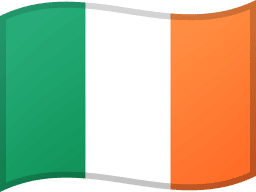
The proportions, colors, and history of Ireland's flag - a banner that tells Ireland's own story.
| Flag | Ireland Flag |
|---|---|
| Country | Ireland |
| Capital | Dublin |
| Continent | Europe |
| Official Languages | Irish, English |
| Currency | Euro (EUR) |
| Dialling Code | +353 |
Ireland Flag Meaning
Flag Design
The flag of Ireland is a vertical tricolour of equal-width green, white, and orange stripes, in that order from the hoist side. The proportions of the flag are 1:2. This distinctive vertical arrangement, with green and orange on either side and white in the middle, is one of the most recognisable visual symbols of the island nation, and is often distinguished from similarly styled flags (like those of Italy or Ivory Coast) by its specific colour order and orientation.
Meaning
Green represents the Gaelic tradition and the majority Catholic population of Ireland, while orange symbolises the Protestant minority, originating from William of Orange. The white in the middle signifies peace and unity between the two traditions. This colour scheme reflects the hope for peaceful coexistence among the different communities in Ireland after a long history of religious and ethnic conflict. White is thus seen as the colour of peace and embodies the flag’s core spirit.
History and Legal Status
The tricolour was first publicly displayed in 1848 by Thomas Francis Meagher, a leader of the Young Ireland movement. It is said that the design was a gift from a French woman, inspired by the French tricolour. The flag was raised at the General Post Office during the Easter Rising of 1916 and subsequently became a symbol of the struggle for independence. After the establishment of the Irish Free State in 1922, it was adopted as the national flag, and its status was formally confirmed in Article 7 of the Constitution of Ireland in 1937. Like the flags of India and Ivory Coast, Ireland’s flag is a vertical tricolour, but its unique colour combination and orientation set it apart. When flown, the green must always be closest to the hoist. This detail is often specified in official guidelines. Today, the flag is widely used during St. Patrick’s Day, national celebrations, and sporting events, and is especially prominent when the Irish rugby team takes to the field.
Ireland Overview
Country Details »Ireland at a Glance
Ireland (officially the Republic of Ireland, known as Éire in Irish) is located on the island of Ireland in northwestern Europe, occupying about five-sixths of the island. It borders Northern Ireland (part of the United Kingdom) to the northeast, faces Wales across the Irish Sea to the east, and is washed by the Atlantic Ocean to the west. The country covers an area of approximately 70,300 square kilometres. Its capital, Dublin, is situated at the mouth of the River Liffey on the east coast and serves as the national centre of politics, economy, and culture, as well as a key hub for technology and finance in Europe.
Ireland is a parliamentary republic, with the President serving as the head of state (current President Michael D. Higgins, in office since 2011), while executive power is exercised by the Cabinet led by the Taoiseach (Prime Minister). The legislature consists of the Dáil Éireann (House of Representatives) and the Seanad Éireann (Senate). The country is divided into 26 counties. The official languages are Irish and English, though English is the main language of daily communication, with Irish still widely spoken in the Gaeltacht regions of the west.
Geography and Climate
Ireland’s terrain is dominated by lowlands in the central region, surrounded by hills and mountains. Its coastline is rugged, especially along the west coast where the Atlantic has shaped numerous cliffs and bays. The country’s highest peak is Carrauntoohil in the MacGillycuddy’s Reeks range of southwestern Ireland, standing at 1,038 metres. The River Shannon, about 360 kilometres long, is the longest river and connects a series of lakes. The interior features extensive peat bogs and pastures with year-round green grass, which earns the country its nickname, the Emerald Isle.
The climate is temperate maritime, influenced by the North Atlantic Current, resulting in mild winters, cool summers, and frequent, changeable rainfall—often with sunshine and rain within a single day. Average temperatures are around 5°C in January and 16°C in July, with extreme cold or heat being rare. The period from May to September offers longer daylight hours and generally better weather, making it the most popular time for travel, though rain gear is recommended year-round.
Historical Background
Ireland has a rich heritage of Celtic and Gaelic culture. After Saint Patrick introduced Christianity in the 5th century, monastic culture flourished, leaving behind a wealth of manuscripts and stone crosses. From the 9th century, Vikings established port towns such as Dublin, and in the 12th century, the Normans invaded. Thereafter, English influence gradually extended over the island. The conquests and colonisation of the 16th and 17th centuries, along with religious conflicts, entrenched centuries of division between Catholic native Irish and Protestant settlers.
Ireland was incorporated into the United Kingdom in 1801. The Great Famine of 1845–1852 caused the deaths of around one million people and prompted more than a million more to emigrate, profoundly altering the nation’s destiny. The Easter Rising of 1816 ignited the independence movement, and after the Irish War of Independence from 1919 to 1921, the Anglo-Irish Treaty was signed. The Irish Free State was established in 1922, a new constitution was enacted in 1937, and the Republic of Ireland was officially declared in 1949. Ireland joined the European Economic Community in 1973, and the Good Friday Agreement of 1998 brought peace to Northern Ireland.
Economy and Currency
Once a relatively poor agricultural nation in Europe, Ireland experienced rapid economic growth from the 1990s onwards, attracting numerous multinational technology and pharmaceutical companies to establish their European headquarters, thanks to its low corporate tax rates, English-speaking environment, and access to the EU market. This period earned Ireland the nickname the Celtic Tiger. Major companies such as Google, Apple, and Intel have significant operations in Dublin. Key exports include pharmaceuticals, software, medical devices, and agricultural products (dairy, beef, and whiskey). Following the 2008 financial crisis, the economy underwent adjustments and has since seen strong recovery.
Ireland uses the euro (EUR), a currency shared by 20 countries in the Eurozone, issued by the European Central Bank and the Eurosystem. One euro is divided into 100 cents. Since adopting the euro for accounting purposes in 1999 and circulating it physically in 2002, Ireland has been one of the founding members of the Eurozone and no longer issues its own currency. Coins and banknotes are supplied uniformly by the Eurosystem. Cross-border travel within the Eurozone does not require currency exchange. However, Northern Ireland, on the same island, uses the British pound, so travellers should be prepared to switch currencies when crossing the border.
Culture and Society
Ireland has a distinguished literary tradition, with world-renowned figures such as Yeats, Shaw, Wilde, Joyce, and Beckett, several of whom were Nobel laureates. In music, traditional folk music and Irish stepdance are globally celebrated, and bands like U2 and The Cranberries have brought Irish pop music to the world stage. St. Patrick’s Day (17 March) is Ireland’s most important national holiday, marked by green-themed parades in cities around the globe. Gaelic football and hurling, governed by the Gaelic Athletic Association, are the national sports, while pub culture lies at the heart of social life.
The traditional diet is based on potatoes, bread, seafood, and dairy. Iconic dishes and drinks include Irish stew, the full Irish breakfast, soda bread, seafood chowder, Guinness stout, and Irish whiskey. Irish people are known for being talkative and humorous, and striking up a conversation with strangers in a pub is a common travel experience.
Tourism Overview
Ireland’s appeal lies in its natural beauty and cultural richness: Dublin is home to Trinity College and the Book of Kells, the Guinness Storehouse, St. Patrick’s Cathedral, and Temple Bar. The Cliffs of Moher on the west coast, rising over 200 metres, are an iconic sight. The Ring of Kerry, Killarney National Park, the Dingle Peninsula, and the cities of Galway and Connemara showcase pristine coastal and lakeland scenery. Cork, Blarney Castle, and Waterford each offer unique historical heritage.
Northern Ireland, which includes attractions like the Giant’s Causeway and Belfast, is part of the United Kingdom. While these can be included in cross-border itineraries, please note that separate visa and entry arrangements apply. Ireland has convenient public transport and car rental options, and is a paradise for golfers, anglers, and hikers, ideal for a relaxed, slow-paced island-wide road trip.
Ireland Travel Guide
All Guides »Ireland Travel Quick Guide: Separate Visa, Best Time to Visit, Budget Tips, and Pub Culture
Ireland is not part of the Schengen Area and requires a separate visa. The weath...
8-Day Ireland Loop Itinerary: Dublin, Cliffs of Moher, Ring of Kerry & Galway 8 Days
Travel west from the capital’s literary pubs, connecting the Cliffs of Moher, Ri...
4-Day Ireland Short Break: A Deep Dive into Dublin’s Literature, Pubs, and Temple Bar 4 Days
Even with limited time, you can experience the best of Dublin: explore the Old C...
Essential Attractions in Ireland: Trinity College, Cliffs of Moher, Ring of Kerry & Giant’s Causeway
From Dublin’s literary landmarks to the west coast’s cliffs and scenic drives, t...
Irish Food Guide: Irish Stew, Soda Bread, Stout, and Seafood Chowder
Irish cuisine is built around potatoes, dairy, and seafood. From the full Irish ...
Ireland Travel Guide: Dublin Buses, Intercity Trains & Driving by Car
In Dublin, use buses and trams; for intercity travel, take trains or coaches. Fo...