Samoa Flag
The proportions, colors, and history of Samoa's flag - a banner that tells Samoa's own story.
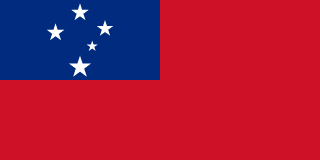
| Flag | Samoa Flag |
|---|---|
| Country | Samoa |
| Capital | Apia |
| Continent | Oceania |
| Official Languages | Samoan, English |
| Currency | Samoan tālā (WST) |
| Dialling Code | +685 |
Samoa Flag Meaning
Flag Design
The Samoan flag is rectangular with a 1:2 aspect ratio. The flag is red, with a blue rectangle in the upper left corner (covering roughly half the flag’s length). Inside the blue area is the white Southern Cross constellation, consisting of four larger and one smaller five-pointed star. The smaller star is positioned slightly below the centre of the cross, representing the faintest but real fifth star of the Southern Cross (Epsilon Crucis).
Meaning
Red symbolises courage and the blood shed in the struggle for freedom and independence; blue represents the surrounding South Pacific Ocean; white stands for purity and peace; and the Southern Cross clearly indicates Samoa’s location in the South Pacific and also symbolises the deep-rooted Christian faith in the region. The flag combines the elements of a national flag, the ocean, and faith into a simple yet distinctly Polynesian design.
History and Legal Status
The predecessor to the current flag appeared in 1948 during the United Nations trusteeship period, when the Southern Cross had only four stars. In 1949, a fifth smaller star was added, creating the version used today. The flag was officially adopted upon the independence of Western Samoa on January 1, 1962, and has remained unchanged since. The use and specifications of the flag are legally regulated. Government offices, schools, and public buildings fly the flag on national holidays (such as Independence Day on June 1) and important celebrations. In Samoa, the flag, along with the fale and tatau, is one of the most tangible symbols of the “Faʻa Samoa” national identity. While the Southern Cross appears on the flags of several South Pacific nations, Samoa’s version with five stars and an asymmetrical layout is unique. The proportions of the blue area and the red field are precisely defined in legal annexes.
Samoa Overview
Country Details »Overview of Samoa
Samoa (officially the Independent State of Samoa) is located in the heart of the Polynesian islands in the South Pacific, occupying the western part of the Samoan Archipelago. It consists of the two main volcanic islands of Upolu and Savai'i, along with the smaller islands of Manono and Apolima. The country covers an area of approximately 2,842 square kilometres and has a population of about 200,000. The capital, Apia, is situated on the northern coast of Upolu Island. The coastal “Beach Road” is home to government buildings, markets, and a seaside promenade, serving as the nation’s political and economic hub. Both Samoan and English are official languages. Samoa gained independence in 1962 and was the first Polynesian nation to reclaim sovereignty. It was formerly known as Western Samoa until the name was simplified to Samoa in 1997.
Geography and Climate
The Samoan Islands were formed by underwater volcanic activity, resulting in dramatic landscapes. The central highlands of Upolu Island are covered with dense tropical rainforests, featuring numerous waterfalls and natural water slides. Savai'i Island is even more pristine, home to the largest volcanic craters and lava formations. The To Sua Ocean Trench on the southern coast of Upolu Island is a natural seawater pool formed by the collapse of ancient volcanic rock. Descending via a ladder through a crevice in the rocks, it is one of Samoa’s most iconic sights. The climate is tropical maritime, with an average annual temperature of around 27°C. The dry season runs from May to October, while the wet season lasts from November to April, occasionally bringing tropical cyclones. The coastline is surrounded by coral reefs, creating calm lagoons, with many villages built along the white-sand beaches inside the lagoons.
Historical Background
Samoa is one of the ancient cradles of Polynesian civilisation. Descendants of the Lapita culture settled here around 3,000 years ago, and local oral histories are closely linked to the migration legends of other eastern Polynesian islands. European navigators arrived in the 18th century, and in the 19th century, Germany, Britain, and the United States fiercely competed for influence. In 1899, the Samoan Islands were divided: the western part became German Samoa, while the eastern part went to the United States (now American Samoa). After World War I, New Zealand took control of Western Samoa. The local Mau movement launched a famous non-violent independence campaign, leading to the declaration of independence of Western Samoa on January 1, 1962. The country’s name was simplified to Samoa in 1997.
Economy and Currency
Samoa’s economy is based on agriculture (coconut products, cocoa, taro, and fishing), remittances (a large diaspora lives in New Zealand and Australia), tourism, and foreign aid, along with some export-oriented manufacturing such as automotive wiring harnesses. The official currency is the Samoan tālā (currency code WST, symbol T, often written as WS$), issued by the Central Bank of Samoa. The currency is relatively stable, with 1 tālā equal to 100 sene. Banks and currency exchange services are readily available in Apia, but cash is predominantly used in rural areas.
Culture and Society
The key to understanding Samoa is “Faʻa Samoa” (meaning “the Samoan way”): it encompasses the village-based governance system led by hereditary chiefs (matai), land and resource sharing within extended family units (“aiga”), the observance of the Sabbath with church attendance, and a strong culture of hospitality. Villages have strict customs: visitors should walk slowly when entering, avoid wearing revealing clothing, and not enter private beach areas without permission. Traditional Samoan houses, called fale, are open-walled structures with thatched roofs, reflecting the openness of family life. A significant cultural ceremony is the ʻava (kava) ritual, considered the highest form of respect. Traditional male tattoos, called tatau, extend from the waist to the knees and symbolise adulthood and honour. These tattoos are created using traditional tools and techniques, and are regarded as living fossils of Polynesian tattoo culture. British author Robert Louis Stevenson spent his final years at his home in Vailima at the foot of Mount Vaea, which is now a museum, and his grave is located at the summit of Mount Vaea.
Tourism Overview
Samoa appeals to in-depth travellers with its “untouched authentic Polynesia”. The southern coast of Upolu Island features a string of attractions including the To Sua Ocean Trench, Lalomanu Beach (often ranked among the world’s best white-sand beaches), and Papaseʻea Sliding Rocks. A short ferry ride across the Apolima Strait takes you to Savai'i Island, where you can explore the Alofaaga Blowholes (where seawater erupts through volcanic rock holes), rainforest trails, and lava fields. Accommodation mainly consists of family-run fale lodges by the beach, most of which include breakfast and dinner. With visa-free entry for many international visitors, minimal time difference, and reasonable prices, Samoa is emerging as a new choice for off-the-beaten-path island travel.
Samoa Travel Guide
All Guides »Samoa Travel Quick Guide: Visa-Free, Seasons, Budget & Village Etiquette
This Polynesian island nation offers a 60-day visa-free stay for most internatio...
Samoa 7-Day Classic Route: Upolu Island Loop — Savai’i Island Hopping 7 Days
Two days exploring the main island’s highlights plus three days of wild Savai’i,...
Samoa 4-Day Short Trip: Highlights of Upolu Island 4 days
Experience the best of Samoa without visiting outer islands: waterfalls, blowhol...
Essential Attractions in Samoa: Trenches, White Sands, and Blowholes
A curated list of the nine most worthwhile attractions in Samoa, organized by is...
Samoa Food Guide: Oka Raw Fish Salad, Palusami, and Coconut Sweet Buns
From raw fish salad to umu-roasted pork, explore the eight essential flavors of ...
Samoa Transport Guide: Airports, Shared Taxis, and Inter-Island Ferries
Left-hand driving, colorful shared taxis, and one ferry line — a concise guide t...