Maldives Flag
The proportions, colors, and history of Maldives's flag - a banner that tells Maldives's own story.
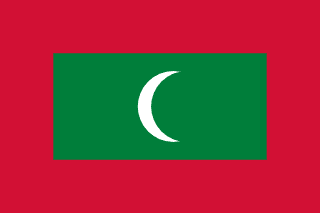
| Flag | Maldives Flag |
|---|---|
| Country | Maldives |
| Capital | Malé |
| Continent | Asia |
| Official Languages | Dhivehi |
| Currency | Maldivian Rufiyaa (MVR) |
| Dialling Code | +960 |
Maldives Flag Meaning
Flag Design
The Maldivian flag has a 2:3 aspect ratio. The background is red, with a green rectangle positioned slightly off-center toward the hoist (the side attached to the pole). Inside the green rectangle is a white crescent, its open side facing the fly (the outer edge of the flag). The red, green, and white colors create a striking, high-contrast design.
Meaning
Red symbolizes the blood of heroes who fought for the nation’s independence and freedom, as well as courage and resilience. Green represents peace, prosperity, and the lush coconut palms and vibrant life of the islands. The white crescent is an Islamic symbol, reflecting the nation’s faith and spiritual devotion. Together, these elements convey sacrifice, abundance, and belief.
History and Legal Status
Early Maldivian flags were purely red. After Islam became the state religion, the crescent was added. In the early 20th century, variations included red flags with black-and-white diagonal stripes or a simple crescent. By around 1926, the red field, green rectangle, and white crescent took shape, gaining official recognition in the 1930s. After independence in 1965, this design became the national flag and remained in use after the republic was established in 1968.
Today, the flag is prominently displayed at government buildings, airports, ports, and resort entrances, symbolizing both national identity and Islamic faith. Disrespecting the flag is considered unacceptable.
Maldives Overview
Country Details »Overview of the Maldives
The Maldives (officially the Republic of Maldives) lies in the northern Indian Ocean, about 700 kilometers southwest of Sri Lanka. It consists of 26 natural atolls and around 1,192 coral islands, stretching roughly 820 kilometers from north to south, with about 200 inhabited. The total land area is approximately 298 square kilometers, making it one of Asia’s smallest countries by land—but it boasts a vast exclusive economic zone.
The capital, Malé, located in Malé Atoll, covers less than two square kilometers yet houses around 250,000 people, making it one of the most densely populated capitals in the world. Across the water, Hulhumalé serves as the new urban center and airport hub. The national population is about 520,000. The official language is Dhivehi, though English is widely spoken in the tourism industry. Islam is the state religion, and the country operates under a presidential system. The first resort island opened in 1972, and since then, the “one hotel per island” model has become the Maldives’ most distinctive national feature.
Geography and Climate
The Maldives is the world’s lowest-lying country, with an average elevation of just 1.5 meters and a highest point of just over two meters—all land is formed by coral. Rising sea levels pose a long-term and very real threat. Each atoll typically encloses a shallow, clear lagoon, beyond which lies the deep Indian Ocean, creating the conditions for exceptionally clear blue-green waters and excellent snorkeling.
The climate is tropical monsoonal, with temperatures ranging between 26°C and 32°C year-round and high humidity. Two monsoon seasons influence the weather: the dry season (November to April), dominated by the northeast monsoon, brings clear skies, little rain, calm seas, and the best underwater visibility—ideal for snorkeling, diving, and honeymoons. The rainy season (May to October), under the southwest monsoon, sees more afternoon showers and choppier seas, but prices drop significantly, and it’s a great time to spot manta rays in Baa Atoll and whale sharks in South Ari Atoll.
Historical Background
Human settlement in the Maldives dates back at least 2,000 years, initially influenced by Indian and Sri Lankan cultures, with Buddhism as the predominant religion. Islam was introduced in 1153 AD and gradually became the state religion, with sultans ruling for centuries. The Portuguese arrived in the 16th century, followed by the Dutch in the 17th and the British in the 19th. The Maldives became a British protectorate in 1887, gained independence in 1965, abolished the sultanate in 1968, and adopted a republic.
Tourism began in 1972 with the opening of the first resort island. Over the following decades, the Maldives grew into one of the Indian Ocean’s premier holiday destinations, thanks to its unique one-island-one-hotel model and world-class diving. Tourism has since replaced fishing as the country’s primary economic pillar.
Economy and Currency
Tourism is the Maldives’ leading industry, contributing about a third of GDP and the vast majority of foreign exchange earnings, followed by tuna fishing and processing. Due to the country’s small size and limited resources, almost all food, fuel, building materials, and consumer goods are imported, keeping prices relatively high in the Indian Ocean region.
The official currency is the Maldivian Rufiyaa (MVR, symbol Rf), issued by the Maldives Monetary Authority. Note that resort islands almost exclusively use U.S. dollars for pricing and transactions, while rufiyaa are mainly used in Malé and local islands. As a result, bringing sufficient U.S. dollar cash and using an international credit card is more practical than exchanging for rufiyaa.
Culture and Society
As an Islamic nation, alcohol and pork products are banned on local islands, and dress codes are more conservative—swimwear is only allowed on resort islands and designated bikini beaches. Friday is the weekly day of prayer (Jumu'ah), and some shops may close during prayer times. Traditional crafts include lacquerwork, weaving, and the bodu beru drum dance.
The cuisine centers on tuna: mas huni (a breakfast dish of shredded tuna with coconut and flatbread) and garudhiya (a fish soup served with rice) are staples, along with various fried snacks (hedhikaa). Resort islands mostly serve Western-style buffets and fusion cuisine, with alcohol available only on resorts and a few cruise boats.
Tourism Overview
Maldives tourism is highly developed and focused: resort islands offer overwater villas, beach bungalows, underwater restaurants, and private butler services—ideal for honeymoons, families, and relaxation. Since 2009, local islands have opened guesthouses, with budget-friendly options like Maafushi and Dhiffushi offering island-hopping, snorkeling, and fishing for backpackers and divers. Inter-atoll travel is usually by seaplane, domestic flight, or speedboat, often arranged by hotels. Key experiences include island-hopping snorkeling, sunset dolphin cruises, night fishing, and stargazing from overwater villas.
Maldives Travel Guide
All Guides »Maldives Travel Quick Guide: Visa-Free Entry, Season Selection, Dual-Budget Islands & Local Taboos
How to enter visa-free, choosing between dry and wet seasons, budget differences...
Classic 7-Day Maldives Itinerary: Resort Overwater Bungalows Plus Local Island Hopping 7 days
Experience both luxury and local life in one week: Stay in an overwater villa an...
Maldives 4-Day Short Trip: Male City, Local Island Homestays, and Deserted Sandbank Hopping 4 Days
You can still enjoy the Maldives on a budget by basing yourself in a local islan...
Essential Experiences in the Maldives: Atoll Snorkeling, Whale Sharks, Manta Rays, and Overwater Resort Stays
The appeal of the Maldives lies not in its architecture but in its oceans. This ...
Maldives Food Guide: Tuna, Coconut Snacks, and Resort Dining Explained
The essence of Maldivian cuisine lies in tuna and coconut. There’s a huge differ...
Maldives Transportation Guide: Seaplanes, Speedboats, Ferries, and Inter-Atoll Transfers
How to fly or take boats between atolls, what the restrictions are for seaplanes...