Côte d'Ivoire Flag
The proportions, colors, and history of Côte d'Ivoire's flag - a banner that tells Côte d'Ivoire's own story.
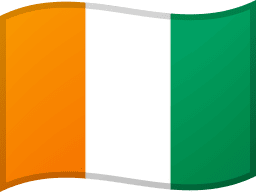
| Flag | Côte d'Ivoire Flag |
|---|---|
| Country | Côte d'Ivoire |
| Capital | Yamoussoukro (political), Abidjan (economic) |
| Continent | Africa |
| Official Languages | French |
| Currency | West African CFA franc (XOF) |
| Dialling Code | +225 |
Côte d'Ivoire Flag Meaning
Flag Design
The flag of Côte d'Ivoire consists of three equal vertical stripes in orange, white, and green, in the ratio 2:3, from left to right. It draws inspiration from the French tricolour layout but uses warm hues symbolising land and nature. The design is clean and bold. Note that the colour order is the reverse of Ireland’s flag—take care not to confuse the two.
Meaning
Orange represents the savanna in the north, the fertility of the land, and the vitality of the nation, as well as aspirations for development and prosperity. White, in the centre, stands for peace and purity. Green symbolises the dense forests of the south and the country’s natural resources, as well as hope. Together, the colours reflect the ideals of unity, peace, and abundance at the time of independence, echoing the meaning behind the country’s former name, the “Ivory Coast.” Orange is often associated with the country’s rich produce and warm climate, while green evokes its world-renowned forests and cocoa plantations.
History and Legal Status
The flag of Côte d'Ivoire was adopted during the transition to autonomy and independence. It was officially taken up by the then-Ivorian Autonomous Republic on December 4, 1959. After independence on August 7, 1960, the orange-white-green tricolour was retained as the national flag and has been in continuous use since. The design is clearly influenced by the French tricolour, reflecting the country’s deep historical and linguistic ties with France. Today, the flag is widely displayed at government buildings, schools, border posts, and sports events, serving as a powerful symbol of national identity. Initially adopted during the autonomous phase under the French Community, it became the definitive emblem of the new republic after full independence.
Côte d'Ivoire Overview
Country Details »Overview of Côte d'Ivoire
Côte d'Ivoire (Republic of Côte d'Ivoire) is located on the northern shore of the Gulf of Guinea in West Africa, bordered by Liberia and Guinea to the west, Mali and Burkina Faso to the north, Ghana to the east, and the Atlantic Ocean to the south. The country covers an area of approximately 322,000 square kilometres and has a population of about 29 million. Its political capital is the inland city of Yamoussoukro, while the economic capital and largest city is the coastal city of Abidjan, which is one of the most important ports, financial, and commercial centres in West Africa. The official language is French, and the country is home to dozens of ethnic languages from the Akan, Kru, Mandé, and Voltaic language families, with major ethnic groups including the Baoulé, Bété, Dioula, Senufo, and Attié.
Côte d'Ivoire is an important member of the Economic Community of West African States (ECOWAS) and the West African Monetary Union (UEMOA), long regarded as one of the economic engines of Francophone Africa. Abidjan’s modern skyline and bustling commerce are often described as the “Little Paris” of West Africa.
Geography and Climate
The terrain of Côte d'Ivoire rises gradually from south to north: the south consists of a narrow coastal plain and lagoons, with Abidjan built on a peninsula and islands surrounded by lagoons; the central region features forested hills; the west and northwest are highland and mountainous areas, with the Nimba Mountains near the Guinea border being particularly elevated; the north is savanna, transitioning into the Sahel. Major rivers include the Bandama, Sassandra, and Comoé, all flowing from north to south into the Atlantic Ocean.
The climate is generally hot and humid, with the south experiencing a tropical rainforest climate—hot year-round with abundant rainfall and a short dry season. The central region is a transitional zone, while the north has a tropical savanna climate with distinct wet and dry seasons. The period from November to March is the driest and most comfortable time to travel. The rainy season runs from April to July (heavy rains) and September to October (lighter rains), with high humidity and concentrated rainfall along the coast—rain gear is essential.
Historical Background
The region now known as Côte d'Ivoire was home to multiple kingdoms and tribal societies in ancient times. The Kong Empire in the north controlled trans-Saharan trade routes, while the Akan-speaking Anyi and Baoulé peoples had close ties with kingdoms in the Ghana region. From the 15th century onwards, European traders—initially Portuguese and later French—arrived along the coast to engage in the ivory, gold, and eventually slave trades. By the late 19th century, France had gradually established the area as a protectorate, officially creating the colony of Côte d'Ivoire in 1893 and incorporating it into French West Africa.
On August 7, 1960, Côte d'Ivoire declared independence. Its first president, Félix Houphouët-Boigny, ruled for decades, pursuing an agricultural economy based on cocoa and coffee exports, leading to significant growth. In 1983, the capital was officially moved from Abidjan to the inland city of Yamoussoukro. From the late 1990s to the early 2000s, the country experienced political instability and armed conflict, but began recovering and rebuilding after 2011, returning to stronger economic growth.
Economy and Currency
Côte d'Ivoire is a key economy in West Africa. Agriculture forms the backbone of the national economy, with cocoa production consistently ranking first in the world—at around 40% of global output. It is also a major producer and exporter of cashews, coffee, rubber, and palm oil. Beyond agriculture, sectors such as oil and gas, port logistics, construction, telecommunications, and services continue to grow, with Abidjan concentrating most industrial and financial activities. The official currency is the West African CFA franc (XOF), issued by the Central Bank of West African States (BCEAO).
Culture and Society
Côte d'Ivoire has a vibrant and diverse culture, with mask culture being particularly prominent. Ethnic groups such as the Attié maintain traditional mask dances and ceremonies, and various mask festivals and communal celebrations offer important insights into local society. Musically, Côte d'Ivoire is the birthplace of popular styles such as zouglou and coupé-décalé, and reggae artist Alpha Blondy is celebrated across Africa. The cuisine primarily features cassava, plantains, yams, and rice, with national favourites including attiéké, kedjenou chicken, fried plantains, and grilled fish. Locals are warm and welcoming, and open-air eateries called maquis are common gathering spots for social meals.
Tourism Overview
Tourism in Côte d'Ivoire balances urban, cultural, and natural attractions: Abidjan offers a modern skyline, scenic lagoons, and a lively arts and music scene; Yamoussoukro is home to the Basilica of Our Lady of Peace, one of the largest churches in the world; Grand-Bassam’s colonial old town is a UNESCO World Heritage Site; Taï National Park and Comoé National Park preserve pristine forests and rich wildlife, also designated as World Heritage Sites; northern areas such as Korhogo showcase savanna landscapes and tribal culture. Overall security is more stable than in many neighbouring countries, but petty theft and scams occur in cities like Abidjan, and the northwestern and southwestern border regions carry certain risks. Travellers should monitor updated consular advisories and avoid travel at night or in remote areas.
Côte d'Ivoire Travel Guide
All Guides »Côte d'Ivoire Travel Quick Guide: Visa Application, Best Time to Visit, Budget, and Etiquette & Taboos
How to apply for an e-visa to Côte d'Ivoire, the best time to go, daily spending...
Classic 7-Day Itinerary in Côte d'Ivoire: Abidjan, Grand-Bassam, and Yamoussoukro 7 days
From modern cities to colonial old towns, and from world-class cathedrals to rai...
4-Day Short Trip to Côte d'Ivoire: A Deep Dive into Abidjan’s City Life, Art, and Lagoons 4 Days
Limited Time? Explore Abidjan Intensively: Break the city center, old town, subu...
Must-visit attractions in Côte d'Ivoire: Abidjan, Grand-Bassam, and national parks
A curated list of Côte d'Ivoire’s top attractions by city and theme, from urban ...
Côte d'Ivoire Food and Snacks Guide: Attiéké, Kedjenou Chicken, and Grilled Fish
From attiéké and kedjenou chicken to grilled fish at Maquis eateries, get to kno...
Complete Guide to Transportation in Côte d'Ivoire: Airport Transfers, Taxis, Ride-Hailing, and Private Cars
Understanding how to get from the airport into town, using taxis and ride-hailin...