Hungary Flag
The proportions, colors, and history of Hungary's flag - a banner that tells Hungary's own story.
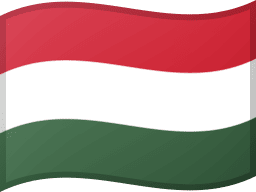
| Flag | Hungary Flag |
|---|---|
| Country | Hungary |
| Capital | Budapest |
| Continent | Europe |
| Official Languages | Hungarian |
| Currency | Hungarian Forint (HUF) |
| Dialling Code | +36 |
Hungary Flag Meaning
Flag Design
The Hungarian flag consists of three horizontal stripes of equal width, in the order of red, white, and green from top to bottom, in a 2:3 aspect ratio. The plain tricolor without the coat of arms is the official national flag, commonly seen on government buildings, public institutions, and streets. The version with the coat of arms is used for formal state occasions, some government offices, and military settings. The colors are vivid and highly recognizable even when the flag is viewed from a distance.
Meaning
Red symbolizes strength and the blood shed for freedom, as well as patriotism and courage; white represents purity, loyalty, and hope; green stands for nature, harvest, and the future of the nation. These meanings have been associated with the tricolor flag since the 1848 revolution and have become the symbolic colors of the Hungarian people. The Hungarian coat of arms is shield-shaped, with the left half showing the red-and-white Árpád stripes and the right half depicting three green hills on a red background with a white double cross. At the top is the famous Holy Crown—the Crown of Saint Stephen. The cross atop the crown is noticeably tilted, a result of historical damage, and has become the most recognizable feature of the Hungarian coat of arms.
History and Legal Status
The red-white-green tricolor was widely used as a national flag during the Hungarian Revolution and War of Independence of 1848–1849 and coexisted for a long time with the black-and-yellow flag of the Habsburg monarchy. During the Austro-Hungarian Empire, Hungary used a variant flag featuring the coat of arms with the Holy Crown. From 1949 to 1956, the People’s Republic added a socialist emblem with a hammer and wheat sheaf to the center of the tricolor. During the 1956 Hungarian Revolution, the public often cut off the emblem, making the plain tricolor a symbol of national identity. The plain tricolor was reinstated in 1957 and officially confirmed by constitutional law after the establishment of the republic in 1990, and has been in use ever since.
Hungary Overview
Country Details »Hungary Overview
Hungary (Magyarország) is a landlocked country in Central Europe, located in the heart of the Carpathian Basin (Pannonian Plain), bordered by Romania and Ukraine to the east, Serbia, Croatia, and Slovenia to the south, Austria to the west, and Slovakia to the north. The country covers an area of approximately 93,000 square kilometers, with a population of around 9.6 million. The official language is Hungarian (Magyar), and its capital, Budapest, is the national center for politics, economy, culture, and transportation, as well as one of the most famous cities along the Danube River.
Hungary is a parliamentary republic, with the president as the head of state and the prime minister holding executive power. The country is divided into 19 counties and the capital city of Budapest. As a member of the European Union, NATO, and the Schengen Area, Hungary is an important manufacturing base and tourist destination in Central Europe, as well as a land corridor connecting Western Europe and the Balkans.
Geography and Climate
Hungary’s terrain is mainly composed of plains and gentle hills, with the Danube and Tisza rivers running north to south, roughly dividing the country in two. In Budapest, the Danube is wide, and Margaret Island in the middle of the river serves as a green oasis for residents. Lake Balaton, located in the west, is the largest lake in Central Europe and is known as the “Hungarian Sea,” serving as a popular summer resort. The northern part features foothills of the Carpathian Mountains, with Kékes Peak (1,014 meters) in the Mátra Mountains being the highest point in the country. Hungary also has abundant thermal water resources, with hundreds of hot springs nationwide, earning Budapest the title of “City of Spas.”
The climate is temperate continental, with distinct seasons: winters are cold, with January temperatures often around 0°C; summers are warm to hot, with daytime temperatures in July and August exceeding 30°C. Spring and autumn are short but pleasant, making them the best times to travel. Precipitation is mainly concentrated in the summer, and the year is relatively dry, with more sunshine hours than average for Central Europe.
Historical Background
The Magyars migrated from the Ural Mountains region to the Carpathian Basin around 896 AD. In the year 1000, Saint Stephen I accepted Christianity and established the Kingdom of Hungary, marking the beginning of the Hungarian state. His coronation crown, the Holy Crown, remains a national symbol to this day. After the Battle of Mohács in 1526, most of Hungary was occupied by the Ottoman Empire for about 150 years, leading to the decline of Buda and Pest. Buda was recaptured in 1686, and Hungary came under Habsburg rule. The Austro-Hungarian Compromise of 1867 led to the formation of the Austro-Hungarian Empire, during which Budapest experienced unprecedented urban development. Most of today’s landmarks, such as the Parliament Building, Heroes’ Square, and Andrássy Avenue, were built during this period.
After World War I, the Austro-Hungarian Empire dissolved. The 1920 Treaty of Trianon resulted in Hungary losing about two-thirds of its territory and a significant portion of its population, an event that deeply impacted its national memory. During World War II, Hungary joined the Axis powers and was occupied by Soviet forces in 1945. In 1949, the People’s Republic of Hungary was established, followed by the Hungarian Revolution of 1956. In 1989, the country transitioned to a multi-party system and a republic. Hungary joined NATO in 1999, the European Union in 2004, and the Schengen Area in 2007. Although a member of the EU, Hungary has not adopted the euro and still uses its national currency, the forint.
Economy and Currency
Hungary has a medium-sized open economy. Key industries include automotive and parts manufacturing, electronics, pharmaceuticals, and agricultural processing. International carmakers such as Audi, Mercedes-Benz, and Suzuki have factories in Hungary. The capital, Budapest, is an important financial and logistics hub in Central and Eastern Europe. The official currency is the forint (Forint, HUF, symbol Ft), issued by the Hungarian National Bank. As an EU member but not part of the eurozone, prices, transactions, and change in Hungary are all in forints. The euro is accepted only in some tourist areas, often at unfavorable exchange rates.
Culture and Society
Hungarian culture combines elements of Central and Eastern Europe. The Hungarian language belongs to the Uralic language family, Finno-Ugric branch, and is quite distinct from the Indo-European languages spoken in neighboring countries. Hungary has a rich musical heritage, with world-renowned composers such as Liszt, Bartók, and Kodály. Performances at Budapest’s opera houses and concert halls are of very high quality. Paprika is the soul of Hungarian cuisine, and dishes like goulash, fisherman’s soup, chicken paprikash, fried dough, and foie gras create a unique flavor profile. Tokaj’s dessert wines have been praised by Louis XIV as the “wine of kings and king of wines.” The thermal bath culture has a long history, from Ottoman-era Turkish baths to 20th-century Art Nouveau-style spas—bathing has long been part of daily life for locals.
Tourism Overview
Hungary is one of the most popular tourist destinations in Central and Eastern Europe. Budapest offers classic sights along the Danube, including Buda Castle, the Parliament Building, the Chain Bridge, Fisherman’s Bastion, and Matthias Church, especially enchanting when illuminated at night. Other highlights include Lake Balaton in the west, Eger and the Tokaj wine region in the central part, Pécs and Szeged in the south, and the Danube Bend towns in the north, forming a rich variety of short-trip routes. Travel costs in Hungary are moderate to low compared to other Central European countries, with well-developed public transport and good safety, making it ideal for first-time travelers to the region.
Hungary Travel Guide
All Guides »Hungary Travel Quick Guide: Schengen Visa, Best Seasons, Budget & Spa Etiquette
Get clarity on the Schengen visa, seasonal timing, daily budget, currency exchan...
Classic 7-Day Hungary Itinerary: Budapest — Danube Bend — Eger — Tokaj — Lake Balaton 7 days
Starting from the twin cities along the Danube, this route connects historic tow...
Hungary 4-Day Itinerary: In-Depth Budapest Tour Plus a Day Trip to the Danube Bend 4 days
See Hungary’s highlights even with limited time: explore Budapest by districts, ...
Must-visit attractions in Hungary: The Danube River, thermal baths, and the Tokaj wine region
A list of over ten top attractions in Hungary, organized by city and region. Eac...
Hungary Food Guide: Goulash, Fisherman’s Soup, Foie Gras, and Tokaji Dessert Wine
The soul of Hungarian cuisine lies in paprika and slow-cooked stews. From street...
Hungary Transport Guide: Getting from Budapest Airport to the City, Metro Tickets & Inter-city Trains
Understanding how to get from the airport to the city, using local transport tic...