Poland Flag
The proportions, colors, and history of Poland's flag - a banner that tells Poland's own story.
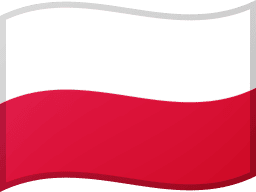
| Flag | Poland Flag |
|---|---|
| Country | Poland |
| Capital | Warsaw |
| Continent | Europe |
| Official Languages | Polish |
| Currency | Polish Zloty (PLN) |
| Dialling Code | +48 |
Poland Flag Meaning
Flag Design
The Polish flag consists of two horizontal stripes of equal width, with white on top and red on the bottom. The official proportions are 5:8. There is also a variant known as the “government flag,” which features the national coat of arms—a white eagle with a red background—centered on the white stripe. This version is reserved for use by government institutions such as embassies, airports, and aircraft, and is not used by the general public.
Meaning
The colors white and red originate from the Polish coat of arms: a white eagle with a golden crown, set against a red shield. White symbolizes the purity and nobility of the eagle, as well as the people’s value for peace. Red represents the blood shed by ancestors for independence and freedom, and is also the color of traditional military attire in Kraków. Legend says that Poland’s founder, Lech, saw a white eagle soaring against the sunset from its nest and chose to establish the nation there. The white eagle has been a national symbol since the 13th century, and the flag’s colors stem from this heritage.
History and Legal Status
The white and red combination as the Polish national flag dates back to its formal recognition by the parliament during the November Uprising in 1831, taken directly from the colors of the national coat of arms. The Second Polish Republic officially confirmed the white-red flag as the national flag in 1919. It remained in use during World War II and the socialist period. In 1980, both the Polish People's Republic and later the Third Republic passed the “Law on the Coat of Arms, Colors and Anthem of Poland,” specifying the proportions of the stripes, the official color codes, and the usage of the flag with the coat of arms. Since 2004, Poland has designated May 2nd as “Flag Day,” when the white-red flag is displayed nationwide. Nowadays, the flag is prominently flown during national holidays such as Constitution Day (May 3rd) and Independence Day (November 11th), as well as during major football matches, serving as a powerful symbol of national identity.
Poland Overview
Country Details »Overview of Poland
Poland (officially the Republic of Poland) is located in Central Europe, bordering the Baltic Sea to the north, Germany to the west, the Czech Republic and Slovakia to the south, and Lithuania, Belarus, and Ukraine to the east. It also borders Russia via the Kaliningrad region. With an area of approximately 312,700 square kilometers, it is the largest country in Central and Eastern Europe both in size and population. The capital, Warsaw (Warszawa), situated on the middle Vistula River, is the nation’s political, economic, and cultural hub. Other historic cities such as Kraków, Gdańsk, and Wrocław each have their own distinctive character. Poland is a member of the European Union, NATO, and the Schengen Area, but has not yet adopted the euro and continues to use its national currency, the zloty.
Geography and Climate
Poland’s terrain slopes from lowlands in the north to highlands in the south. The northern region includes the Baltic Sea coastline and the Pomeranian and Masurian Lake Districts, which feature over ten thousand lakes—earning Poland the nickname “Land of a Thousand Lakes.” The central part consists of the vast Polish Plain, with the Vistula River (Wisła) running across the country and considered its mother river. The southern border is formed by the Carpathian and Sudeten mountain ranges, with Mount Rysy in the Tatra Mountains (2,499 meters) being the highest point in the country. Forests cover about 30% of the land, and the Białowieża Forest is the largest remaining primeval lowland forest in Europe.
The climate is transitional between temperate continental and oceanic. The western part, influenced by the Atlantic, has milder winters, while the eastern part is colder and more continental. Summers (June–August) are cool and pleasant, averaging 19–22°C. Winters (December–February) are cold, with frequent sub-zero temperatures and snowfall in Warsaw, and snow cover in the mountains lasting for months.
Historical Background
Poland was established in 966 AD when the Piast dynasty converted to Christianity. It flourished during the Kraków-centered medieval era, and from the 14th century was ruled by the Jagiellonian dynasty. In 1569, Poland formed the Polish-Lithuanian Commonwealth with Lithuania, becoming one of the largest and most culturally vibrant countries in Europe. In the latter half of the 18th century, Poland was partitioned three times by Russia, Prussia, and Austria, leading to 123 years of foreign rule before regaining independence in 1918 at the end of World War I.
Germany’s invasion of Poland in 1939 triggered World War II, causing immense destruction across the country. Warsaw’s Old Town was almost completely razed and was later meticulously reconstructed based on historical documents and paintings; in 1980, it was inscribed on the UNESCO World Heritage List as a unique reconstruction. After the war, Poland entered a socialist period. In 1980, the Solidarity movement emerged at the Gdańsk Shipyard, heralding change across Eastern Europe. Peaceful transformation occurred in 1989 through roundtable talks, and Poland joined the EU in 2004. Its history of being partitioned three times and reborn three times has made “resilience and rebirth” a defining trait of the Polish national spirit.
Economy and Currency
Poland is the largest economy in Central and Eastern Europe and one of the few European countries that maintained positive growth during the 2008 global financial crisis. It has a strong manufacturing sector including automotive parts, home appliances, aerospace components, furniture, and food processing, as well as rapidly growing logistics and IT outsourcing services. The official currency is the Polish Zloty (PLN). Although Poland has been an EU member for nearly two decades, it has not set a definitive timeline for joining the eurozone due to economic and public opinion considerations, so travelers should prepare to pay in zloty.
Culture and Society
Poland is a deeply Catholic country, with churches found throughout urban and rural areas. Religious holidays and family values play an important role in daily life. Musically, Chopin’s mazurkas and polonaises are the soul of the nation’s music. The annual International Chopin Piano Competition held in Warsaw is one of the most prestigious events in the classical music world. Literature boasts multiple Nobel laureates, including Sienkiewicz, Miłosz, and Szymborska. The cuisine follows Eastern European traditions, with pierogi (dumplings), pork chops, and borscht among the most common national dishes. Vodka culture also has a long history in Poland.
Tourism Overview
Polish tourism focuses on history and cities: Wawel Castle and the Main Market Square in Kraków represent the essence of a medieval royal capital; the nearby Auschwitz-Birkenau Memorial and Museum is a key site for learning about World War II history; the underground chapels of the Wieliczka Salt Mine are astounding; Warsaw’s Old Town showcases the miracle of post-war reconstruction; and Gdańsk is known for its Baltic port atmosphere and Solidarity movement heritage. Coupled with Gothic towns like Toruń, the Tatra Mountain resorts in Zakopane, and relatively affordable prices, Poland is a highly cost-effective choice for in-depth European travel.
Poland Travel Guide
All Guides »Poland Travel Snapshot: Schengen Visa, Best Seasons, Zloty Budget & Local Etiquette
Get your visa, seasonal tips, budget, and local customs sorted before visiting P...
Classic 7-Day Poland Itinerary: Warsaw – Kraków – Auschwitz – Wieliczka – Gdańsk 7 days
This route connects the capital’s Old Town, a thousand-year royal city, a salt m...
4-Day Poland Itinerary: A Kraków and Southern Highlights Road Trip 4 Days
Centered around Kraków and covering Auschwitz, Wieliczka, and Zakopane, this fou...
A must-visit list of attractions in Poland: From Wawel Castle to Baltic port cities
A curated list of 16 top attractions in Poland by city, covering UNESCO World He...
A Guide to Polish Cuisine: National Table Favorites – Pierogi Dumplings, Breaded Pork Chops, and Vodka
Understand the soul of Polish cuisine – its trio of staples: dumplings, pork cho...
Complete Guide to Transportation in Poland: Airport Transfers, Intercity Trains & City Passes
Understand PKP train classes, city tickets, and airport express lines—Poland’s i...