Nicaragua Currency Nicaraguan CórdobaNIO
What money to use in Nicaragua, how notes and coins break down, and the best ways to exchange - get the local cash sorted before you go.
| Currency Name | Nicaraguan Córdoba |
|---|---|
| Currency Code | NIO |
| Currency Symbol | C$ |
| Issuing Country | Nicaragua |
| Time Zone | UTC-6 |
| Dialling Code | +505 |
About Nicaraguan Córdoba (NIO)
Currency Overview
The official currency of Nicaragua is the Nicaraguan Córdoba (currency code NIO, symbol C$). The córdoba is named after Francisco Hernández de Córdoba, a Spanish governor who played a role in Nicaragua during the colonial period, and is issued by the Central Bank of Nicaragua (Banco Central de Nicaragua).
Historically, the córdoba experienced severe hyperinflation in the 1980s, leading to multiple redenominations. The current gold córdoba (córdoba oro) has been in use since 1991, operating under a crawling peg exchange rate mechanism referenced to the U.S. dollar, with official rates adjusted slightly each day and a gradual long-term depreciation trend.
Denomination System
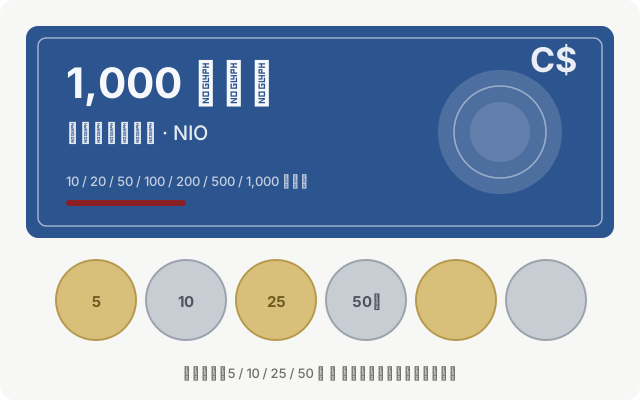
The currently circulating banknotes mainly come in denominations of 10, 20, 50, 100, 200, and 500 córdobas. Both old and new versions are often in circulation simultaneously, featuring historical figures, landmarks, and natural landscapes such as poet Rubén Darío, the Granada Cathedral, and images of volcanoes and lakes. Coins are available in denominations of 5, 10, 25, and 50 centavos, as well as 1 and 5 córdobas, typically displaying the national coat of arms or the word “República.” One córdoba equals 100 centavos, but coins are rarely used in daily transactions.
Cash and Payment Practices
Daily transactions in Nicaragua are primarily cash-based. Markets, street food stalls, buses, and taxis generally accept only córdoba cash. Some restaurants, supermarkets, and hotels accept credit cards (Visa, Mastercard; American Express is less common) and may charge additional fees. U.S. dollars are widely accepted in hotels, tour packages, and some shops, but change is usually given in córdobas at the daily exchange rate, which can be slightly disadvantageous for dollar holders.
ATMs are mainly found in Managua, Granada, León, and major tourist areas, dispensing either córdobas or U.S. dollars. Be aware of transaction fees and withdrawal limits, and machines in smaller towns may be unreliable. For currency exchange, choose banks or authorized exchange offices.
Traveler Tips
- U.S. dollars are widely accepted in tourist areas, but paying in córdobas is usually more economical. Large bills like 100 USD may be refused or exchanged at unfavorable rates in small shops.
- Carry small denominations of córdobas for buses, street food, restrooms, and entrance fees.
- Credit cards are less accepted in remote areas (such as Ometepe, San Juan River, Caribbean coast), so carry sufficient cash.
- Córdobas are difficult to exchange outside Nicaragua. It’s advisable to convert leftover cash back to U.S. dollars at the airport or a bank before departure.
Nicaragua Overview
Country Details »Nicaragua Overview
Nicaragua is the largest country in Central America, bordered by Honduras to the north, Costa Rica to the south, the Caribbean Sea to the east, and the Pacific Ocean to the west, covering an area of approximately 130,400 square kilometers. The capital, Managua, is located on the Pacific volcanic and lake region in the west and serves as the country’s political, economic, and transportation hub. With a population of about 6.6 million, Nicaragua operates under a presidential republic system.
The country is divided into several departments and indigenous autonomous regions. The North Atlantic and South Atlantic Autonomous Regions are home to indigenous groups such as the Miskito people and Afro-descendant communities along the Caribbean coast. Their languages and cultures are more closely aligned with the Caribbean English-speaking world and differ markedly from the Spanish-speaking regions of the west.
Geography and Climate
Nicaragua is situated in the volcanically active Central American isthmus. The Pacific side features a chain of active volcanoes, including Masaya, Momotombo, and San Cristóbal, some of which remain active today. The central region consists of highlands and mountains, while the northern and eastern areas are covered by vast tropical rainforests. The country has two major lakes: Lake Nicaragua (also called Cocibolca), the largest in Central America, which uniquely hosts islands and once recorded sightings of freshwater sharks, and is also home to the Ometepe Island formed by two volcanoes; the other is Lake Managua.
The climate is tropical, with distinct dry and wet seasons. On the Pacific side, the dry season runs from November to April and the wet season from May to October. The Caribbean side experiences more rainfall and is humid throughout the year.
Historical Background
Nicaragua was originally inhabited by indigenous groups such as the Nahuatl. In 1524, Spanish colonists established the cities of Granada and León, representing conservative and liberal factions respectively, and political disputes often revolved around these two cities. Nicaragua gained independence from Spain in 1821, briefly joining the Mexican Empire before becoming part of the Federal Republic of Central America, and achieved full independence as a republic in 1838.
In the mid-19th century, Nicaragua was a key transit route across the isthmus. Throughout the 20th century, it was long ruled by the Somoza family. In 1979, the Sandinista National Liberation Front overthrew the Somoza regime, and the country experienced civil war in the 1980s. Since then, the political situation has undergone multiple changes, with the current government in power since 2007.
Economy and Currency
Nicaragua is a Central American country with a relatively small economy primarily based on agriculture. Major exports include coffee, beef, sugar, gold, shrimp, and beans. Textile and garment processing, as well as remittances, are also important sources of income. Tourism has been growing rapidly in recent years, with a focus on colonial cities, volcanoes, and lakes.
The official currency is the Nicaraguan Córdoba (currency code NIO, symbol C$), issued by the Central Bank of Nicaragua. The currency has experienced severe inflation and multiple reforms in the past, with the current Córdoba introduced in 1991. U.S. dollars are widely accepted in tourism and large transactions.
Culture and Society
Nicaraguan culture blends Spanish colonial heritage with indigenous and Afro-Caribbean elements. The official language is Spanish, while Miskito and Creole English are spoken in the Caribbean coastal regions. The country has a rich literary tradition, with poet Rubén Darío regarded as a pioneer of modernist poetry. The predominant religion is Catholicism, and local patron saint festivals are vibrant celebrations.
The cuisine is based on corn, beans, rice, and plantains. Popular national dishes and snacks include gallo pinto (rice and beans), nacatamal (corn husk-wrapped tamale), vigorón (fried pork rinds with yuca and cabbage salad), and quesillo (cheese wrapped in onion). The rum brand Flor de Caña is internationally renowned.
Tourism Overview
Nicaragua’s main tourism attractions are concentrated in the western and southern regions: Granada is a well-preserved colonial city with colorful facades and a cathedral overlooking the lake; León is known for having the largest cathedral in Central America (a UNESCO World Heritage Site) and its liberal history; Masaya Volcano National Park offers views of volcanic smoke and nighttime lava flows; Ometepe Island allows hiking on twin volcanoes, seeing waterfalls, and enjoying pristine lake scenery; the San Juan River winds through rainforest and historic fortresses toward the Caribbean; the Caribbean-facing Corn Islands are famous for diving and coral reefs. This blend of nature and culture makes it one of the least commercialized destinations in Central America.
Objective advisory: In recent years, Nicaragua’s political and social environment has been unique. Many countries have issued travel advisories. Following election disputes, the government closed many civil society organizations and media outlets, and there is uncertainty regarding entry and freedom of expression. Travelers should monitor their home country’s consular advisories, avoid participating in demonstrations or political activities, maintain a low profile, and safeguard their documents.
Nicaragua Travel Guide
All Guides »Nicaragua Travel Snapshot: Visa, Seasons, Budget & Safety Tips
Visa & Entry, Dry vs Wet Season Choices, Budget Guide, and Essential Safety & Et...
Nicaragua 7-Day Classic Itinerary: Volcanoes, Lakes, and Colonial Cities 7 days
Managua, Masaya, Granada, Ometepe, and León form the most essential route throug...
Nicaragua 4-Day Short Trip: Granada and Masaya Volcano 4 days
Base yourself in Granada to pack colonial architecture, lakeside islands, and an...
Must-visit attractions in Nicaragua: volcanoes, sanctuaries, and lake islands
From UNESCO-listed cathedrals to twin volcanic islands in the lake, here’s a gui...
Nicaragua Food Guide: Gallo Pinto and National Snacks
Red bean rice, tamales steamed in corn husks, and fried pork rinds—sample Nicara...
Nicaragua Transportation Guide: Airports, Buses, Ferries, and Car Rentals
From getting into town from the airport, to intercity buses, the Ometepe ferry, ...