Oman Currency Omani RialOMR
What money to use in Oman, how notes and coins break down, and the best ways to exchange - get the local cash sorted before you go.
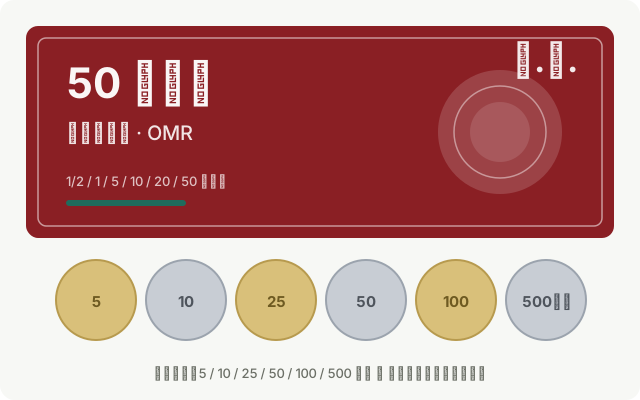
| Currency Name | Omani Rial |
|---|---|
| Currency Code | OMR |
| Currency Symbol | ر.ع. |
| Issuing Country | Oman |
| Time Zone | UTC+4 (UTC) |
| Dialling Code | +968 |
About Omani Rial (OMR)
Currency Overview
The official currency of Oman is the Omani Rial (currency code OMR, symbol ر.ع., often written in English as Omani Rial or RO). One Rial equals 1,000 baisa (or piastres). Issued by the Central Bank of Oman, the Rial is one of the highest-valued currencies in the world, with a long-standing fixed exchange rate of about 1 Rial = 2.6 USD. Due to its high value, travelers should pay attention to the actual worth of banknotes, which may be higher than expected.
Denominations
Circulating banknotes include denominations of 100 baisa, half Rial, as well as 1, 5, 10, 20, 50 Rials. Notes typically feature portraits of the Sultan and national emblems on the front, and important Omani architecture and natural landscapes on the back. Coins come in 5, 10, 25, 50 baisa, as well as quarter and half Rial, varying in material and size. Some smaller baisa coins are less commonly used today.
Cash and Payment Habits
Oman remains a cash-oriented society. Traditional markets, small shops, gas stations, and taxis often deal only in cash. Major malls, hotels, restaurants, and car rental companies generally accept international credit cards (Visa, Mastercard), while UnionPay acceptance is more limited. ATMs are widely available in cities and airports and dispense Rials, though some machines may charge fees for foreign cards. It’s advisable to carry a mix of small bills and coins, including 1 Rial notes, for markets and small purchases.
Traveler Tips
- The Rial has a high value; always check the current exchange rate, as airport rates are usually less favorable than those at banks and authorized exchange offices in town.
- Bargaining is common in markets. Count your change carefully upon payment, especially with small coins.
- Restaurant bills usually include service charges, so tipping is not required, though tipping is appreciated in high-end hotels.
- It’s advisable to exchange leftover Rials back to major foreign currencies before departure, as smaller denominations may be hard to exchange.
Oman Overview
Country Details »Overview of Oman
Oman (officially the Sultanate of Oman) is located in the southeastern part of the Arabian Peninsula, guarding the western approach to the Strait of Hormuz at the mouth of the Persian Gulf. It borders the United Arab Emirates to the northwest, Saudi Arabia to the west, Yemen to the southwest, faces the Gulf of Oman to the north, and the Arabian Sea to the southeast. It also includes the exclave of the Musandam Peninsula, which overlooks Iran across the Strait. The country covers an area of approximately 309,500 square kilometers, with its capital, Muscat, situated on the northern coast. Muscat serves as the political, economic, and cultural center of the nation.
Oman is a monarchy, with the Sultan serving as both the head of state and government. The country is divided into more than ten governorates. Arabic is the official language, while English is widely spoken in tourism, business, and the hospitality industry. The predominant religion is Ibadism, a branch of Islam, and Omani society is relatively moderate and tolerant compared to other Gulf states. It is one of the Arabian Peninsula nations that has preserved traditional culture more intact.
Geography and Climate
Oman features diverse landscapes: the Hajar Mountains in the north form a continuous range, with Jebel Shams being the highest peak at around 3,000 meters. The central region consists of vast gravel plains and sand dune areas, including the famous Wahiba Sands (also known as the Eastern Dunes), a classic destination for experiencing Bedouin life. The Dhofar region in the south experiences the Khareef monsoon from June to September, bringing green hills and flowing waterfalls—rare cool spots on the Arabian Peninsula. The northernmost Musandam Peninsula is known for its fjord-like steep bays, often described as the “Norwegian Fjords of Arabia.”
The climate is generally hot and dry, with inland summer temperatures often exceeding 45°C and higher humidity along the coast. Winters (November to March) see daytime temperatures of about 20–30°C and cool nights, making it the prime travel season. The monsoon season in Salalah contrasts sharply with the dry season in the north, so packing should be adjusted according to your destination.
Historical Background
Anciently known as Magan, Oman was engaged in copper and frankincense trade with Mesopotamia and the Indus Valley as early as the 3rd millennium BCE, with one end of the Frankincense Route located in today’s Dhofar region. Islam was introduced in the 7th century. In the early 16th century, the Portuguese occupied coastal strongholds, but were expelled by the Omanis in the mid-17th century. The Yaruba dynasty was then established, ushering in a period of national strength and eastward expansion into East Africa.
In the 19th century, Oman’s maritime trade empire was at its peak, with Zanzibar as its overseas hub, linking the Swahili Coast with the Arabian Peninsula. In 1970, Sultan Qaboos ascended the throne and initiated comprehensive modernization reforms, officially naming the country the Sultanate of Oman. He developed the oil industry and infrastructure. Following Qaboos’s death in 2020, Haitham bin Tariq succeeded him, continuing the path of reform and opening up, and launching the “Oman Vision 2040” to promote economic diversification.
Economy and Currency
Oman’s economy has long been reliant on oil and natural gas, but in recent years it has actively developed tourism, logistics, manufacturing, fishing, and mining. Oman was one of the earlier Gulf nations to develop tourism, with landmarks such as the Sultan Qaboos Grand Mosque and the Royal Opera House significantly enhancing its international image. The national currency is the Omani Rial (OMR), issued by the Central Bank of Oman. The Rial is one of the highest-valued currencies in the world, pegged to the US Dollar at around 1 Rial = 2.6 USD. Travelers should note the impact of its high value on budgets.
Culture and Society
Omani society respects tradition. Men often wear white robes (dishdasha) with headscarves or turbans, while women commonly wear black abayas when going out. Hospitality is highly valued, with hosts often serving Omani coffee (kahwa, lightly spiced with cardamom) and dates. When accepting, use the right hand and gently shake the cup to indicate you’ve had enough. Oman is known for its silver jewelry, curved daggers (khanjar), frankincense, and handmade pottery. Traditional souks (markets) are great places to experience local life. The country enjoys steady social development, with high female education levels and good public order.
Tourism Overview
Oman is often referred to by travelers as “the most authentic destination in the Arabian Peninsula,” with fewer skyscrapers and more nature and forts than its neighbors. The Sultan Qaboos Grand Mosque, Mutrah Souq, and the Royal Opera House in Muscat showcase the blend of modernity and tradition. Inland, Nizwa Fort, Jabrin Castle, and Bahla Fort form the Forts Route. Experiences such as camel treks and stargazing in Wahiba Sands, night turtle nesting viewings at Ras al Jinz Turtle Reserve, and dolphin-watching boat trips in the Musandam fjords are uniquely memorable. The country is generally safe, making it a great destination for self-drive or private car exploration. Public consumption of alcohol is prohibited, so dress modestly and respect Islamic customs.
Oman Travel Guide
All Guides »Oman Travel Quick Guide: Visa, Best Time to Visit, Omani Rial Budget & Cultural Etiquette
Get your Oman trip essentials sorted before you go: how to apply for an e-Visa, ...
Classic 7-Day Oman Itinerary: Muscat — Nizwa — Wahiba Desert — Sur Turtle Beach 7 days
A classic northbound loop through Oman: mosques and souks of the capital, the Fo...
Oman 4-Day Short Trip: In-Depth Exploration of Muscat City and Nearby Attractions 4 days
Even with limited holiday time, you can experience the highlights of Oman: divid...
Must-visit attractions in Oman: Sultan Qaboos Grand Mosque, Forts Route, deserts and turtle reserves
From capital landmarks to inland forts, from desert camps to Indian Ocean turtle...
Omani Cuisine Guide: From Whole Roast Lamb and Spiced Rice to Date Desserts and Arabic Coffee
Omani cuisine is one of the mildest styles in the Gulf region: slow-roasted whol...
Complete Guide to Transportation in Oman: International Flights, Self-Drive & Car Rental, Local Buses & Taxis
Oman is vast and sparsely populated—driving yourself is almost the only practica...