Liechtenstein Currency Swiss FrancCHF
What money to use in Liechtenstein, how notes and coins break down, and the best ways to exchange - get the local cash sorted before you go.
| Currency Name | Swiss Franc |
|---|---|
| Currency Code | CHF |
| Currency Symbol | CHF |
| Issuing Country | Liechtenstein |
| Time Zone | UTC+1 to UTC+2 (6 hours during daylight saving time) |
| Dialling Code | +423 |
About Swiss Franc (CHF)
Currency Overview
The official currency of Liechtenstein is the Swiss Franc (currency code: CHF, symbol: CHF or Fr.). A useful note for travellers: although Liechtenstein is located in Central Europe and is part of both the Schengen Area and the European Economic Area, it is not a member of the European Union and not part of the eurozone. The currency used in daily transactions is the Swiss Franc, not the euro. This arrangement comes from the 1923 customs and monetary union with Switzerland — the two countries share an open border, and Liechtenstein delegates some diplomatic responsibilities to Switzerland. Its monetary system is fully aligned with Switzerland’s, and the policies of the Swiss National Bank (SNB) apply here as well. Liechtenstein does not issue its own banknotes, although some commemorative Swiss Franc coins are produced in Liechtenstein and are considered collectible items.
Denominations
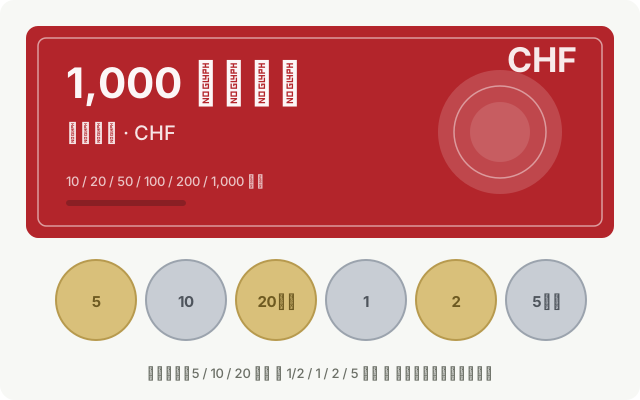
Swiss Franc banknotes are issued in denominations of 10, 20, 50, 100, 200, and 1,000 francs. The current ninth series features a “Time and Space” design, using modern layouts, distinct colour blocks for each denomination, and advanced security features. Coin denominations include 5, 10, 20, and 50 rappen (half a franc), as well as 1 franc, 2 francs, and 5 francs. The 1 rappen coin is still legal tender but is rarely used in circulation. 1 franc equals 100 rappen (or cents). While the exchange rate of the Swiss Franc to other currencies may vary, always check the latest rate for accuracy.
Cash and Payment Habits
The payment environment in Liechtenstein is similar to that in Switzerland: card and mobile payments are widely accepted. Supermarkets, restaurants, museums, and hotels typically accept Visa, Mastercard, and debit cards, and some also accept local options such as Twint. However, smaller cafés, rural guesthouses, souvenir stands at stamp museums, and mountain rest stops often prefer cash. It’s a good idea to carry some low-denomination bills and coins (10–50 francs). Because the country is small, bank branches are mainly found in Vaduz and Schaan, and ATMs can be limited. It’s generally better to withdraw cash in Switzerland (for example, in Zurich or Chur) or before you arrive. Some shops may accept euros, but the exchange rates are often unfavourable, so it’s not recommended to rely on them.
Traveler Tips
- Do not rely on euros as your main currency — the Swiss Franc is the only currency accepted everywhere in Liechtenstein.
- No customs checks when entering from Switzerland, but note that VAT refund policies differ between the two countries.
- Smaller bills (10/20 francs) and coins are especially useful in rural shops. Large 1,000-franc notes are seldom usable for getting change.
- The Swiss Franc is a high-value currency — it’s helpful to mentally convert prices to understand the cost before paying.
Liechtenstein Overview
Country Details »About Liechtenstein
Liechtenstein (officially the Principality of Liechtenstein) is a small inland microstate in Central Europe, nestled between Switzerland and Austria. It covers an area of approximately 160 square kilometers and has a population of less than 40,000, making it one of the few sovereign states in the world with an area under 200 square kilometers. Its capital, Vaduz, located on the eastern bank of the Rhine River, serves as the nation’s political and cultural center, though it is only about the size of a small town and can be explored on foot in half a day. The country is a hereditary constitutional monarchy, with the Princely Family of Liechtenstein being one of the oldest noble families in Europe. The current head of state is Prince Hans-Adam II, with Crown Prince Alois acting as regent. The country is divided into 11 municipalities. Despite its small size, Liechtenstein has one of the highest per capita GDPs in the world and is truly a wealthy nation.
Geography and Climate
The country is long and narrow, stretching from north to south, with a width of about 12 kilometers and a length of about 24 kilometers. It borders Switzerland to the west across the Rhine River and Austria to the east along the Alps. The terrain rises from west to east: the western Rhine Valley plain is the most densely populated and agricultural area, while the eastern mountainous region belongs to the Rätikon mountain range, with the highest peak, Grauspitz, reaching 2,599 meters above sea level. The famous mountain resort of Malbun, at around 1,600 meters above sea level, is the country’s only skiing and hiking base.
The climate is temperate continental, influenced by the Föhn wind from the Alps, resulting in relatively mild conditions in the valley areas: summers range from 20–26°C, and winters hover around 0°C, with abundant snowfall in the mountains. The prime hiking season is from May to September, when valley trails and cliffside routes (such as the Fürstensteig) are fully open. In winter, the Malbun ski area is particularly family-friendly.
Historical Background
The House of Liechtenstein originated from territories in 12th-century Austria. In the late 17th century, it acquired the lordships of Schellenberg and Vaduz. In 1719, Holy Roman Emperor Charles VI united these territories and elevated them to the status of a principality, thus establishing Liechtenstein. After gaining de facto independence by joining the Confederation of the Rhine under Napoleon in 1806, it became a permanently neutral state following the dissolution of the German Confederation in 1866 and has since never participated in any wars—its military last saw action in 1866, famously “bringing back one extra friend,” which became a curious anecdote in European military history.
In 1868, Liechtenstein disbanded its army and declared permanent neutrality. In 1921, it enacted a constitution that remains in use today. In 1923, it formed a customs and monetary union with Switzerland, and Switzerland has long handled its diplomatic affairs. During World War II, it remained neutral and successfully protected its royal collections. After the war, it rapidly grew wealthy through low taxes, precision manufacturing, and financial services, transforming from an agricultural backwater into one of the world’s most affluent economies per capita. It joined the Schengen Area in 2011, becoming one of the non-EU Schengen members alongside Switzerland, Norway, and Iceland.
Economy and Currency
Liechtenstein’s economic structure is highly unusual for such a small nation—it is not reliant on a single industry like gambling or tourism, but instead has a solid industrial base: Hilti is a leading global brand in construction tools and fastening technology, Ivoclar Vivadent’s dental materials are sold worldwide, automotive steering system factories supply many European carmakers, and its financial and trust services attract substantial offshore assets due to a stable legal environment. Additionally, since issuing its first stamp series in 1912, philately has become a national hallmark, with its stamp museum and annually issued exquisite stamps attracting collectors globally.
The official currency is the Swiss Franc (CHF), stemming from the 1923 customs and monetary union with Switzerland. Liechtenstein does not have its own central bank or issue currency independently—the policies of the Swiss National Bank directly apply here. Although it maintains European Economic Area (EEA) membership with the EU, it is explicitly not part of the eurozone, so travelers should not confuse it with the euro.
Culture and Society
The official language is German, but the everyday spoken form is a Rhine Valley dialect (Liechtenstein German), written and grammatically following Swiss German conventions. Around 80% of the population is Catholic, and religious holidays and rural festivals shape much of social life. The country retains strong Alpine rural traditions: brass bands, choirs, and folk dancing groups exist in nearly every municipality. On August 15, the National Day, the lawn of Vaduz Castle is opened to the public, where the princely family mingles with citizens over a communal feast—an experience considered among Europe’s most approachable national celebrations.
The relationship between the monarchy and the state is close. Vaduz Castle has been the residence of the Liechtenstein family since the 12th century, and the princely family still lives there, so it is not open to the public—except on National Day, when it draws throngs of visitors.
Tourism Overview
Liechtenstein is ideal for a 1–3 day niche trip. Key sites in Vaduz, such as the Stamp Museum, Art Museum, and castle viewpoints along the hill, can be explored in just a few hours. The Gutenberg Castle in Balzers and cliffside hikes in Triesen showcase the mountainous side of the country. The 75-kilometer Liechtenstein Trail connects all 11 municipalities and can be hiked in two days, making it the most classic way to experience the “Kingdom of Hiking.” Most travelers combine it with Zurich, Chur in Switzerland, or Feldkirch in Austria, reaching it in just over ten minutes by bus from Buchs or Feldkirch—making it a great stop on any Alpine loop route.
Liechtenstein Travel Guide
All Guides »Liechtenstein Travel Quick Guide: Schengen Visa, Seasons, Budget & Etiquette
Key pre-trip info for visiting this tiny principality from Switzerland: visa req...
6-Day Alpine Immersion in Liechtenstein: Vaduz – Malbun – Rhine Valley 6 days
Explore the entire Alpine experience in this 160-square-kilometer country: castl...
Liechtenstein 3-Day Short Trip: Classic Vaduz + Malbun Combination 3 Days
A pocket-sized country itinerary achievable on a short weekend trip: one day in ...
Must-visit attractions in Liechtenstein: castles, stamps, and cliffside trails
12 recommended spots across the country’s 11 municipalities, each with highlight...
Liechtenstein Food Guide: A Fresh Take on Alpine Home Cooking
This tiny country nestled between Switzerland and Austria feeds every hiker with...
Liechtenstein Transport Guide: A Transit Paradise and Its Capital Without a Train Station
Getting Around Without a National Railway: Complete Guide to Day Passes, Malbun ...