Azerbaijan Currency Azerbaijani manatAZN
What money to use in Azerbaijan, how notes and coins break down, and the best ways to exchange - get the local cash sorted before you go.
| Currency Name | Azerbaijani manat |
|---|---|
| Currency Code | AZN |
| Currency Symbol | ₼ |
| Issuing Country | Azerbaijan |
| Time Zone | UTC+4 |
| Dialling Code | +994 |
About Azerbaijani manat (AZN)
Currency Overview
The Azerbaijani manat (currency code: AZN, symbol: ₼, Azerbaijani: manat) is the official currency. One manat equals 100 qəpik (gopik). Issued by the Central Bank of Azerbaijan, the new manat replaced the old one in 2006 at a rate of 1 new manat = 5,000 old manats. Since 2015, it has floated freely, maintaining relative stability in the region.
Denominations
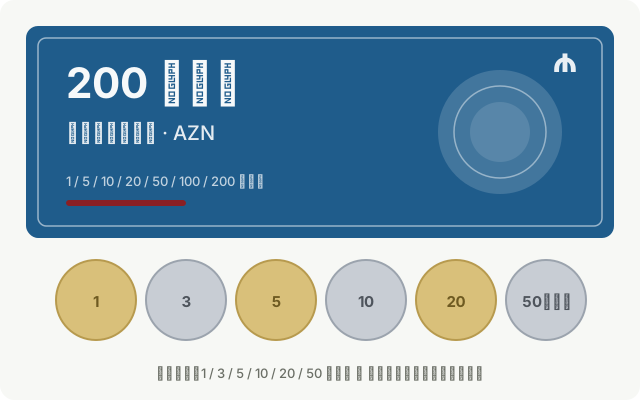
Banknotes in circulation include 1, 5, 10, 20, 50, 100, and 200 manat denominations, featuring Azerbaijani architecture, musical instruments, carpet patterns, and cultural motifs. Coins come in 1, 3, 5, 10, 20, and 50 qəpik, often displaying maps, crescents, and traditional symbols. Larger denominations (100 and 200 manat) are less common for everyday small purchases, which typically use 1–20 manat notes.
Cash and Payment Practices
Hotels, restaurants, supermarkets, and malls in cities widely accept international credit cards (Visa, Mastercard). Mobile payments and card usage are growing in tourist hubs like Baku, but taxis, markets, small shops, and rural areas still rely on cash. ATMs are common in urban and airport areas, dispensing manat, though some may charge fees for foreign cards. Carry small bills (1–20 manat) for transit and small vendors.
Traveler Tips
- Exchange manat at banks or authorized exchange offices—airport rates are usually less favorable.
- Old manat banknotes are no longer valid; ensure you receive current notes.
- Restaurants may include service charges; if not, 5–10% tipping is appreciated.
- Unused manat can often be exchanged back to foreign currency, with some banks requiring exchange receipts.
Azerbaijan Overview
Country Details »Azerbaijan Overview
Azerbaijan (officially the Republic of Azerbaijan) is located in the eastern South Caucasus, bordered by the Caspian Sea (the world’s largest inland body of water) to the east, Russia to the north, Georgia to the northwest, Armenia and Turkey to the west, and Iran to the south. Covering about 86,600 square kilometers, its capital Baku sits on the Absheron Peninsula along the western Caspian coast, serving as the national political, economic, and cultural hub, as well as one of the largest cities in the Caucasus.
Azerbaijan regained independence after the Soviet Union’s dissolution in 1991 and operates as a presidential republic. The official language is Azerbaijani, though Russian remains widely used in daily life and business, and English is increasingly spoken in tourist areas. The population is predominantly Muslim (mainly Shia), but the society is highly secular, with Western-style clothing and lifestyles common. Mosques coexist with cafes and bars, creating a typical multicultural blend.
Geography and Climate
Azerbaijan’s terrain slopes from north to south, with the Greater Caucasus Mountains stretching across the north, the Lesser Caucasus in the southwest, and the Kura-Aras lowland plains formed by river valleys in the center. Mountains cover about half the country. Natural landscapes are diverse, including Caspian dunes and salt lakes, Caucasian forests and glaciers, and the famous "Land of Fire" methane seeps.
The climate varies: Baku has a semi-arid climate with hot, windy summers (earning its nickname "City of Winds") and mild winters. The central valleys have temperate conditions suitable for agriculture, while the southern Lenkoran region is humid and rainy, ideal for tea and citrus farming. The northern mountains are cold in winter, good for skiing. Overall, spring (April–June) and autumn (September–October) are the most comfortable and popular travel seasons.
Historical Background
Azerbaijan means "Land of Fire," named for its natural gas seeps that have ignited spontaneously for centuries. Zoroastrianism (the ancient Persian religion) once flourished here, making fire a sacred symbol. Historically ruled by Persians, Arabs, Mongols, Ottomans, and Safavids, the region blended Islamic and Persian cultures.
In the late 19th century, Baku boomed as a major global oil producer. In 1918, Azerbaijan briefly became the first Muslim-majority parliamentary republic—the Azerbaijan Democratic Republic—a short-lived but significant milestone. It joined the Soviet Union in 1920 and regained independence in 1991. The long-standing Nagorno-Karabakh conflict affected regional stability, with major developments in 2020 and 2023. Travelers should heed border and safety advisories, avoiding sensitive areas.
Economy and Currency
Oil and gas dominate Azerbaijan’s economy, with pipelines like Baku-Tbilisi-Ceyhan and the Southern Gas Corridor linking Caspian energy to Europe. Recent efforts focus on diversifying into agriculture, tourism, IT, and logistics. The national currency is the Azerbaijani manat (AZN), issued by the Central Bank of Azerbaijan. Since 2015, it has floated freely and remains relatively stable in the region.
Culture and Society
Azerbaijani culture merges Turkic, Persian, and Islamic traditions. Mugham (a classical music genre) is UNESCO-listed intangible heritage, alongside carpet weaving, miniature art, and Nizami Ganjavi’s epic poetry. Hospitality is key, with tea served with jams, sugar cubes, and nuts. Staple dishes include plov (pilaf), kebabs, and dolma (stuffed grape leaves). Society is open-minded, with active female participation, and festive celebrations like Nowruz (Persian New Year) are vibrant.
Tourism Overview
Azerbaijan is a rapidly emerging South Caucasus destination. Baku blends futuristic Flame Towers and the Heydar Aliyev Center (designed by Zaha Hadid) with UNESCO-listed Old City sites like Maiden Tower and the Palace of the Shirvanshahs. Nearby, Gobustan’s petroglyphs and mud volcanoes, plus the eternal flames of Yanar Dag, showcase the "Land of Fire." Northward lie Caucasian villages near Quba and Gabala, while westward Sheki’s palace and Ganja reflect Silk Road heritage. Infrastructure is solid, prices reasonable, and the mix of urban and rural experiences suits varied travel styles.
Azerbaijan Travel Guide
All Guides »Azerbaijan Travel Quick Guide: E-Visa Application, Best Seasons, Manat Budget & Cultural Etiquette
Essential Read Before Leaving Baku: How to Apply for the ASAN E-Visa, When Is th...
Classic 7-Day Azerbaijan Itinerary: Baku — Gobustan — Sheki — Caucasus Mountain Village 7 days
Starting from the Flame Towers on the Caspian Sea, passing mud volcanoes and pre...
Azerbaijan 4-Day Short Trip: Classic In-Depth Tour of Baku’s Old Town and Caspian Shore 4 days
Short on time? Focus on Baku: Explore the UNESCO-listed Old Town, modern archite...
Must-visit attractions in Azerbaijan: Flame Towers, mud volcanoes, rock art, and Sheki Khan’s Palace
From the UNESCO-listed Old City and Zaha Hadid architecture to prehistoric rock ...
Azerbaijan Food Guide: From Plov and Kebabs to Pomegranate Juice and Hospitality Tea Culture
The Essence of the Caucasus Table: Royal-Style Plov, Charcoal-Grilled Kebabs, Qu...
Complete Guide to Transportation in Azerbaijan: Baku Airport, Metro, Ride-Hailing Apps, and Overnight Trains
Airport express buses into the city, metro transportation cards, Bolt ride-haili...