Belgium Currency EuroEUR
What money to use in Belgium, how notes and coins break down, and the best ways to exchange - get the local cash sorted before you go.
| Currency Name | Euro |
|---|---|
| Currency Code | EUR |
| Currency Symbol | € |
| Issuing Country | Belgium |
| Time Zone | UTC+1 to UTC+2 (UTC+2 during daylight saving time) |
| Dialling Code | +32 |
About Euro (EUR)
Currency Overview
The official currency of Belgium is the euro (currency code EUR, symbol €), used by 20 eurozone countries and issued and managed jointly by the European Central Bank (ECB) and the Eurosystem. One euro equals 100 cents. Since adopting the euro for accounting in 1999 and full circulation in 2002, Belgium no longer issues its own currency. Travelers moving between France, Germany, the Netherlands, and Belgium do not need to exchange money, and prices are directly comparable.
Denominations
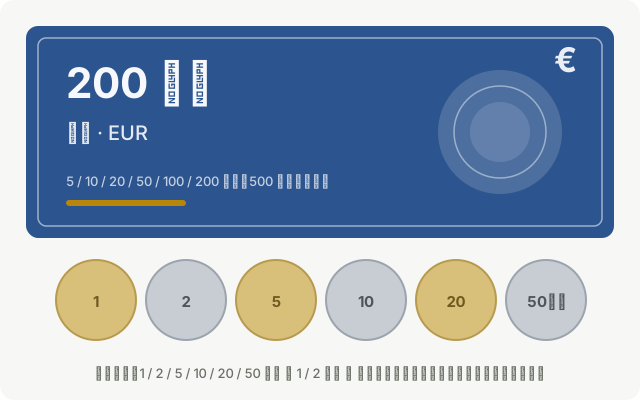
Euro banknotes come in seven denominations: €5, €10, €20, €50, €100, €200, and €500, featuring architectural styles from different periods in European history with varying colors and sizes. €500 notes were discontinued in 2016 but remain legal tender. Coins come in eight denominations: 1, 2, 5, 10, 20, and 50 cents, plus €1 and €2. The front side designs vary by member country, while the back is standardized across the eurozone.
All euro coins issued by Belgium feature the likeness of the reigning king: King Philippe since 2014, and previously King Albert II, along with Belgium’s trilingual name and the year. Belgium also issues many €2 commemorative coins each year with themes ranging from architecture and historical figures to major events, which are popular among collectors.
Cash and Payment Habits
Belgium has widespread use of credit and debit cards. Restaurants, supermarkets, hotels, and gas stations almost all accept card and contactless payments. The main domestic debit card system is Bancontact, while international Visa and Mastercard are widely accepted. Many merchants also accept mobile wallets, though larger amounts (typically over €50) may require a PIN. Small cash amounts are still useful at bakeries, market stalls, and some cafés, so it’s good to carry a few coins and small bills.
Traveler Tips
- Eurozone exchange rates are unified. Exchange money before departure based on the daily rate; airport counters are usually less favorable than banks in town.
- Prices in Belgian shops typically include a 21% VAT. Non-EU travelers can claim a refund on purchases over €50.01 at a single store.
- Restaurant bills usually include service charges, but you can round up or leave a small tip if desired.
- When using ATMs, watch for issuer fees and possible local charges. Withdrawing larger amounts in one go helps reduce costs.
Belgium Overview
Country Details »Overview of Belgium
Belgium (Kingdom of Belgium) is located in western Europe, bordering the North Sea to the northwest and adjacent to France, Luxembourg, Germany, and the Netherlands. It covers an area of approximately 30,500 square kilometers and stretches about 300 kilometers from north to south. The country is divided into three federal regions: the Flemish Region, the Walloon Region, and the Brussels-Capital Region. The official languages are Dutch, French, and German. The capital, Brussels, located in the central Senne River valley, serves as both the political center of Belgium and is often referred to as the capital of Europe—hosting the European Commission, the Council of the European Union, NATO headquarters, and numerous international institutions.
Belgium is a constitutional monarchy and a federal state. The king is the head of state (the current king is Philippe, who ascended the throne in 2013), while actual power is exercised by the federal parliament and cabinet. Its highly developed open economy, tri-lingual social structure, and balance between the Flemish and Walloon language regions shape the country’s unique political and cultural identity.
Geography and Climate
Belgium’s terrain is divided into three belts from northwest to southeast: the coastal lowlands (including the Polder region) and sandy plains in the northwest, the fertile central plateau and river valleys in the middle, and the Ardennes highlands in the southeast, with the highest point, Signal de Botrange, at 694 meters above sea level. Major rivers include the Scheldt and the Meuse, with dense water networks supporting thriving inland shipping and world-class ports like Antwerp.
The climate is temperate maritime, influenced by the Atlantic Ocean, resulting in mild and humid conditions year-round with frequent overcast and rainy days. Winters are not harsh and summers are not extremely hot, with average temperatures around 3°C in January and 18°C in July. Rainfall is evenly distributed, making umbrellas useful nearly all year. April to June and September to October offer relatively stable weather, making them the best times to travel. The higher-altitude Ardennes region occasionally sees snow in winter, suitable for short skiing and hiking trips.
Historical Background
The lowland region where Belgium is located has long been a crossroads of trade and transportation in Europe, successively ruled by the Celts, the Roman Empire, and the Frankish Kingdom. During the Middle Ages, the County of Flanders and the Duchy of Brabant flourished through the wool textile industry, with cities like Bruges, Ghent, and Antwerp becoming among the wealthiest commercial hubs in Europe. From the 15th century, the region was ruled by the Duchy of Burgundy and the Habsburgs. After the religious wars and Eighty Years' War of the 16th century, the northern part became independent as the Netherlands, while the southern part (today’s Belgium) continued under Spanish and Austrian rule.
In 1795, it was annexed by France, and in 1815, it became part of the United Kingdom of the Netherlands. In 1830, revolution broke out in Brussels, leading to Belgium’s declaration of independence. In 1831, a constitutional monarchy was established, with Leopold I of Saxe-Coburg as the first king. Leveraging coal and iron resources along with colonial expansion, Belgium rapidly industrialized, becoming one of the first countries in Europe to complete the Industrial Revolution. Occupied by Germany in both World Wars, it later became a founding member of the Benelux Economic Union, the European Community, and NATO. Between 1970 and 1993, Belgium gradually implemented federal reforms.
Economy and Currency
Belgium is a highly developed industrial and trading nation with one of the world’s highest GDP per capita. Its key industries include chemicals and pharmaceuticals, machinery and auto assembly, food processing, diamond cutting (Antwerp is the diamond capital of the world), and port logistics (including the Port of Antwerp-Bruges). The service sector accounts for about 70% of the economy. As a core driver of European integration, Brussels hosts numerous EU institutions, lobbying groups, and international organizations, boosting convention and business tourism.
Belgium uses the euro (EUR), a founding member of the eurozone, and does not issue its own independent currency. The eurozone’s unified monetary policy is set by the European Central Bank in Frankfurt, allowing travelers to move freely between Belgium, France, Germany, and the Netherlands without currency exchange.
Culture and Society
Belgian culture reflects a rich tapestry of linguistic regions and diverse traditions. Dutch is spoken in the northern Flemish region, French in the southern Walloon region, and about 70,000 people in the east speak German. The capital, Brussels, is bilingual in Dutch and French. In visual arts, it boasts painters like the Van Eyck brothers, Rubens, and surrealist master René Magritte. Architecturally, it introduced Art Nouveau through Victor Horta, and in comics, it gave birth to globally beloved series like The Adventures of Tintin, The Smurfs, and Lucky Luke, earning its title as the comic book capital of Europe. In music, artists like Jacques Brel, Stromae, and the Tomorrowland electronic music festival are internationally renowned.
Its culinary scene is equally vibrant: Belgium offers thousands of beer varieties, including abbey beers, lambics, and witbiers. Chocolate, Liège waffles, Brussels waffles, French fries, mussels with fries, and boiled chicken are national favorites. Belgians value quality of life, with cafés and pubs serving as important social hubs.
Tourism Overview
Belgium’s compact size and dense rail network make it ideal for short, linked trips. Brussels showcases history and modernity through the Grand Place, Manneken Pis, the Atomium, and the EU district. Bruges’ well-preserved medieval canals and old town are a UNESCO World Heritage Site. Ghent, Antwerp, and Leuven feature Gothic architecture and museums. The Ardennes highlands in the southeast are great for hiking and kayaking, while Dinant and Namur along the Meuse River offer scenic beauty. The historic battlefield of Waterloo is a must-visit for history enthusiasts.
Shopping highlights include chocolate, beer, lace, and comic merchandise. Transportation is mainly by train, with most intercity trips taking under an hour. Due to its compact attractions and Schengen visa, Belgium is perfect for multi-country trips combined with the Netherlands, France, or Luxembourg, offering excellent value and experience for European independent travel.
Belgium Travel Guide
All Guides »Belgium Travel Essentials: Schengen Visa, Best Seasons, Budget & Table Manners
Get clarity on the Schengen visa, best travel seasons, daily budget, and dining ...
Classic 7-Day Belgium Loop: From Brussels Grand Place to Bruges, Ghent, and Antwerp 7 days
This itinerary connects Belgium’s four most beautiful cities by national rail, c...
Belgium 4-Day Short Trip: A Medieval Twin-City Excursion Based in Brussels 4 days
Based in Brussels with radial day trips, this 4-day itinerary covers the highlig...
Essential Attractions in Belgium: Grand Place, Atomium, Bruges Canals, and Ghent Old Town
Explore Belgium’s top sights by city—from Brussels landmarks to medieval canal t...
A Guide to Belgian Cuisine: Trappist Beer, Waffles, Fries, and Handmade Chocolate
From thousands of beer varieties to street-side fries, Belgium is an underrated ...
Belgium Travel Guide: SNCB Trains, City Trams, and Money-Saving Tickets
Belgium is a small country, and trains are the best option for intercity travel....