Sao Tome and Principe Currency São Tomé and Príncipe dobraSTN
What money to use in Sao Tome and Principe, how notes and coins break down, and the best ways to exchange - get the local cash sorted before you go.
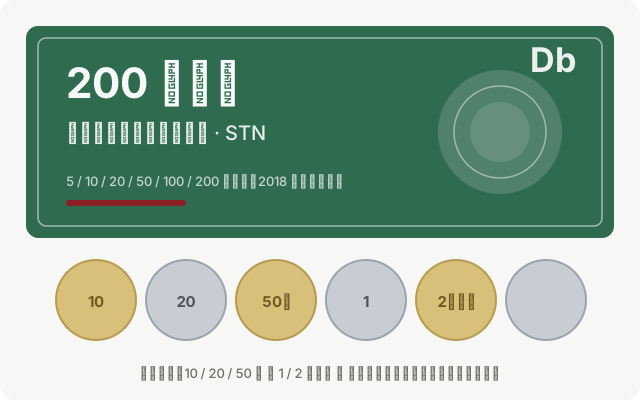
| Currency Name | São Tomé and Príncipe dobra |
|---|---|
| Currency Code | STN |
| Currency Symbol | Db |
| Issuing Country | Sao Tome and Principe |
| Time Zone | UTC+0 |
| Dialling Code | +239 |
About São Tomé and Príncipe dobra (STN)
Currency Overview
The official currency of São Tomé and Príncipe is the dobra (currency code STN, symbol Db), issued by the Central Bank of São Tomé and Príncipe, with 1 dobra equal to 100 centavos. Starting January 2018, the country implemented a currency redenomination, where 1 new dobra equals 1,000 old dobras. All currently circulating currency is the new dobra. Since 2010, the dobra has been pegged to the euro at approximately 24.5:1, stabilizing the pricing system. Due to the small economy and high demand for cash, lower denomination banknotes often show signs of wear, and receiving older bills is normal—merchants accept them without issue.
Denomination System
New dobra banknotes come in denominations of 5, 10, 20, 50, 100, and 200 dobras, featuring national flowers, birds, historical figures, and estate culture. Coins are issued in 10, 20, 50 centavos and 1, 2, 5 dobras. For everyday transactions, small denomination notes and coins are essential: street markets, taxis, and food stalls often cannot provide large change, so bills under 200 dobras are most welcome.
Cash and Payment Habits
São Tomé City has some banks and ATMs, but machines are limited and may run out of cash. Card payments are only accepted in hotels, supermarkets, and a few restaurants—cash remains the dominant payment method. Local currency cannot be directly exchanged for US dollars. It is recommended to carry euro cash: the official exchange rate is pegged to the euro, and euro notes are widely accepted at exchange points and some merchants. Príncipe Island and rural areas rely almost entirely on cash.
Budget reference: backpackers can cover simple meals and local transport for 200–400 dobras per day; estate visits, island-hopping, and national park guided tours are charged per activity—prepare enough cash in São Tomé City before heading out on your island circuit.
Traveler Tips
- Dobra is almost impossible to exchange abroad—use it up or convert it back to euros before leaving.
- ATMs are scarce and may be out of service—don’t wait until funds are low to withdraw cash, and prepare in advance for important trips.
- Be aware of the significant difference between old and new dobras after redenomination—if you hear an old price (e.g., thousands of dobras), confirm whether it refers to the old currency to avoid confusion.
- Euro notes are the most practical backup currency—carry small denominations for flexible exchange and direct payment.
Sao Tome and Principe Overview
Country Details »Overview of São Tomé and Príncipe
São Tomé and Príncipe (officially the Democratic Republic of São Tomé and Príncipe) is an island nation located in the Gulf of Guinea, about 250 kilometers off the central western coast of Africa. It consists of the islands of São Tomé, Príncipe, and several smaller surrounding islets, covering a total land area of approximately 1,001 square kilometers. It is Africa’s second smallest country, after Seychelles. The capital, São Tomé City, is situated on the northeastern coast of São Tomé Island and has a population of around 230,000. It serves as the country’s political, economic, and transportation hub.
The country practices a multi-party parliamentary democracy. Since 1991, it has held multiparty elections with multiple peaceful transitions of power, making it one of Africa’s more politically stable small nations. Portuguese is the official language, while Creole languages such as Forro, based on Portuguese, are widely spoken among the populace. The population is predominantly of mixed Creole descent, with strong Catholic influence. The pace of life is slow and the people are known for their friendliness.
Geography and Climate
Both islands are of volcanic origin, featuring rugged terrain and dense rainforests. The highest peak on São Tomé Island, Pico de São Tomé, rises to 2,024 meters, with its southwestern face dropping directly into the Atlantic Ocean. On the northeastern coast, Pico Cão Grande (Big Dog Peak) is a towering volcanic rock needle that rises hundreds of meters from the rainforest and is considered a national landmark. Príncipe Island is smaller and quieter. The entire island and its surrounding waters are designated as a UNESCO Biosphere Reserve. Ilhéu das Rolas, a small island south of Príncipe (geographically part of São Tomé Island), lies exactly on the equator and features an equator crossing marker.
The climate is equatorial maritime, hot and humid year-round, with an average annual temperature of about 27 degrees Celsius. From June to September, the dry and cool southeast trade winds known locally as the Garvãna winds bring relatively dry weather. The main rainy season lasts from September to May, with frequent but brief heavy rains. About 30% of the country is covered by the pristine rainforests of Obô Natural Park, which boasts rich endemic biodiversity, earning it the nickname “Galápagos of the Gulf of Guinea.”
Historical Background
The islands were uninhabited before the arrival of the Portuguese. Around 1470, Portuguese navigators discovered São Tomé Island around the feast of Saint Thomas, from which the island takes its name. By the late 15th century, the Portuguese began establishing sugarcane plantations worked by African slaves, making São Tomé Portugal’s first tropical plantation colony in the Atlantic. After the decline of sugar in the 16th century, the plantation (roça) economy shifted to cocoa. By the late 19th and early 20th centuries, São Tomé was one of the world’s largest cocoa exporters, and its reputation for high-quality cocoa continues to this day.
On July 12, 1975, the islands gained peaceful independence following negotiations with Portugal. The post-independence period saw a single-party system before multiparty democracy began in 1991. In recent years, the economy has been transitioning through eco-tourism and premium cocoa revitalization. Old plantations, colonial-era buildings, and remnants of the slave trade form a rich historical layer on the islands.
Economy and Currency
São Tomé and Príncipe is a small developing economy, with cocoa, fisheries, and tourism as its main sources of foreign exchange. The country relies heavily on foreign aid. In recent years, single-origin premium cocoa has re-entered the European market, and local chocolate brands have begun to emerge. Cocoa estate experience tours have become a new attraction. The official currency is the dobra (STN), issued by the Central Bank of São Tomé and Príncipe. In 2018, a currency redenomination took place (1 new dobra = 1,000 old dobras), and since 2010 the dobra has been pegged to the euro at approximately 24.5 dobras per euro, contributing to relatively stable prices.
Culture and Society
São Tomé culture is a blend of Portuguese, African, and plantation heritage. The Forro Creole language carries folk stories and songs, and traditional performance art such as Tchiloli—a narrative opera that reenacts medieval legends—is recognized as national cultural heritage. The sobrado-style mansions from the colonial era and the widespread roça estate complexes are living architectural museums. The cuisine features fish, shrimp, bananas, breadfruit, and cocoa, with the national dish Calulu (a stew of dried and fresh fish) reflecting the islands’ flavor profile.
Social life revolves around churches, markets, and estate communities. People greet each other warmly, and the level of commercialization is low due to limited tourism development. During festivals, the whole island comes alive with music and dance. Visitors are often drawn in by the relaxed pace of life, which epitomizes the notion of a “quiet paradise.”
Tourism Overview
São Tomé and Príncipe is truly an off-the-beaten-path destination: there are no large resorts or crowds, and the focus is on pristine rainforest hiking, estate cultural exploration, and coastal adventure. Classic experiences include crossing the equator monument on Ilhéu das Rolas, visiting the Obô Biosphere Reserve and Roça Belo Monte on Príncipe Island, admiring the volcanic spire of Pico Cão Grande, birdwatching in Obô National Park, and joining cocoa and coffee estate tasting tours. Transportation usually involves a direct flight from Lisbon with TAP Air Portugal, or connecting through Ghana, Cape Verde, and others. Príncipe Island has domestic flights and small fixed-wing aircraft connections. For travelers seeking tranquility, nature, and history, this is one of Africa’s last hidden island gems.
Sao Tome and Principe Travel Guide
All Guides »São Tomé and Príncipe Travel Quick Guide: e-Visa, Dry Cool Season, Budget & Local Etiquette
Entry Essentials for Africa’s Second-Smallest Country: How to Apply for an E-Vis...
Classic 7-day São Tomé and Príncipe itinerary: Old Town — Southern Coast — Equator Line — Príncipe 7 days
Cover the highlights of both islands: colonial Old Town, volcanic spires, crossi...
4-Day São Tomé Island Loop Itinerary: Old Town, Cocoa Estates, Southern Cliffs, and Equator Monument 4 Days
Even without visiting Príncipe, a four-day loop around São Tomé Island offers a ...
Essential Attractions in São Tomé and Príncipe: The Equator Line, Peak of the Great Dog, and Cocoa Estates
Ten national landmarks, from crossing the equator to rainforest secrets—each ent...
São Tomé Food Guide: Calulu Stewed Fish, Cocoa Chocolate, and Plantation Coffee
The tables of the Gulf of Guinea revolve around fish and cocoa: how to eat the n...
Complete Travel Guide to Transportation in São Tomé and Príncipe: International Connections, Inter-Island Flights, and Private Transfers
A destination so off the beaten path that even navigation apps struggle: how to ...