Sudan Currency Sudanese PoundSDG
What money to use in Sudan, how notes and coins break down, and the best ways to exchange - get the local cash sorted before you go.
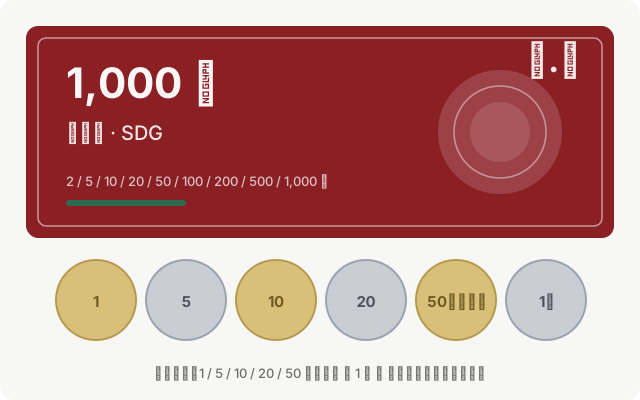
| Currency Name | Sudanese Pound |
|---|---|
| Currency Code | SDG |
| Currency Symbol | ج.س |
| Issuing Country | Sudan |
| Time Zone | UTC+2 |
| Dialling Code | +249 |
About Sudanese Pound (SDG)
Currency Overview
The official currency of Sudan is the Sudanese Pound (currency code: SDG, symbol: ج.س), issued by the Central Bank of Sudan. One Sudanese Pound equals 100 piastres (qirsh), though piastres are rarely used in daily transactions, which are conducted almost exclusively in pounds. After South Sudan’s independence in 2011, Sudan issued a new version of the Sudanese Pound between 2011 and 2012 to replace the old currency, with changes in paper quality and design. Due to years of inflation and the 2023 conflict, the Sudanese Pound’s exchange rate has steadily declined, with significant disparities between official and black-market rates—the real value is determined by market rates.
Denominations
Current Sudanese Pound banknotes in circulation include denominations of 1, 2, 5, 10, 20, 50, 100, 200, 500, and 1,000 pounds. The 1,000-pound note, introduced in recent years to address cash shortages, is the highest denomination, though its purchasing power fluctuates rapidly with inflation. Coin denominations are small and rarely used in daily life. Due to wartime printing and limited currency recall capacity, both old and new versions circulate, making authenticity verification difficult—always count cash in person and prefer newer notes when possible.
Cash and Payment Practices
Sudan is a highly cash-dependent economy, with minimal card acceptance. ATMs are mostly found in major cities like Khartoum (pre-war) and Port Sudan but often malfunction due to power or network outages. Mobile money and bank transfers existed before the war but have become unreliable due to network and banking infrastructure damage. International credit cards are extremely limited in acceptance and should not be relied upon.
For travelers (currently not advised to visit), cash is the primary method. Euros and U.S. dollars are relatively easier to exchange in places like Port Sudan. Northern and eastern regions have few banks, so plan all expenses in advance.
Traveler Notes
- The Ministry of Foreign Affairs’ Consular Protection Center has repeatedly advised against travel to Sudan; this section is for informational purposes only and should not be used to plan trips.
- Sudan is an Islamic country with a nationwide alcohol ban. Do not bring or consume alcoholic beverages, and e-cigarettes are also strictly restricted.
- The Sudanese Pound’s exchange rate is volatile, and black-market transactions carry legal and safety risks. Always exchange currency through official channels.
- Sudanese Pounds are generally unusable abroad, so keep only a small amount and handle it as needed at the airport.
Sudan Overview
Country Details »Overview of Sudan
Sudan (officially the Republic of Sudan) is located in northeastern Africa, bordered by Egypt to the north, the Red Sea and Eritrea and Ethiopia to the east, South Sudan to the south, the Central African Republic and Chad to the west, and Libya to the northwest. With an area of approximately 1.886 million square kilometers, it is the third-largest country in Africa (after Algeria and the Democratic Republic of the Congo). The capital, Khartoum, lies at the confluence of the Blue Nile and White Nile, comprising three towns—Khartoum, Omdurman, and North Khartoum—separated by the Nile and connected by bridges. Collectively known as the "Three Towns" or Greater Khartoum, it serves as the national political, economic, and commercial hub.
Sudan gained independence from British-Egyptian condominium rule in 1956. It subsequently endured prolonged civil wars between the north and south, culminating in the secession of South Sudan following a 2011 referendum, which cost the country most of its oil-producing regions. In 2019, the long-ruling regime of Omar al-Bashir was overthrown amid mass protests, leading to the establishment of a transitional government. In April 2023, large-scale clashes erupted between the Sudanese Armed Forces and the Rapid Support Forces, with ongoing fighting severely worsening the security situation.
Geography and Climate
Sudan’s terrain is dominated by the Nile Valley and surrounding deserts and plateaus: the north consists of extensions of the Sahara and Nubian Deserts, with dunes, rocky plains, and oases; the central region features sparse savannahs and clay plains on the southern edge of the Nubian Desert; and the narrow Nile Valley along the river is the most densely populated and agriculturally productive area. The Blue Nile originates from the Ethiopian Highlands, while the White Nile comes from East Africa’s Great Lakes region. The two rivers converge in Khartoum and flow northward through the desert, forming the famous sixth to second cataracts of the Nile and nurturing the Kingdoms of Kush and Nubia.
The east borders the Red Sea, with Port Sudan as the primary coastal port and the country’s maritime gateway. Nearby waters host world-class coral reef diving spots (such as Sanganeb Atoll). Climatically, the country is predominantly tropical desert and semi-arid, with the north experiencing extreme heat and minimal rainfall year-round—summer temperatures in Khartoum often exceed 40°C. The Red Sea coast is more humid, but winters (November to February) are relatively cooler, making it the best season for travel. Rainfall increases from north to south, with the south having a rainy season from June to September.
Historical Background
Northern Sudan is one of the oldest cradles of civilization in the world: around 2000 BCE, the Kingdom of Kush emerged in the Nubian region, with Jebel Barkal as its religious center. In the 8th century BCE, the Kushites briefly conquered Egypt and established the 25th Dynasty (the Nubian Dynasty). Their capital later moved south to Meroë, where they left behind a pyramid complex far exceeding Egypt’s in number—estimated at around 200, smaller, steeper, and more pointed—forming Sudan’s most striking historical sites. Both Meroë and Jebel Barkal are UNESCO World Heritage Sites, with the latter and Napata jointly designated as the "Gebel Barkal and the Sites of the Napatan Region" World Heritage Site.
Christian Nubian kingdoms (Nobatia, Makuria, and Alodia) thrived here for nearly a millennium before gradual Islamicization began after the 7th century. In the 19th century, Egypt ruled Sudan under nominal Ottoman suzerainty until the 1881 Mahdist uprising overthrew Egyptian control and established the Mahdist State. British-Egyptian forces reconquered Sudan in 1898, reinstating the condominium. After independence in 1956, decades of civil war between the north and south ensued. Omar al-Bashir seized power in a 1989 coup and ruled for decades until the 2011 secession of South Sudan, the 2019 regime change, and the April 2023 outbreak of armed conflict, which remains unresolved.
Economy and Currency
Sudan’s economy is primarily based on agriculture and mining: the Nile Valley produces cotton, wheat, sorghum, and gum arabic, with Sudan accounting for about 70% of global gum arabic production—an irreplaceable ingredient in beverages and confectionery, dubbed "Sudan’s white gold." Gold has become the most significant export in recent years, while oil revenues sharply declined after South Sudan’s independence. Livestock and Red Sea fisheries are also sizable industries. The official currency is the Sudanese Pound (SDG), issued by the Central Bank of Sudan. A new version of the Sudanese Pound was reissued after 2011, but years of inflation and the 2023 conflict have caused severe exchange rate volatility and cash shortages.
Culture and Society
Sudanese society is rooted in Arab-Islamic culture while retaining deep Nubian indigenous traditions. Northern Nubians still speak the Nubian language and maintain unique architectural styles and painted-door customs. Sufi religious gatherings (such as Friday ceremonies at the tomb of Hamid al-Nil in Omdurman), known for drumming and whirling dervishes, are considered among Sudan’s most captivating cultural experiences. Hospitality is strong, with a traditional welcome including spiced Sudanese coffee (jabana) served with ginger-flavored coffee and incense.
The diet centers on sorghum and wheat, with common dishes including stews, flatbreads, and ful (stewed beans). Tea stalls and street cafes are ubiquitous, serving as social hubs. Football is the most popular sport.
Tourism Overview
In terms of resources, Sudan was once one of Africa’s most underrated travel destinations: the Meroitic pyramids, Gebel Barkal and Napata temple ruins, the Mahdi’s Tomb and camel market in Omdurman, diving off Port Sudan on the Red Sea, Nubian villages in the Nile Valley, and ancient Egyptian-Kushite relics in the desert collectively form a compelling cultural itinerary. The capital’s Three Towns and their Nile confluence are also iconic. However, it must be emphasized: the armed conflict that erupted in April 2023 is ongoing, with infrastructure in Khartoum and other areas damaged and medical and transport services severely limited. The Ministry of Foreign Affairs’ Consular Protection Center has repeatedly advised against travel. The above attractions are presented purely for cultural and geographical context; actual travel should only be considered once the situation stabilizes and official travel advisories are lifted.
Sudan Travel Guide
All Guides »Sudan Travel Snapshot: Safety Situation, Visa, Seasons & Budget Guide
Understand the armed conflicts and safety conditions since 2023 first, then chec...
8-Day Sudan Cultural & Geographic Tour: Khartoum – Meroë – Jebel Barkal – Red Sea (Currently Not Advisable) 8 Days
This itinerary connects three towns, the Nile cataracts, the Meroë Pyramids, and...
Sudan 4-Day Short Trip: Khartoum’s Three Towns and Meroë Knowledge Tour (Currently Not Advisable to Visit) 4 days
A 4-day conceptual itinerary centered on the capital’s three towns and the Meroë...
A list of cultural and natural highlights in Sudan: from the Pyramids of Meroë to the coral reefs of the Red Sea
A regional breakdown of Sudan’s most significant World Heritage Sites, Nile land...
Sudan Food Guide: Stewed Beans, Flatbread, Spiced Coffee, and Nile Flavors
Sudanese cuisine is based on sorghum, wheat, and stewed beans, influenced by bot...
Travel Guide: Transportation and Safety in Sudan – Flights, Nile Valley Roads, and Red Sea Ports
Sudan is a vast country, with many historical sites located far from the Red Sea...