Turkey Currency Turkish LiraTRY
What money to use in Turkey, how notes and coins break down, and the best ways to exchange - get the local cash sorted before you go.
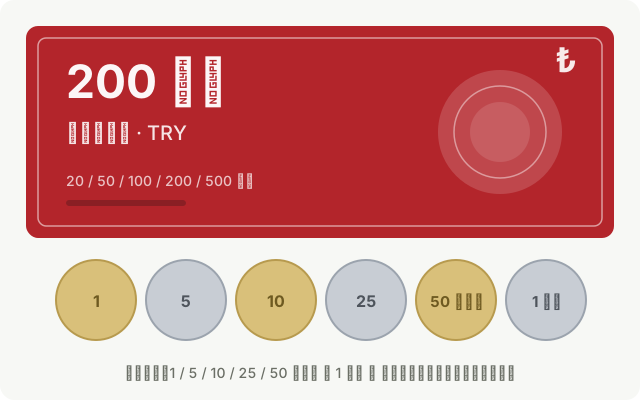
| Currency Name | Turkish Lira |
|---|---|
| Currency Code | TRY |
| Currency Symbol | ₺ |
| Issuing Country | Turkey |
| Time Zone | UTC+3 |
| Dialling Code | +90 |
About Turkish Lira (TRY)
Currency Overview
The official currency of Turkey is the Turkish Lira (currency code TRY, symbol ₺), issued by the Central Bank of the Republic of Turkey (Türkiye Cumhuriyet Merkez Bankası). One lira is divided into 100 kuruş. In 2005, Turkey introduced the New Turkish Lira to replace the former currency, and in 2009, the name returned to "Turkish Lira." Current banknotes and coins are part of the post-reform series.
Denominations
Currently circulating banknotes are issued in denominations of 5, 10, 20, 50, 100, and 200 lira. The front side features a portrait of Mustafa Kemal Atatürk, the founder of the Republic of Turkey, while the back includes historical figures, landmarks, and cultural motifs, with each denomination in a distinct colour. Coins come in values of 1, 5, 10, 25, 50 kuruş, and 1 lira, with kuruş coins typically used for smaller purchases.
Cash and Payment Habits
In Turkey’s major cities, most hotels, restaurants, shopping malls, and chain stores accept Visa and Mastercard, and contactless payments are common. However, traditional markets, small restaurants, taxis, public toilets, and some street vendors often deal only in cash. It’s a good idea to carry some Turkish lira for small purchases.
You can exchange currency at airports, banks, and street exchange offices (known as Döviz). Rates at city-based exchange offices are usually better than those at airports or hotels. ATMs are widely available, and international cards can be used to withdraw cash. Some machines have a multilingual interface. Because the lira can be volatile, it’s best to exchange money in smaller amounts and avoid carrying large sums. Paying directly in USD or EUR is also not recommended, as you may get unfavourable exchange rates.
Traveler Tips
- Lira exchange rates can change significantly. Check live rates before you travel and exchange money in small amounts.
- When using cards, make sure the cashier doesn’t process the transaction in the local currency to avoid double conversion fees.
- Restaurant bills may include a service charge, but tipping around 5–10% is common.
- For taxis, use the meter or confirm the starting fare. Ride-hailing apps such as BiTaksi are also available.
- When buying valuable items like carpets or ceramics, choose reputable shops and ask for an invoice and any necessary export documentation.
Turkey Overview
Country Details »Turkey Overview
Turkey (officially the Republic of Turkey) is located at the crossroads of southeastern Europe and southwestern Asia, covering about 783,600 square kilometers. It straddles both continents, bordered by the Black Sea to the north, the Mediterranean Sea to the south, and the Aegean Sea to the west. Neighboring countries include Greece, Bulgaria, Georgia, Armenia, Azerbaijan, Iran, Iraq, and Syria. Its capital is Ankara, while its largest city is Istanbul, which spans the Bosphorus Strait.
Turkey is a republic, with the president serving as both head of state and government. The country is divided into 81 provinces, with a population of around 85.3 million. The official language is Turkish. Its unique geography has made it a historical hub for civilizations, trade, and religions, shaping its diverse and inclusive society today.
Geography and Climate
Turkey’s terrain is dominated by plateaus and mountains, with the Anatolian Plateau covering much of the central region. The Pontic Mountains lie to the north, the Taurus Mountains to the south, and the Armenian Highlands to the east. Lake Van is the country’s largest lake. The western and southern coasts feature plains and beaches along the Aegean and Mediterranean Seas. Cappadocia is renowned for its unique rock formations carved by volcanic ash erosion, while Pamukkale consists of terraces of white mineral-rich thermal springs.
The climate varies widely: the Mediterranean and Aegean coasts have a Mediterranean climate with hot, dry summers and mild, rainy winters; the Anatolian Plateau experiences a continental climate with cold winters and hot summers, along with significant temperature variations; the Black Sea coast is humid and rainy; and the eastern region sees harsh, snowy winters. The most pleasant travel months are April–May and September–October, when the weather is mild across the country.
Historical Background
Anatolia has been a cradle of human civilization, with ancient kingdoms such as the Hittites, Phrygians, and Lydians rising in succession. The Greeks and Romans left monumental ruins like Ephesus and Troy in the region around the turn of the Common Era. In 330 AD, Roman Emperor Constantine moved the capital to Byzantium, renaming it Constantinople (modern-day Istanbul), which served as the heart of the Eastern Roman (Byzantine) Empire for over a thousand years.
In 1453, the Ottoman Empire captured Constantinople and expanded into a vast transcontinental empire spanning Europe, Asia, and Africa, ruling the Balkans, the Middle East, and North Africa for centuries. After World War I, the empire dissolved, and under the leadership of Mustafa Kemal Atatürk, the Turkish War of Independence culminated in the founding of the Republic of Turkey in 1923. The new republic established Ankara as its capital and implemented sweeping reforms in language, law, and secular governance. Today, Turkey remains a key regional power connecting Europe, the Middle East, and Central Asia.
Economy and Currency
Turkey has a diverse economy, with manufacturing (automotive, appliances, textiles, and food processing), agriculture, tourism, and construction all playing significant roles. Istanbul serves as the region’s financial and trade hub. Tourism is a vital contributor to the national economy and foreign exchange earnings, attracting visitors from Europe, Russia, and the Middle East.
The official currency is the Turkish Lira (TRY, symbol ₺), issued by the Central Bank of the Republic of Turkey. In recent years, the lira has experienced significant exchange rate fluctuations and high inflation. While travelers often find favorable rates for currency exchange, it’s important to monitor real-time rates for ATM withdrawals and card payments.
Culture and Society
Turkish society blends Islamic traditions with secular institutions. The call to prayer from mosques coexists with cafes and bars, while experiences like Turkish baths (Hamam), Sufi whirling dervish dances, and carpet weaving are iconic cultural highlights. Turks are known for their hospitality, with tea and coffee at the heart of social life. Street-side teahouses and dessert shops are ubiquitous.
The cuisine features grilled meats (Kebab), flatbreads, yogurt, and desserts. A traditional Turkish breakfast (Kahvaltı) is hearty and varied, while Turkish delight and baklava are popular souvenirs. Football, tea culture, and bustling bazaars are integral to daily life.
Tourism Overview
Turkey is one of the most popular travel destinations in Eurasia. Istanbul’s Hagia Sophia, Blue Mosque, Topkapi Palace, and Grand Bazaar form its historic core. Cappadocia is world-famous for its cave hotels and sunrise hot air balloon rides. Pamukkale’s white travertine terraces contrast beautifully with the ancient ruins of Hierapolis. Sites like Ephesus and Troy showcase classical antiquity. The Aegean and Mediterranean coasts, including Antalya and Fethiye, are ideal for beach holidays.
Domestic transportation is well-developed, with reliable intercity flights, long-distance buses, and car rentals. Travelers can plan itineraries combining Istanbul, Cappadocia, and coastal destinations, while also leaving time to experience Turkish baths and local cuisine.
Turkey Travel Guide
All Guides »Quick Guide to Traveling in Turkey: E-Visa, Best Seasons, Budget & Mosque Etiquette
How to get a visa, the most comfortable time of year to visit, how much you’ll s...
Classic 8-Day Turkey Itinerary: Istanbul – Cappadocia – Pamukkale – Ephesus 8 Days
This route covers imperial capitals, dramatic rock formations, white travertine ...
Turkey 4-Day Itinerary: In-Depth Tour of Istanbul’s Old Town and the Bosphorus 4 days
Exploring just Istanbul can still be incredibly rewarding: This itinerary is div...
Essential Attractions in Turkey: From Hagia Sophia to Cappadocia Hot Air Balloons
A city-by-city guide to Turkey’s must-see sights, covering Hagia Sophia, Topkapi...
A Guide to Turkish Cuisine: Kebabs, Turkish Breakfast, and Baklava Recommendations
From street-side kebabs to hearty Turkish breakfasts, and from baklava to Turkis...
Turkey Travel Transport Guide: Istanbulkart, Domestic Flights, and Long-Distance Buses
This guide covers all major ways to get around Turkey — Istanbul’s public transp...