South Sudan Currency South Sudanese PoundSSP
What money to use in South Sudan, how notes and coins break down, and the best ways to exchange - get the local cash sorted before you go.
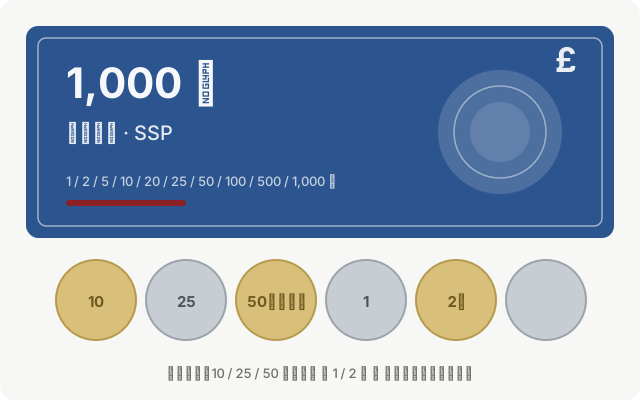
| Currency Name | South Sudanese Pound |
|---|---|
| Currency Code | SSP |
| Currency Symbol | £ |
| Issuing Country | South Sudan |
| Time Zone | UTC+2 |
| Dialling Code | +211 |
About South Sudanese Pound (SSP)
Currency Overview
The official currency of South Sudan is the South Sudanese Pound (currency code SSP, symbol £, also often written as SS£), issued by the Bank of South Sudan. It was officially introduced in 2011 upon the country's independence, replacing the previously circulating Sudanese Pound. This new currency symbolizes the monetary sovereignty of the young nation. Due to a single-resource economy and significant fiscal pressures, the South Sudanese Pound has faced persistent high inflation, resulting in limited currency stability. This is a key reason why the US dollar is widely accepted in local markets.
Denominations
Since its introduction, the South Sudanese Pound has been issued in multiple series, with banknotes in denominations including 1, 5, 10, 25, 50, 100, and later larger denominations. Coins are of smaller value and have limited circulation, with most daily transactions conducted using banknotes. Due to inflation, higher-denomination banknotes are playing an increasingly prominent role, and different years' issues may circulate simultaneously.
In actual transactions, prices are often quoted in both South Sudanese Pounds and US Dollars, especially in Juba's hotels, markets, and transport services, where US Dollar pricing is common. Travelers need to understand both pricing methods.
Cash and Payment Practices
South Sudan is a highly cash-based economy, with bank cards and electronic payments almost non-existent. ATMs are extremely rare and generally unreliable. Markets, shops, restaurants, and transport services typically accept only cash. The US Dollar serves as a hard currency and is widely accepted, often even more so than the local currency.
Due to inflation and exchange rate fluctuations, holding South Sudanese Pounds carries depreciation risks. Travelers usually settle transactions primarily in US Dollar cash, using South Sudanese Pounds only for small change. Currency exchange should be done through official channels, with amounts counted in person to avoid issues at informal exchange points.
Traveler Tips
- It is recommended to carry US Dollar bills in good condition, as smaller denominations are more readily usable and accepted for change in markets.
- Given the high risk of depreciation and inflation, it is not advisable to hold large amounts of local currency.
- Bank cards and mobile payments are largely unavailable, so do not rely on electronic payments for travel expenses.
- Due to the serious security situation, always refer to the latest travel advisories issued by the Ministry of Foreign Affairs and embassies or consulates before traveling.
South Sudan Overview
Country Details »Overview of South Sudan
The Republic of South Sudan is located in northeastern Africa and is an inland country in East Africa. On July 9, 2011, South Sudan gained independence from Sudan, becoming one of the youngest sovereign states currently recognized by the United Nations. It borders Sudan to the north, Ethiopia to the east, Kenya, Uganda, and the Democratic Republic of the Congo to the south, and the Central African Republic to the west. Its capital, Juba, is situated on the banks of the White Nile. The country covers an area of approximately 644,000 square kilometers. English is the official language, while Arabic and ethnic languages such as Dinka and Nuer are also widely spoken. The population is around 11 million.
South Sudan operates as a presidential republic. As a young nation, its government institutions, infrastructure, and public services are still under development, which directly limits its tourism capacity. Travel conditions here differ significantly from those in more established tourist destinations.
Geography and Climate
Located in the upper reaches of the Nile, South Sudan is traversed by the White Nile, which forms the vast Sudd wetlands in the central part of the country. These are among the largest wetlands in the world and an important habitat for wildlife. Most of the country consists of expansive plains and plateaus, with higher-altitude mountains near the East African Rift in the southern border regions. Tropical savannas and wetlands dominate the landscape, and the differences between the dry and rainy seasons are striking.
The climate is tropical savanna, characterized by year-round heat. The rainy season from April to November brings concentrated rainfall, causing many areas to become muddy and rivers to overflow, making many dirt roads and makeshift bridges impassable. The dry season from December to March sees little precipitation and relatively passable roads, but daytime temperatures often remain very high. Seasonal changes have a far greater impact on transportation and travel planning here than in most other countries.
Historical Background
The South Sudan region has historically been closely tied to Sudan, with Nilotic ethnic groups long engaging in pastoralism and farming here. Since 1955, prolonged civil wars have occurred between the north and south of Sudan due to differences in religion, culture, and resources. The first civil war lasted until 1972, and the second continued from 1983 to 2005. In 2005, the Sudanese government and the Sudan People's Liberation Movement signed the Comprehensive Peace Agreement, granting South Sudan autonomy. A referendum held in 2011 resulted in an overwhelming majority vote in favor of independence.
On July 9, 2011, South Sudan officially became independent, forming the 54th country in Africa. Since then, the country has experienced repeated periods of instability, with internal conflict breaking out in 2013. A peace agreement was reached in 2018, leading to the formation of a transitional government and gradual national reconstruction. Understanding this history helps explain South Sudan's current security situation and fragile infrastructure.
Economy and Currency
Oil is the main pillar of South Sudan's economy, with crude oil exports accounting for the vast majority of government revenue and exports. However, oil exports rely on pipelines through neighboring countries, making them susceptible to external factors. Agriculture and livestock are the primary livelihoods for most residents, with sorghum, millet, maize, and peanuts being the main crops. Cattle herding holds a central place in the culture of the Nilotic peoples.
The official currency is the South Sudanese Pound (currency code SSP, symbol £), issued by the Bank of South Sudan. It was introduced in 2011 upon independence, replacing the Sudanese Pound. Due to economic and fiscal pressures, the South Sudanese Pound has faced significant inflationary pressures for years, and the US dollar is widely used in market transactions, effectively serving as a key settlement currency.
Culture and Society
South Sudan is composed of numerous Nilotic ethnic groups, including the Dinka and Nuer. Cattle culture is key to understanding local society: cattle symbolize wealth and status, serve as bridewealth, and play important roles in rituals and songs. The community has a rich tradition of poetry and songs praising cattle. Music, dance, and oral traditions hold significant importance in communal life.
The diet primarily consists of porridge-like staples made from sorghum and millet, served with milk, beans, and stews. Northern areas influenced by Arab cuisine feature flatbread-like staples. In riverine and wetland areas, fishing is an important food source. Traditional clothing, body adornments, and clan-based ceremonial culture form a unique cultural landscape in South Sudan.
Tourism Overview
In terms of natural resources, South Sudan has unique appeal: Boma National Park is known for one of the world's largest terrestrial animal migrations, with large numbers of kob and other wildlife moving across the plains each year. The Sudd wetlands are among the largest freshwater wetlands in the world, rich in waterbirds and wildlife. Bandingilo National Park is also an important wildlife reserve. The White Nile showcases a distinctive landscape of wetlands and river networks.
However, it must be objectively stated that South Sudan has endured prolonged civil war and instability, resulting in a serious security situation, extremely weak infrastructure, and nearly non-existent tourism facilities. Official travel safety advisories should be the primary consideration when deciding whether to travel. If travel is essential, travelers must stay updated on the latest advisories, purchase insurance with emergency medical and evacuation coverage, and take comprehensive health precautions, including malaria prevention.
South Sudan Travel Guide
All Guides »South Sudan Travel Snapshot: Safety Alerts, Seasonal Guide, Budget Range & Health Prep
South Sudan currently does not offer standard travel conditions. This article fo...
South Sudan Reference Itinerary: Exploring Juba, Boma National Park, and the Sudd Wetlands 7 days
Subject to official travel advisories, a South Sudan itinerary focuses on Juba a...
4-Day Short Itinerary in South Sudan: City Walks in Juba and Visits Along the White Nile 4 days
Even within Juba, daytime excursions should be planned with safety as the top pr...
List of Natural Highlights in South Sudan: Boma National Park, Sudd Wetlands, and the White Nile
The great migration of antelopes in Boma and the renowned Sudd Wetlands are famo...
Overview of South Sudanese Cuisine: Sorghum and Millet Porridge, Milk, Stewed Beans, and Nile River Grilled Fish
A dietary structure centered around sorghum and millet as staples, supplemented ...
Travel Guide to South Sudan: Juba International Airport, Regional Flights, and Nile River Transport Options
Juba International Airport is the only reliable gateway. Road travel is limited ...