Russia Currency Russian RubleRUB
What money to use in Russia, how notes and coins break down, and the best ways to exchange - get the local cash sorted before you go.
| Currency Name | Russian Ruble |
|---|---|
| Currency Code | RUB |
| Currency Symbol | ₽ |
| Issuing Country | Russia |
| Time Zone | UTC+3 |
| Dialling Code | +7 |
About Russian Ruble (RUB)
Currency Overview
The official currency of Russia is the Russian Ruble (currency code: RUB, symbol: ₽). Issued by the Bank of Russia (the central bank), the ruble is subdivided into 100 kopeks. Historically, the ruble has experienced significant fluctuations, especially in recent years due to international sanctions and energy price changes, making it one of the more volatile major currencies. Travelers should plan budgets based on real-time exchange rates and avoid exchanging large amounts of cash in advance.
Denominations
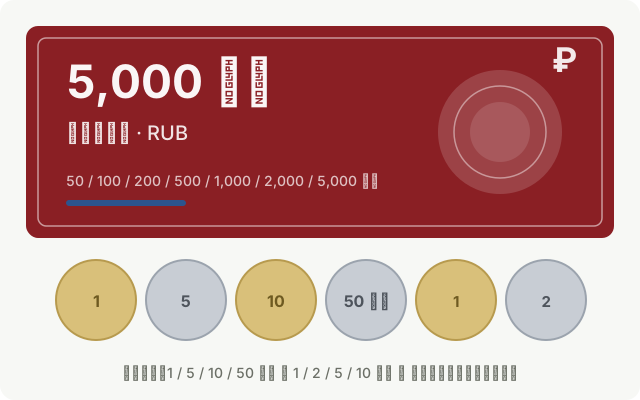
Common banknotes in circulation include denominations of 50, 100, 200, 500, 1,000, 2,000, and 5,000 rubles. Since 2022, the Bank of Russia has issued a new series of banknotes (Modernized Series) featuring landmarks and cities from various federal districts. Coins come in denominations of 1, 2, 5, and 10 rubles, as well as 1, 5, 10, and 50 kopeks. In daily transactions, large denominations like 5,000 rubles may be difficult to break in taxis or small shops, so it’s advisable to carry medium denominations between 500 and 2,000 rubles.
Cash and Payment Habits
While domestic card payment systems (like Mir) and mobile payments are widely used in Russian cities, international cards such as Visa and Mastercard are no longer accepted at most physical locations in Russia. Some UnionPay cards may still work at certain ATMs and merchants, but availability may change with policy updates. Therefore, cash is the most reliable payment method for travel in Russia. It’s recommended to exchange enough rubles in advance through major banks in your home country or withdraw cash at ATMs in Moscow and Saint Petersburg airports or city centers upon arrival.
Typical expenses: Metro rides cost around 50–70 rubles, meals at Russian restaurants range from 1,000 to 2,000 rubles per person, and coffee costs about 200–350 rubles. Keep ruble cash in multiple places, as some small vendors may be selective about accepting damaged bills.
Traveler Tips
- Check the daily exchange rate before your trip to budget effectively, as the ruble is highly volatile. Avoid hoarding too much cash.
- Visa and Mastercard are generally not accepted at Russian merchants, so rely primarily on cash and carry a UnionPay card as a backup.
- Large denominations (5,000 rubles) can be hard to break, so carry smaller bills (100–2,000 rubles).
- Tipping is not mandatory but appreciated. Leaving 5–10% in restaurants is a common practice.
Russia Overview
Country Details »Overview of Russia
Russia (officially the Russian Federation) spans both Europe and Asia, bordered by the Arctic Ocean to the north, the Pacific Ocean to the east, and the Baltic Sea and Eastern European countries to the west. With a land area of approximately 17.1 million square kilometers, it is the largest country in the world. The European part, which accounts for about three-quarters of the population and most economic activities, includes Moscow—the political, economic, and transportation hub—and Saint Petersburg, a cultural capital oriented toward Europe. The vast and sparsely populated regions of Siberia and the Russian Far East lie east of the Ural Mountains, with Lake Baikal and Vladivostok being among the most familiar eastern destinations.
The Russian Federation consists of over 80 federal subjects and more than 190 ethnic groups, with Russian as the official language. As a permanent member of the United Nations Security Council and a major energy exporter, Russia holds significant influence in global politics and the energy sector.
Geography and Climate
Divided by the Ural Mountains, Russia has distinct European and Asian sections. The European part mainly comprises the East European Plain, where Moscow and Saint Petersburg are located. Siberia is divided by the Yenisei and Lena Rivers into the West Siberian Plain, the Central Siberian Plateau, and the East Siberian Mountains, with the Caucasus and Altai mountain ranges along its southern border. Lake Baikal, the deepest and most voluminous freshwater lake in the world, remains frozen for up to five months in winter.
Russia’s climate is predominantly continental, covering multiple natural zones from the polar deserts and tundra in the north to taiga forests, forest-steppes, and semi-deserts in the south. Winters in Moscow are long and harsh, with average January temperatures around -10°C, while summers are cool and brief. Saint Petersburg, moderated by the Baltic Sea, is more humid, with the unique phenomenon of the “White Nights” in June and July. Siberia experiences extreme winter cold, with temperatures dropping below -40°C, while Sochi on the Black Sea coast offers a rare subtropical escape.
Historical Background
The origins of Russia trace back to the Kievan Rus in the 9th century. Following the Mongol invasion in the 13th century, the Grand Duchy of Moscow rose to prominence, with Ivan IV crowned as the first Tsar in 1547. The Romanov dynasty ruled for over 300 years starting in 1613. Peter the Great moved the capital to Saint Petersburg and initiated Western-style reforms, while Catherine the Great greatly expanded the empire’s territory. The Winter Palace and the Hermitage Museum date back to this era.
The Soviet Union was established after the October Revolution in 1917. Throughout the 20th century, it underwent industrialization, fought in World War II (known as the Great Patriotic War in Russia), and engaged in the Cold War. In 1957, it launched the world’s first artificial satellite, and in 1961, Yuri Gagarin became the first human to travel into space. After the dissolution of the Soviet Union in 1991, the Russian Federation was formed. The iconic St. Basil’s Cathedral on Moscow’s Red Square and the red walls of the Kremlin remain enduring symbols of the nation’s history.
Economy and Currency
Russia is a leading global energy exporter, with oil, natural gas, coal, and metal minerals comprising a significant portion of its economy. It also has strengths in military industry, aerospace, fertilizers, and grain production (being one of the world’s largest wheat exporters). The national currency is the Russian Ruble (RUB), issued by the Bank of Russia (the central bank). The ruble experiences significant exchange rate fluctuations, so travelers should monitor real-time rates before visiting. Due to recent international sanctions, the use of foreign bank cards in Russia is restricted, making cash and payment planning essential for travelers.
Culture and Society
Russian culture is distinct within European civilization. Its literary heritage includes works by Pushkin, Tolstoy, and Dostoevsky; its musical and ballet traditions feature composers like Tchaikovsky and iconic performances such as Swan Lake at the Bolshoi Theatre. Onion-domed Orthodox churches and the intricate mosaic murals in metro stations contribute to its rich cultural identity. Russians may appear reserved at first but are often warm and hospitable once acquainted. The majority religion is Eastern Orthodox Christianity, and visitors to churches should dress modestly and maintain a quiet demeanor.
The cuisine features staples such as bread, borscht (beet soup), caviar, vodka, and kvass. Russian meals are hearty, with winter specialties like honey cake (Medovik) and blini (pancakes) being particularly popular.
Tourism Overview
Russia offers three main travel routes for international visitors: the “Twin Cities Route,” featuring Moscow’s Kremlin, Red Square, and St. Basil’s Cathedral alongside Saint Petersburg’s Hermitage Museum, Summer Palace, and Neva River cruises, showcasing imperial and artistic heritage; the “Baikal Route,” starting from Irkutsk, offering summer lake tours around Olkhon Island and winter blue ice viewing from February to March; and the “Far East and Polar Regions,” including the Eurasian blend of Vladivostok, the aurora in Murmansk, and the Arctic wilderness of Teriberka. The Trans-Siberian Railway spans the country, and international trains from Beijing to Moscow offer a legendary journey in themselves.
Russia Travel Guide
All Guides »Russia Travel Quick Guide: Visas, Cash, Seasons & Etiquette
How to apply for an e-visa, why cash is essential, when to see the White Nights ...
Classic 7-Day Russia Itinerary: Moscow–St. Petersburg Dual-City Tour 7 Days
Red Square and the Hermitage, the Kremlin and the Neva River—connect Russia’s tw...
4-Day Russia Short Trip: Lake Baikal’s Ice and Blue Ice 4 days
From Irkutsk to Olkhon Island, experience the winter wonders of the world’s deep...
Must-visit attractions in Russia: Red Square, the Hermitage, and Lake Baikal
From the Kremlin to the world’s deepest lake, this guide outlines essential dest...
A Guide to Russian Cuisine: Borscht, Caviar, and Kvass
Russian Food Is More Than Vodka: Soups, Bread, Desserts, and Theater Dining — Ma...
Russia Travel Guide: High-Speed Rail, Metro & Trans-Siberian Railway
From double-city high-speed rail and underground palace metro to Baikal rideshar...